3D Cardboard Project

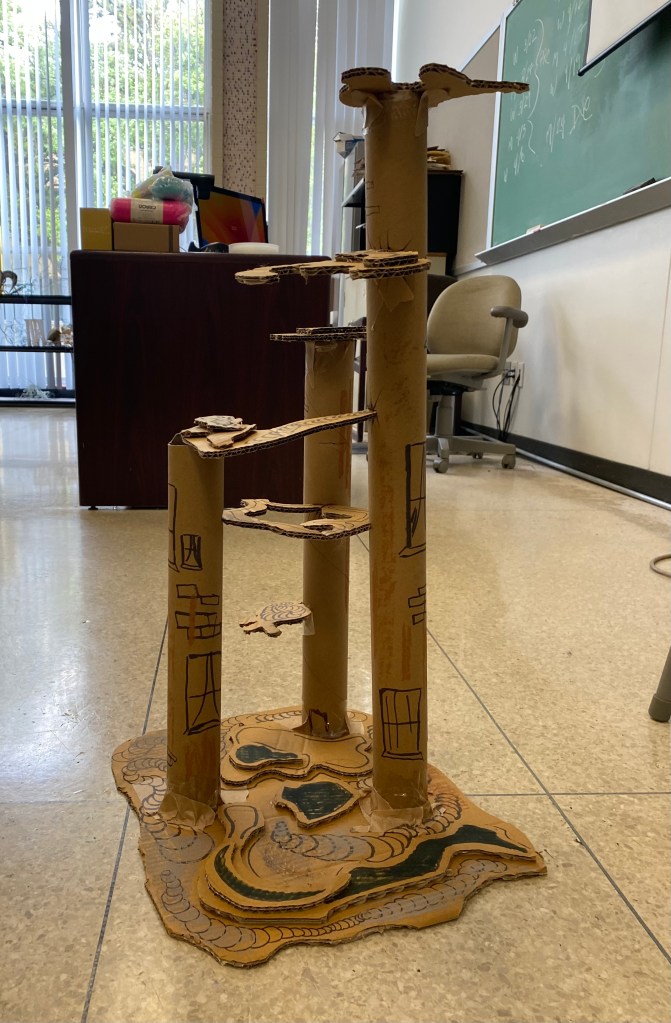
I had no set plan going in to this project, so I explored the different forms of recycled cardboard in the bin for inspiration. I found a few cardboard tubes that inspired me to create something upright/vertically standing, sort of like a tower or tree house. I did a lot of taking apart pieces and combining until I was satisfied. I made two different sculptures in class that I combined together, but in the end I wan’t feeling it so I decided to scrap it and create an entirely new one at home. I still wanted to stick to the treehouse appearance, so I got some more cardboard tubes, cut flat cardboard into organic shapes, and then attached them by inserting the shapes into slits on the tubes. In the end, the piece ended up looking like a cat tree. I drew abstract patterns and little windows across the structure with sharpie and pastel- I wish I had been more organized with these drawings, but since I worked last minute it came out a little incoherent. Oh well! Maybe sometime in the future I’ll give cardboard another go.

Scrapped in-class project
Final product
Drawings

Dan Lam

Dan Lam is a sculptor who is originally from the Philippines, when she was young her family relocated to Texas. She received a BFA in fine art at the University of North Texas and a masters from Arizona state university. She currently lives and works in Texas.

In her work she uses polyurethane foam, resin,  pigments, and paint to create blob-like forms that appear to be dripping. She enjoys using bright colors and highlighting texture.  She works in a variety of sizes, some of her work small enough to fit on a phone case and some large enough to stand under. Lam has been in a number of group and solo shows. Her work is currently being installed in a branch of Meow Wolf, a business that creates large scale immersive installations, that is set to open in Grapevine Texas.

Lam considers her work something that feels that it has a connection to nature without being a direct representation. She has spoken about being interested in the idea of allowing people to decide what the work reminds them of. She enjoys hearing what people come up with because for her that means that she is doing well at pushing the boundaries of the medium used.

Works cited

https://www.maakemagazine.com/dan-lam

https://www.artsy.net/artist/dan-lam

https://bydanlam.com/

Research #10

This week I researched Architect and Artist, Suzanne Lovell. While I was looking for artists to research, I wanted to find a more architectural approach rather than strictly spatial art.
Suzanne moved to Chicago in 1980 after finishing her professional degree in architecture. In 1985 she started her own company, Suzanne Lovell Inc. focusing on residential architecture and interior design. Her firm also includes a fine art collection advisory. She is widely recognized as an expert in fine art, textiles, and design. Suzanne Lovell Inc. has received national and international design awards and has been published many times by Architectural Digest, The Wall Street Journal, and Forbes just to name a few. Her art, as well as the fine art she chooses for homes, creates both a comfortable and engaging experience with the viewers/ residents. Her art advisory offers customized visions and strategies around art collecting. They, “create collections that bridge various periods and are anchored by significant works that epitomize the ideologies of their time.” I love this “strategy” strictly because of the fact that they are bridging time periods. I feel too often collectors are so focused in one time period of style.

This won’t let me add pictures so I’ll add url links.

← Back

Thank you for your response. ✨

Roy Lichtenstein

Roy Fox Lichtenstein was born on October 29, 1923, in New York City, New York. His mom was a homemaker and his dad was a real estate broker. He was born into an upper-middle-class both German and Jewish family. When he was finishing up his high school career he applied to take summer classes at the Art Students League of New York where he studied under Reginald Marsh.

After graduating Lichtenstein took his talents to the Ohio State University where he studied fine arts however he didn’t stay there long. He was called to be in World War II from 1943 to 1946. Post-war, he went back to studying, this time with the supervision of Hoyt L. Sherman to which Roy later donated money for the art center to be named after him at Ohio State. Roy received his Master of Fine Arts from Ohio State University in 1949.

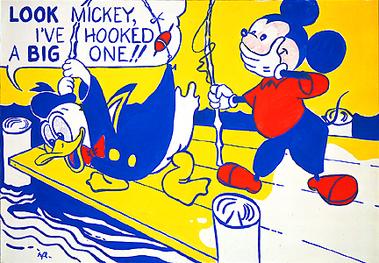
Once he got his degree, Roy started to truly make his art. Lichtenstein’s first solo exhibition at the Carlebach Gallery in New York. From this point forward, Roy Lichtenstein worked heavily in cubism, expressionism, and pop art in one point even started to incorporate mickey mouse and bugs bunny hidden in his work. He completed many paintings and sculptures throughout his career. On September 29, 1997, Roy Lichtenstein passed away at the New York University Medical Center with pneumonia just weeks before his 74th birthday. 

Look Mickey, 1961 with oil paints on a canvas, located at the National Gallery of Art in Washington D.C.
Cap de Barcelona, 1992 multimedia sculpture, located in Barcelona, Spain.

Leonardo da vinci

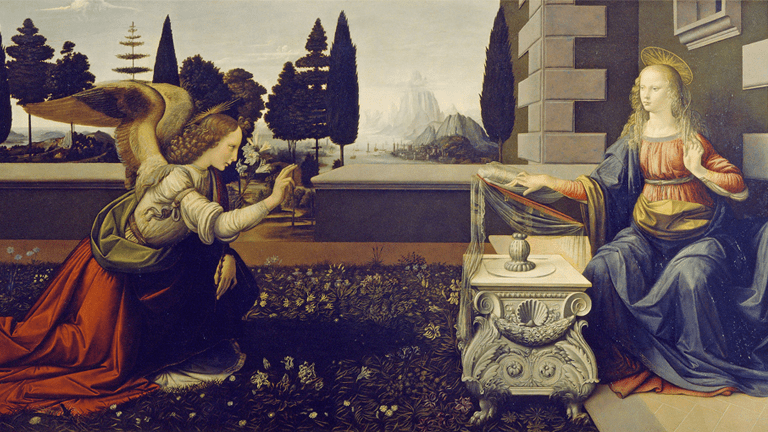
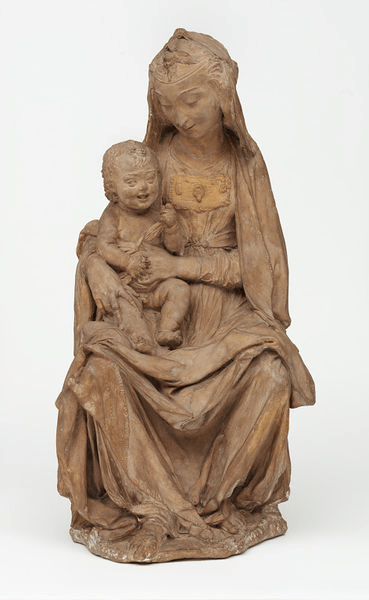
Leonardo was born on April 15, 1452 and died May 2, 1519 due to a stroke. He was an Italian polymath of the High Renaissance, who was active as a painter, engineer, scientist, sculptor, and architect. Leonardo first gained attention for his work on the Baptism of Christ, painted in conjunction with Verrocchio. Around in the 1480’s, Leonardo received two very important commissions and commenced another work that was of ground-breaking importance in terms of composition. Two of the three were never finished, and the third took so long that it was subject to lengthy negotiations over completion and payment. One of these paintings was Saint Jerome in the Wilderness, which Bortolon associates with a difficult period of Leonardo’s life, as evidenced in his diary, “I thought I was learning to live, I was only learning to die. ”

His artwork is one of my favorites when it comes to very old artists from history. It’s so realistic to me, that it feels like I’m actually looking at a real photo of someone/people. It’s sad that he died too soon and didn’t continue to creative many more paintings, sculptors, and drawings for the world to see.

Irving Amen

In 1918 Irving Amen was born in New York City. Interestingly enough is that World War I had ended. He had started his life in art at the age of four years old where he started to draw. In the 1940s he served in the Armed forces, going overseas to fight in the war; which at the time was World War II. He ended up making two murals. One in the United States and one in Belgium.

Once he returned from the army, he went to Paris in the 1950s to study art. In 53, he went on to travel in Italy. There he did lots of woodcutting and paintings. One of the pieces he did is called, “Piazza San Marco #4”

In the 1960s, he traveled to many other places in Europe as well. He went on the design a set of stained glass windows in Ohio which are absolutely beautiful. He did the Twelve Tribes of Israel for Agudas Akim Synagogue. (shown below)

His work had themes to them, often relating to religion, his environments of when he traveled, and many more. He died in 2011 in Coconut Creek, Florida.

https://www.annexgalleries.com/artists/biography/45/Amen/Irving

Tanya Aguiñiga

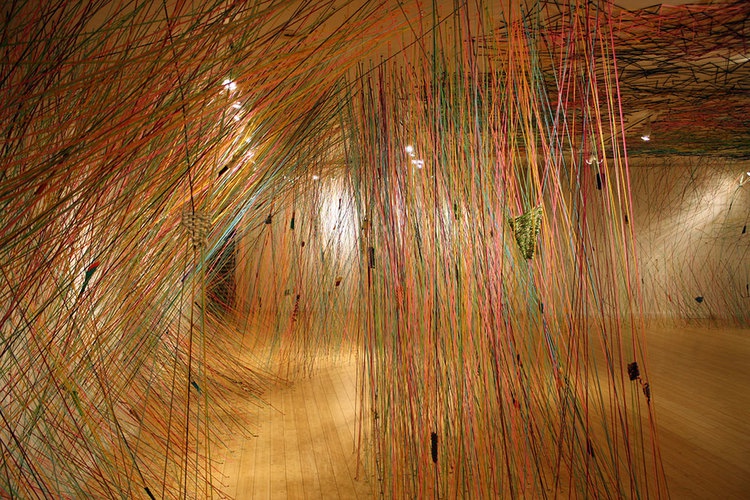
This final research post will be over the contemporary artist Tanya Aguiñiga who is well known for her distinctive approach to sculpture and textile art. Aguiñiga’s work is renowned for examining the connections between social justice, design, and craft. Her art is strongly influenced by her Mexican-American ethnicity and her experiences growing up on both sides of the US-Mexico border. She frequently employs traditional textile techniques from Mexico to produce expansive installations that deal with problems like environmental degradation, labor, and migration. The tactile texture of Aguiñiga’s art encourages the observer to interact with it on a sensory level. Aguiñiga is a community organizer and activist in addition to her artistic activity. In 1988, she assisted in establishing the Border Artists Workshop ‘Taller de Arte Fronterizo’ and has collaborated with multiple organizations that advocate for social justice and support immigrant rights. Aguiñiga’s work stands as a powerful example of how art can be used to address complex social and political issues.

http://www.tanyaaguiniga.com/exhibitions#/crossing-the-line/

Ale Rambar

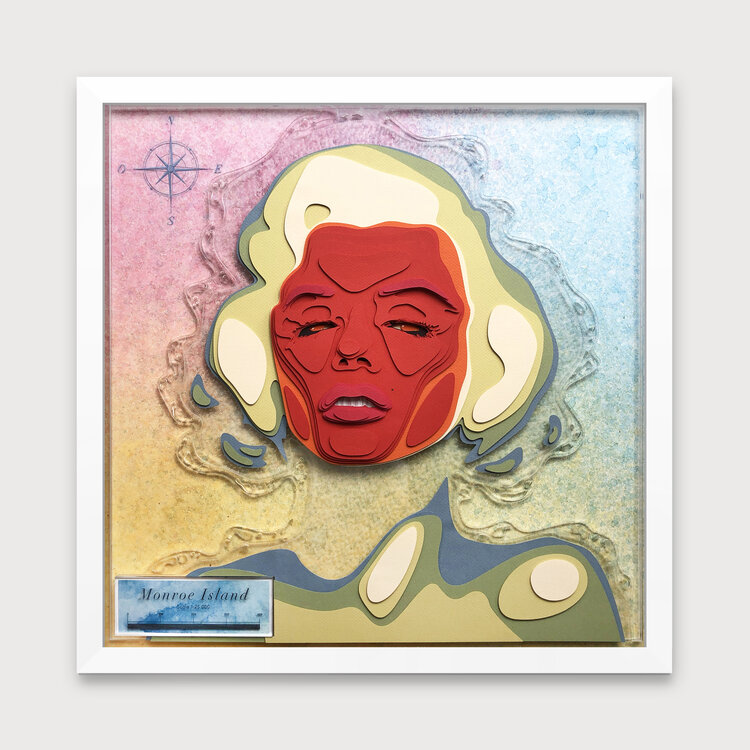
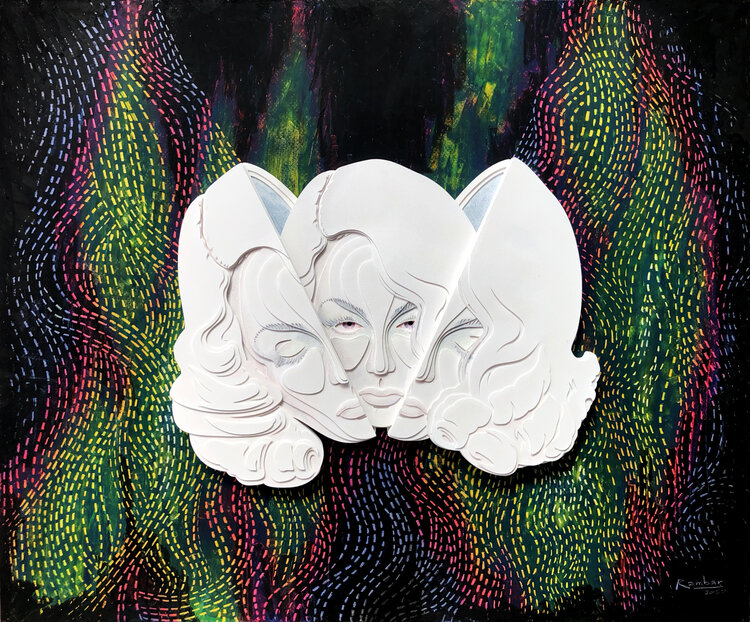
Ale Rambar is a Costa Rican artist that makes 3D art using layers of paper. During his time as an architect back in 2013, Rambar was drawn to the beauty of topographic maps. He found the concept of the topographic map with 2D layers transforming into 3D elements and this concept became his main artistic work.

Rambar makes each of his pieces by analyzing and following the topographic map of human bodies from their bumps and crevices to their indentations and protruding elements. He sketches out everything to perfectly map out each person’s topography.

“Each piece is cut separately, layer by layer, and then assembled by hand to create ‘human topographies’” as his work. The reason Rambar enjoys using paper is that he is drawn to how clean and crisp the end results are once you learn how to manipulate the paper properly.

Rambar believes that art should try to change society and bring attention to issues that are a part of our daily lives. This is why Rambar uses his work to open conversations about the experiences of sexual identity or the discrimination people have felt from their identities.

Andy Goldsworthy

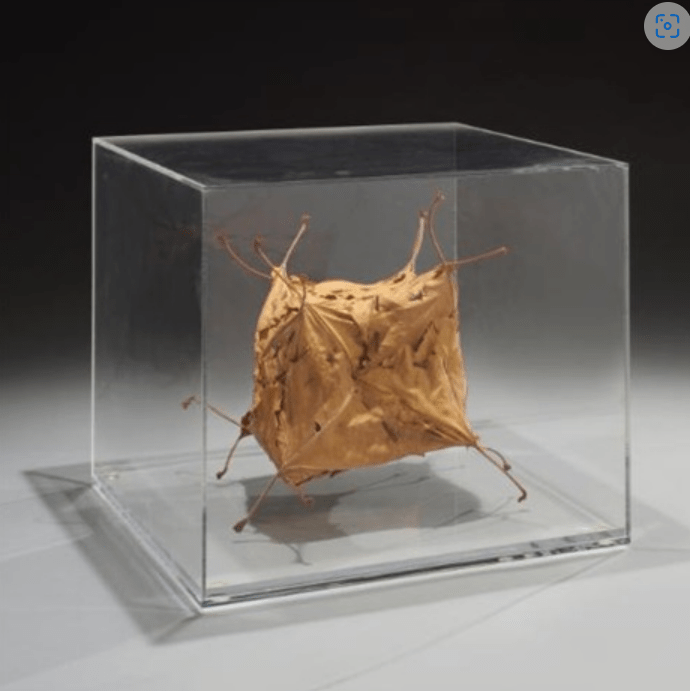
Andy was born on July 26, 1956 in Cheshire, United Kingdom and is 66 years old. He’s an English sculptor, photographer, and environmentalist who produces site-specific sculptures and land art situated in natural and urban settings. Working as both sculptor and photographer, Goldsworthy crafts his installations out of rocks, ice, leaves, or branches, cognizant that the landscape will change, then carefully documents the ephemeral collaborations with nature through photography. “It’s not about art,” he has explained. “It’s just about life and the need to understand that a lot of things in life do not last.” In his teen years, he worked as a farm laborer in rural England before going on to study art at Bradford College of Art and later Preston Polytechnic. In 1985, the artist moved to Scotland where he began producing work. Goldworthy’s works are held in the collections of the Courtauld Institute of Art in London, the Storm King Art Center in Mountainville, NY, and the National Gallery of Art in Washington, D.C, among others.  The artist currently lives and works in Dumfriesshire, United Kingdom.

Gustave Eiffel

Gustave Eiffel was born Alexandre Gustave Bronickhausen dit Eiffel on December 15, 1832, in Dijon, Burgundy, France with his parents migrating from Germany before Gustave was born. Eiffel was a very studious student all through his upbringing, he attended college or university at École Centrale des Arts et Manufactures in which he studied chemistry. 

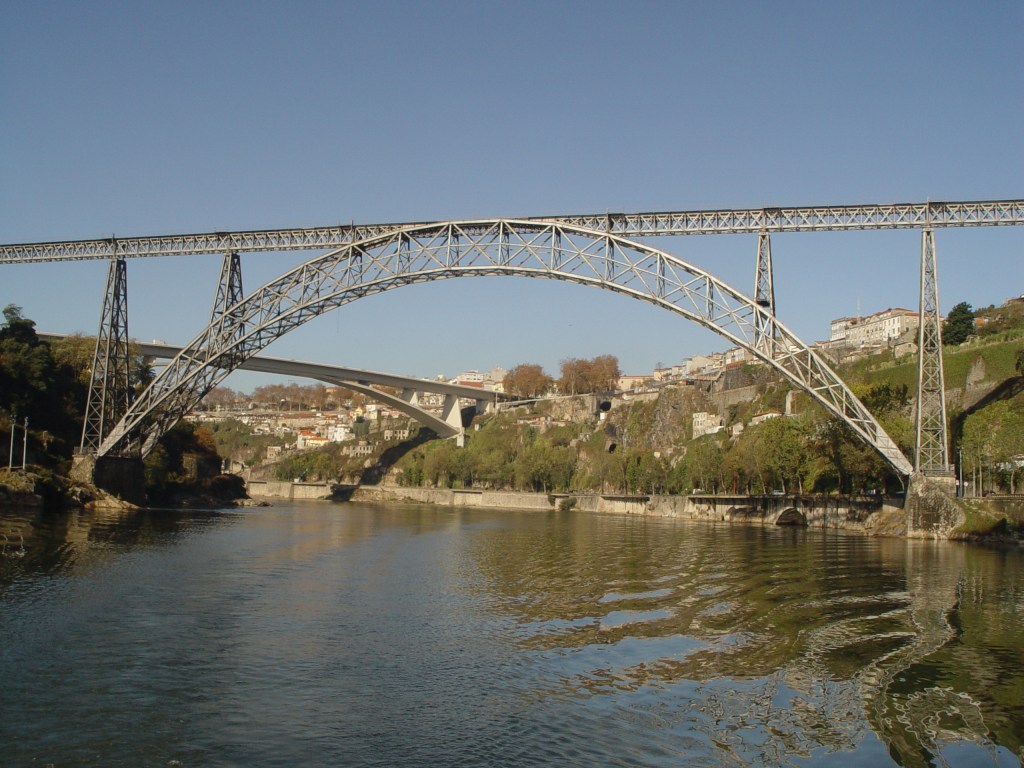
After he finished his education, Eiffel went to work on a railroad engineering project for his first primary paid job. He then went to work on a railway bridge in Bordeaux, France. His most notable work was the Eiffel Tour located in Paris, France which has now become one of Paris’ most prominent tourist attractions. The construction of this structure was started in 1887 and was completed in 1889 in time for the Word’s Fair which was being hosted in Paris that year. Gustave Eiffel died on December 27, 1913, while listening to some Beethoven and was buried in his family’s tomb located northwest of Paris, France.

Maria Pia bridge completed in 1877, is located in Douro, Portugal
Eiffel Tower completed in 1889, is Located in Paris, France