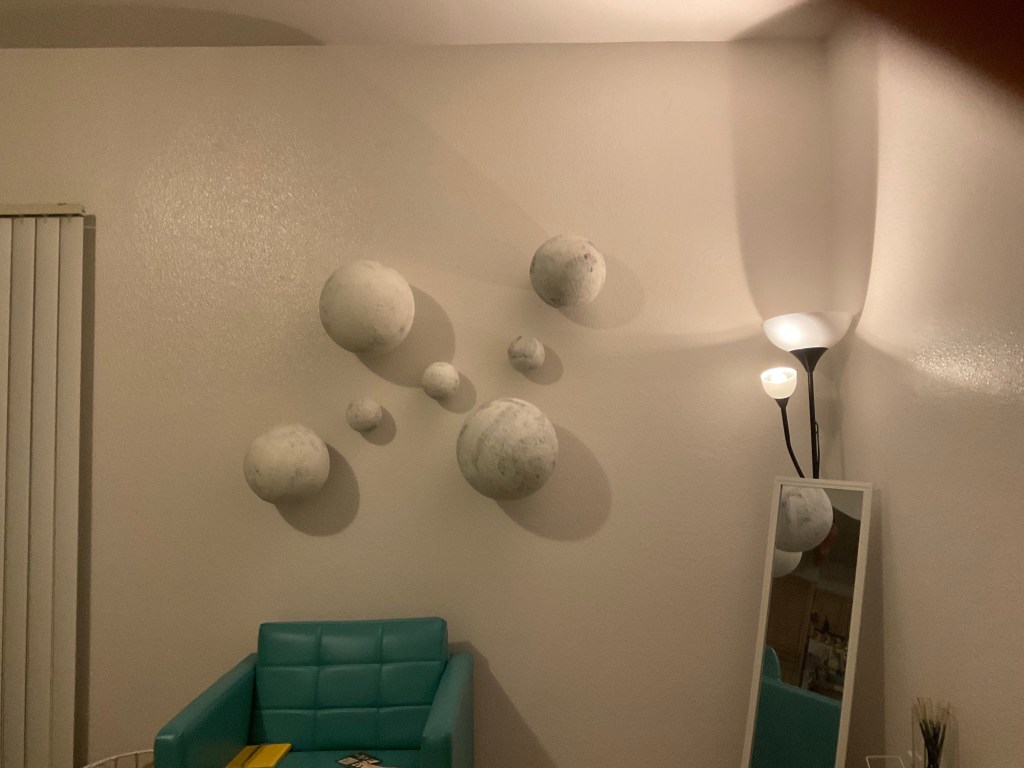
For my individual art project I chose to use paper-mache techniques to create a series of different sized balls and explore the usage of texture on viewers experience as well as the artists, myself, as well.
I wanted to revisit a childhood craft of paper mache. This is primarily what inspired me to create this project. I knew I wanted to work with paper mache… the actual subject came later although I knew that I was going to be creating balls. I came across a Pinterest video of textured paint so from this came the idea of incorporating the usage of textured, thick patterned marks of black paint on the big balls.
The paste was made out of flour, glue, white acrylic paint, and water. I mixed black acrylic paint with flour as well to create the thick, textured element I wanted. I used a thick, dry brush to add it which helped create the streak marks on the black mark slabs.
The pictures below show how I went about choosing their placements.
I believe this project deals with the class theme, Drawing into Space, because of its 3D effect of balls and dots and lines. I see this project as a drawing brought to life.
For my individual project I used what I had learned from our past projects that had to do with collage and layering to create this piece that deals with themes of memory. In this project I started off with images already existing in my camera roll and transferred them onto transparent film using a liquid medium. I collaged those images with writings and painted on symbols that I associate with that memory and layered them either on top or on bottom. The reason for their placement being on the bottom was to represent the memories that are no longer as vivid as the ones placed on top.
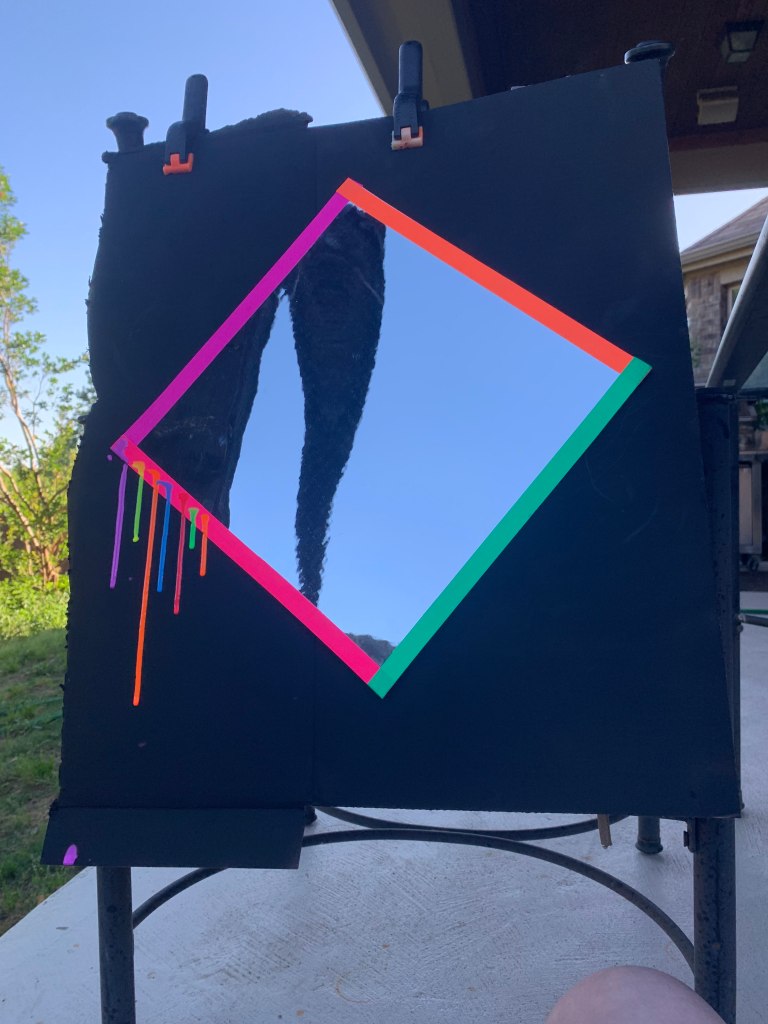
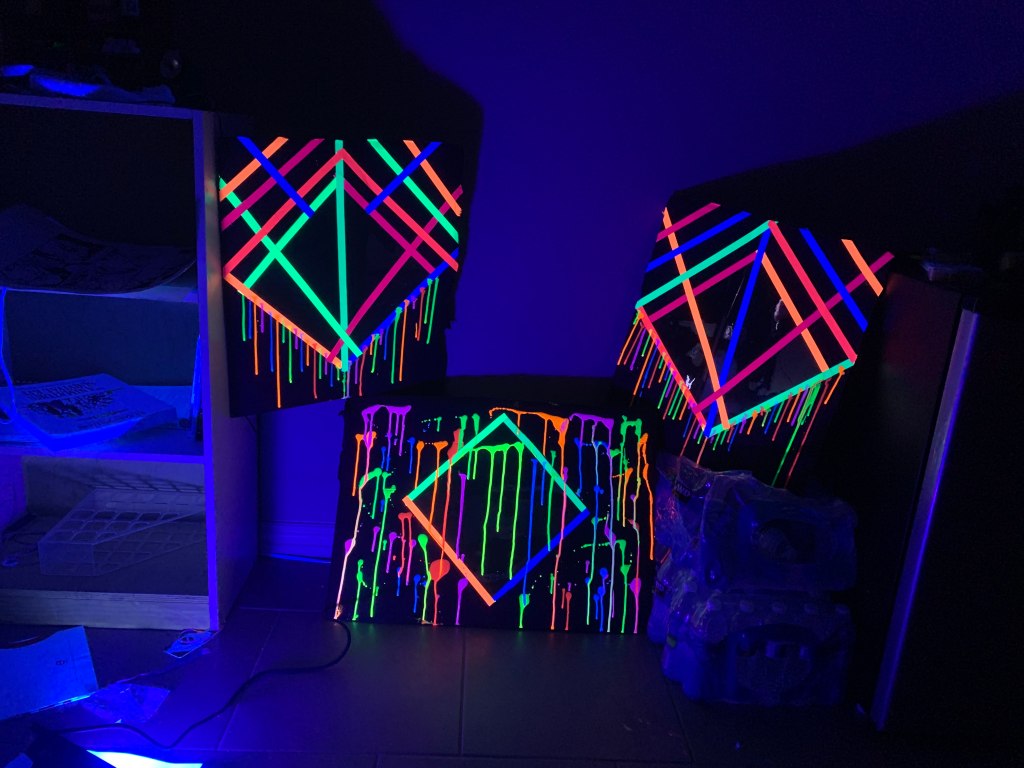
When I first started this project, I know exactly what I wanted to do. I wanted to work with neon colors in a dark environment! I was influenced by this bar I went to in downtown San Marcos that was a dark room FULL of neon colors all over and I wanted to do something similar.
When I first started, I spray painted some cardboard black and added neon tape around the edges of the mirrors. I put the mirror on the cardboard and started to drip the paint downwards.
When I was done adding the paint, I thought it wasnt enough and I added more tape at the top which was such a payoff.
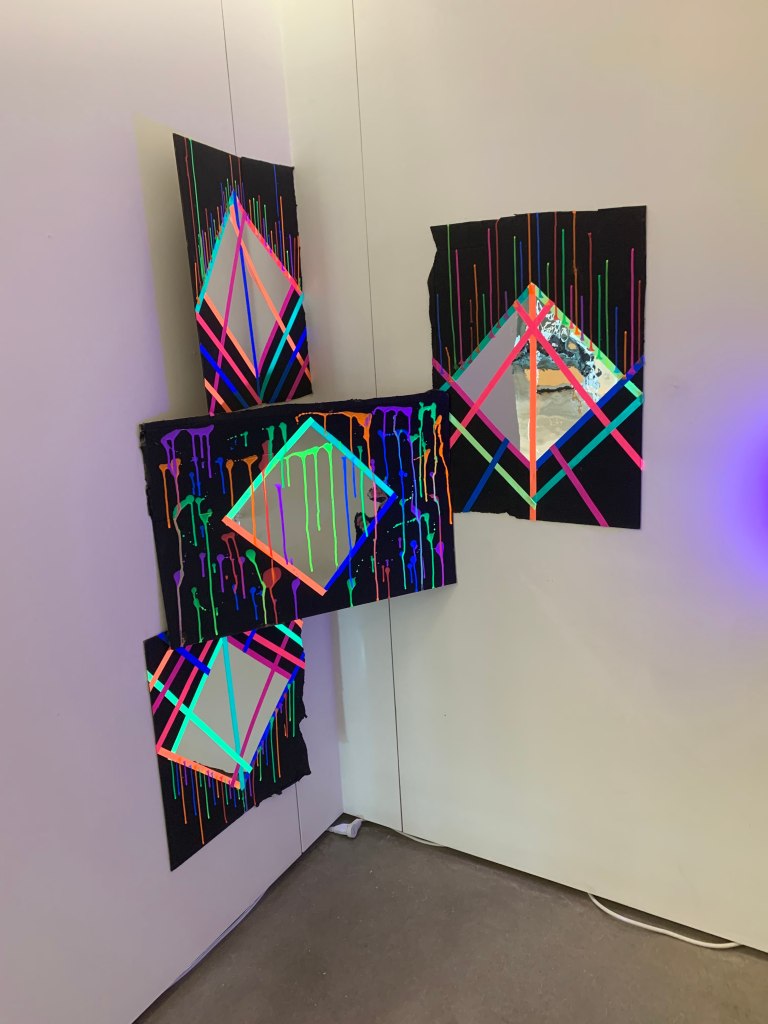
I decided to do this do all of them besides the center piece. I dripped the paint all over the cardboard this time instead!
The work was meant to be shown in complete darkness in order to get the full effect of the piece.
When installing my piece, the room was a brighter than I thought. It was difficult to make it darker but thats okay! I really enjoyed putting up my first installation ever!
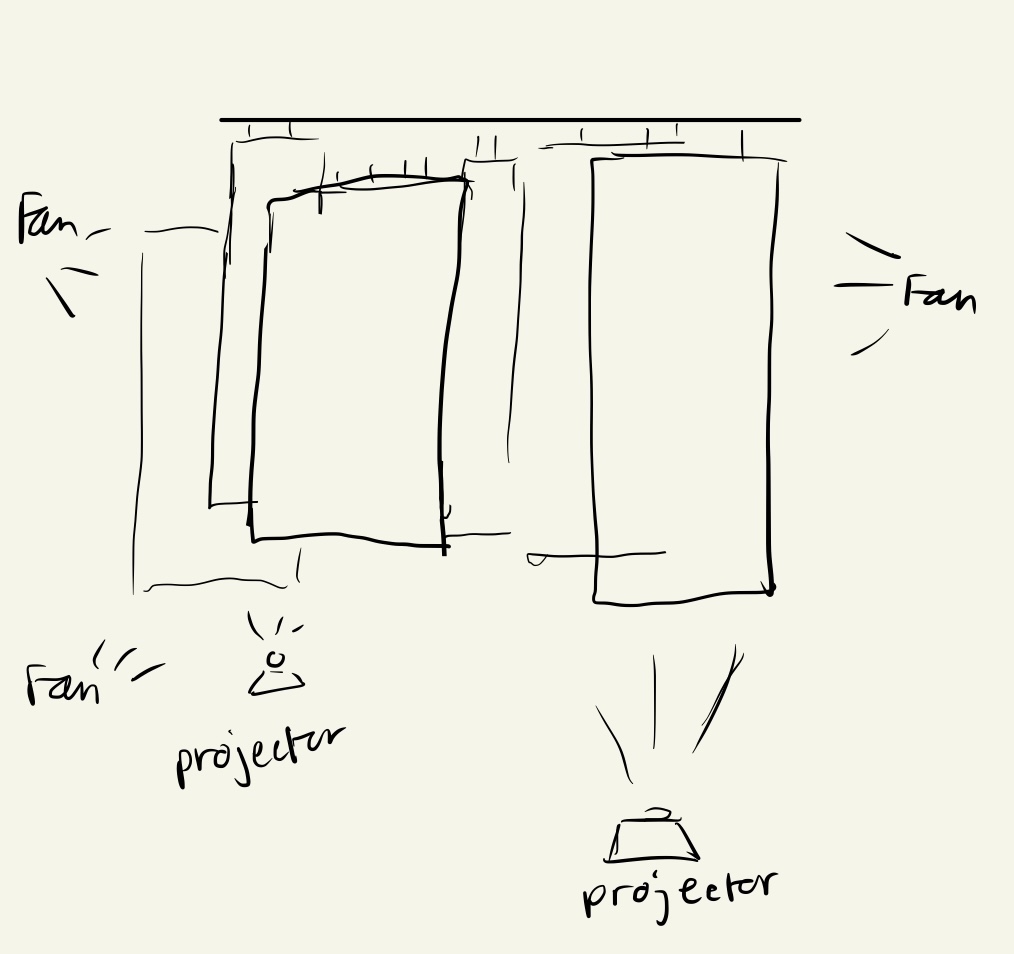
For the Team Project, I was grateful to have been chosen to execute my proposal. I proposed to explore the intersection of nature and the mind using sensory perceptions. Materials used were mixed-media (video clips collected being projected), nature sounds, and others such as a fan and sheer curtains to allude to the qualities of nature. I drew inspiration from Artist Rachel Schmidt. Her installation “All My Children Sleep in the Sea” was exactly the idea I had in mind when brainstorming this project.
After doing further research on this artist and her works, I cam across another installation of hers titled “Out of Balance”. This installation is a mixed media work that explores the topics of climate change themes. It is accompanied by series of abstract paintings and sculptural elements that allude to the distrusted landscapes in nature. It also accompanied by chakra healing frequency-like sounds created by Kevin O’Meara. The videos of nature play on loop.
My group and I first began by locating a specific site where we would like to install this project. We ended up choosing the closet in the back of the screen printing room since it was very spacious and allowed for easy access to outlets. We cleaned it out and covered the walls and windows with some panels that were in there. We also decided to cover the windows from the screen printing room to allow for minimum amount of light from the outside to come in to allow viewers to see the projection best although, the long windows in the right side still had some light coming in. After this we used the super long tall latter to begin clipping some “clippers” to the ceiling panels. We tied the fishing line from these clippers to the metal rods which is how we were able to hang the sheer curtains.
This process took a while because we tried to be strategic about where we wanted the curtains to hang from and what angle we wanted them to be facing. We considered the viewers experience as well in regards to what passage/direction the location of the curtains would lead them to take. When I first proposed this project, I thought I wanted all of the curtains to all be hanging parallel to one another while they were all staggered, each having a different length to them, but as we began hanging the idea of creating an immersive experience for viewers came into mind which is why we ended up using the entire space in the room.
Initial idea on set up During set up
As a team, we divided the task of collecting video clips to later edit and put together on loop. We also divided the tasks of collecting nature sounds. I was able to capture videos of nature using my 50 mm lens camera which allowed for very detail, depth of field videos.
Lady bug on leaf, 50 mm lens camera Water sounds and video, 50 mm lens camera
I used the audio recording app on my iPhone to record sounds of water, birds, chirping, and other sounds of nature. Once all of the curtains were hung, we sat down as a group to look over the video that America had put together no edited. We decided we wanted not only peaceful sounds with a Chakra healing frequency over it as the zen-full, peaceful clips were being portrayed, but we also decided to incorporate a couple sped up, more chaotic sounding clips to throw viewers off. After the video was finalized, we set it up on two projectors, each being on opposite sides of the room.
Overall I was extremely happy with the outcome and extremely thankful for such an amazing group. I am very thankful and appreciated of all of them and of this project.
2:52 Projection During Day Time Projection during day time Projection at night time Projection at night time Projection at night time Projection during day time
For the 3D sculpture project I chose to create little cube-homelike structures. I got inspiration from the homes in Guanajuato, Mexico.
Homes in Guanajuato, Guanajuato Mexico Streets of San Miguel de Allende Gto, Mexico Roof top view of homes in San Miguel de Allende GTO, Mexico
I furthered my research on Pinterest. Pinterest taught me a variety of techniques when creating cardboard structures. I began by stripping the cardboard of the top layer of “paper” it was covered with. I did this to reveal the textured part of the cardboard because one thing about me is that I love textured artwork. I then cut the 4 sides of the cubes/ “walls”. Two “walls” were a little longer in length allowing me to crease and fold them some so I could then glue the other wall allowing me to connect the walls to create the cube. I then went in and glued the roof to the four walls which completed the cube figure. Once I had the cube completed, I went in and drew rectangles and squares and cut them out with an exact knife to reveal a window in the now “homes”. Once I had a good amount of them, I began stacking them to play around with dimensions and to see how I wanted them to lay out. I used E600 glue as well as Tacky glue to allow for a sturdy finish.
JR is a French artist and photographer known for his large-scale public art installations. He began his career as a graffiti artist and later turned to photography, using his camera to document the lives and stories of people in communities around the world. JR’s work often involves pasting giant photographs onto buildings, streets, and other public spaces, creating striking and thought-provoking images that challenge viewers to think differently about social and political issues. He has created installations in cities all over the world, including New York, Paris, and Rio de Janeiro, and has been recognized with numerous awards and honors for his work. JR is also known for his commitment to social justice causes, and has used his art to raise awareness about issues such as immigration, poverty, and conflict.
He created a large scale installation located on the US-Mexico border wall near Tecate, California titled “Giants, Kikito”. The installation consists of a series of black and white photographs of people, mostly Mexicans, that are pasted onto the Mexican side of the border wall. The photographs are large enough to be visible from the US side of the wall, creating an image that appears to show people climbing over the wall or peering through gaps in the metal slats.
The installation was intended to draw attention to the human stories behind the debate over the border wall, and to challenge the idea that the wall can be an effective solution to issues of immigration and security. JR has described the installation as a way to “bridge the gap” between people on both sides of the border and to create a sense of connection and empathy.
The installation was controversial for some critics argued that it promoted illegal immigration and undermined national security. However, supporters of the project saw it as a powerful statement about the importance of compassion and human connection in a divided world.
Giants, Kikito on scaffolding, Tecate, Border Mexico-USA, 2017Giants, Kikito, View of scaffoldings, Tecate, Border Mexico-USA, 2017
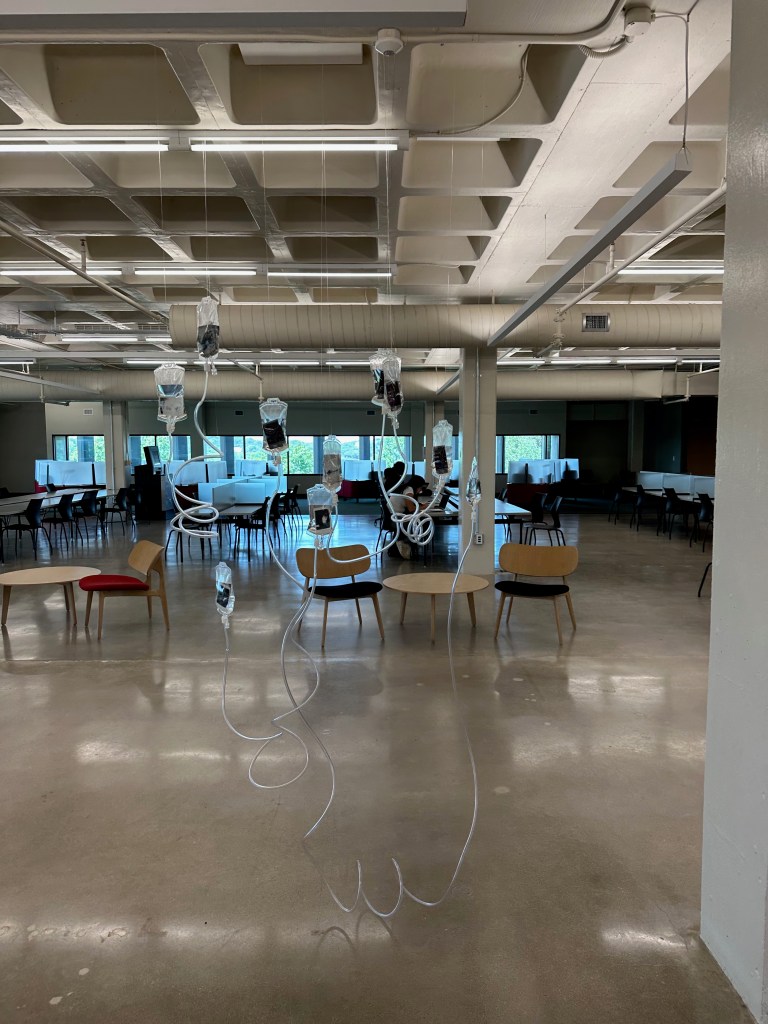
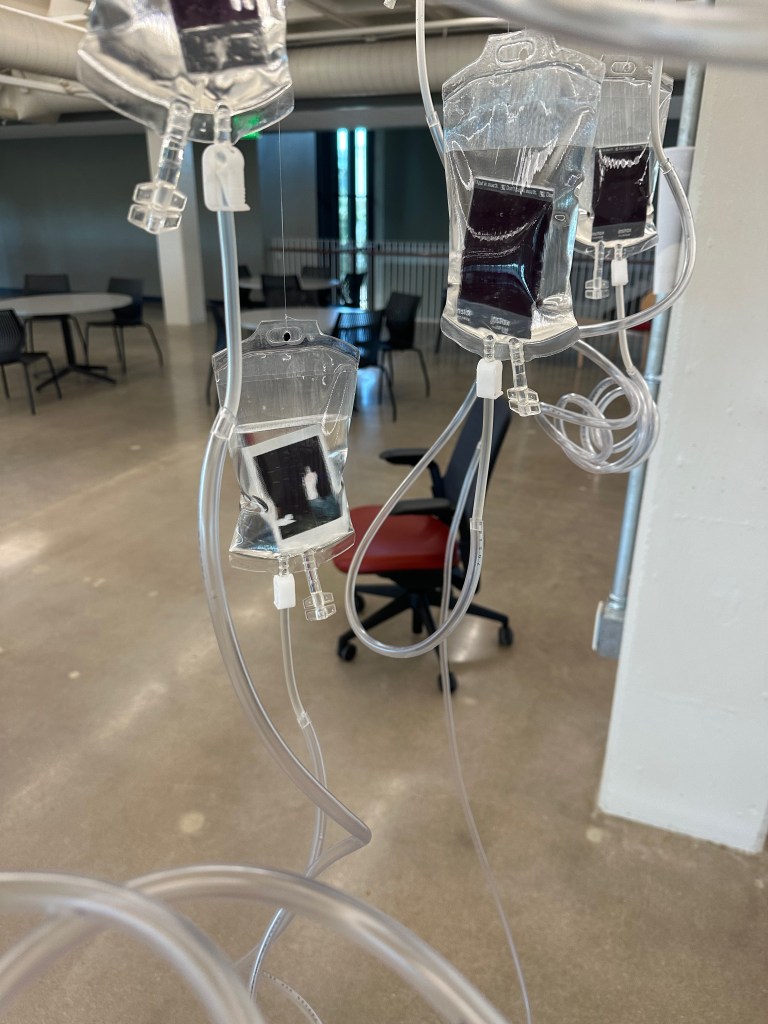
I wanted to create an installation that represents the connection between life and the absolute necessity of human interaction. Going into this, i didn’t have much planning other than I knew I wanted to hang the IV bags and have polaroids inside them. Taking the polaroids were definitely the most challenging part of this installation. I wanted to get genuine interactions of people, and that was difficult given I had ti get very close with the camera.
I feel this project addresses drawing into space by using all of the plastic tubing to create different shapes, patterns, and designs. I think meticulously connecting them to certain bags gives it that spatial drawing aspect.
The groups that used yarn, wrapping it around trees, really helped me figure out how I wanted to configure the plastic tubing. Yes, I could’ve just connected them to anything or not even used them at all, but I wanted to expand the feeling of connection.
One thing I would definitely do differently would be to use a camera that has the capability to zoom in and make it easier to take pictures, especially since I am definitely not a photographer. One thing I considered was to maybe add more bags. Initially I wanted to install around 20, but I think it’s actually still successful with just the 10 that I have.
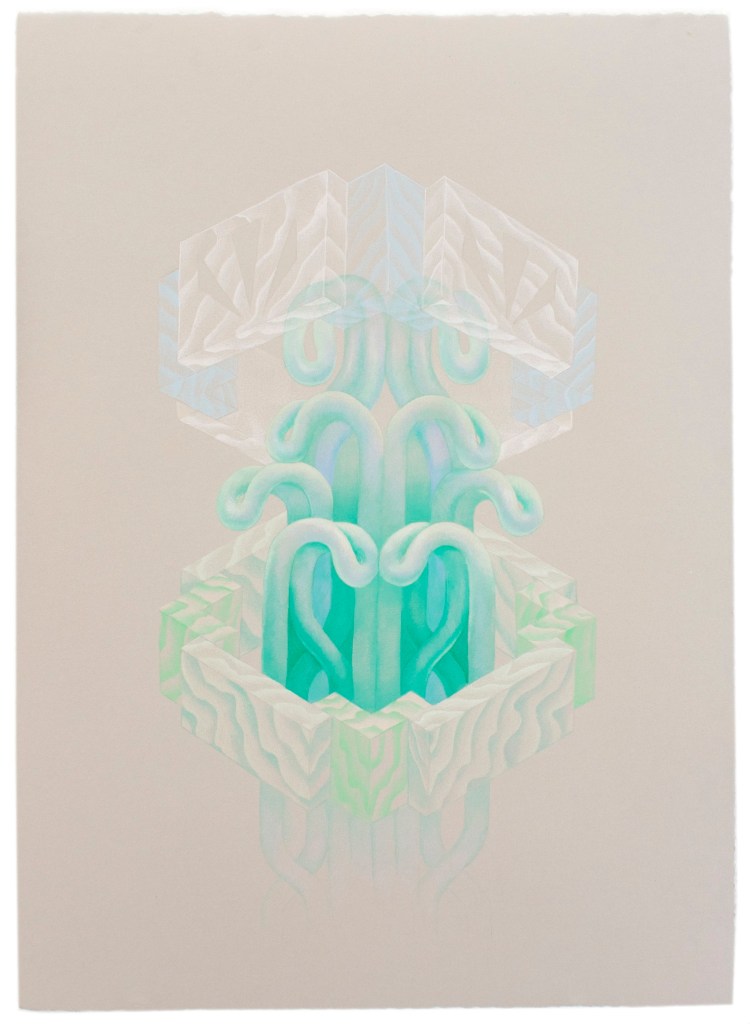
Lauren Clay is a contemporary American artist known for her colorful, abstract sculptures and installations. She was born in 1982 in Savannah, Georgia. She received a Bachelor of Fine Arts degree from the University of Georgia and a Master of Fine Arts from Virginia Commonwealth University. Clay’s work is characterized by its use of vibrant colors and organic forms, often incorporating repetitive patterns and geometric shapes.
Clay’s sculptures are created using a variety of materials, including paper, wood, and ceramics, and are often inspired by nature, particularly plant life and rock formations. She is interested in exploring the relationship between organic and inorganic materials, and her work often blurs the boundaries between the two.
In addition to her sculptures, Clay also creates large-scale installations that transform entire spaces. Her installations often incorporate geometric shapes and bright colors, creating immersive environments that engage the viewer’s senses. Her work has been praised for its bold use of color and form and its ability to create an atmosphere of playfulness and joy.
Wind-Eye, 2023, oil paint, paper pulp, high density urethane panel, 66 x 39 x 3 inchesOrange Eleusis Gate, 2021, oil, paper pulp, plaster, epoxy clay, mixed media on panel, 82 x 80 x 4 inches, 208 x 203 x 10 cmAbove and below, 2022, oil, paper pulp, mixed media on panel, 28 x 23 x 2.5 inchesAd Fontes (In The Garden), 2022, colored pencil on paper, 15 x 21 inches
Marc Chagall was born in Belarus in 1887, he was of Jewish descent and had 8 siblings. The town he was born in the majority of the residents were Jewish. He was part of many art movements, and worked in nearly every medium. He was known as one of the most impressive Jewish artists by many critics and writers. He created stain glass for many monumental buildings, painted murals, and had many more accomplishments. Before World War I he spent time traveling. He created his own unique style after traveling to Berlin, Paris, and Saint Petersburg. His work was rooted in Jewish folk culture as well as his concept of Eastern European culture. During World War I, he established himself as a primary artist in the Avant-Garde style. His focus on color was imminent making his a famous colorist. He He died in 1985 in France.
Amedeo Modigliani was born in 1884 in Livorno, Italy. He moved to Florence in 1902 and studied at Academia di Belle Arti, which translates to “Free School of Nude Studies.” After that he moved to Venice to work as a professional artist. He started experimenting with drugs. He moved to Paris and drank alcohol, smoked heavily, and drank absinthe. He started using narcotics, which led him to the philosophical belief that creativity was only possible through rebellion. This led to a life of addiction and his eventual death from tuberculosis. His unexpected death at 36 was followed by his wife’s suicide. His reckless behavior was prompted with his diagnosis of tuberculosis when he was young, which made him feel as though he didn’t need to make an effort to better his life. Modigliani created a large number of works, but most were given away or destroyed by him.











 drawing into space