Goodbrush and lighting in space

Goodbrush ( a.k.a Craig Mullins) is a renowned concept artist,well known for his digital work and amazing ability to suggest the inessential and while maintaining a high level of visual fidelity to the work.

What always brings my attention on his work has always been his attention to light and shadows, and how that always creates intense depth in space and often nods at the scale of the space and the relationship between objects. It also helps that he chooses to simplify the forms the further they go in space, which is also a great way to create and manage depth.

hovership_dome.jpg

hovership_acrylic.jpg

hallway.jpg

blue_coat.jpg

hovershiphall.jpg

india3_19.jpg


Sources:

http://www.goodbrush.com/x4oynmjkxr5fhgmi0xsh6a9ml2dhxl

Craig Mullins (Goodbrush), new website


Mia Pearlman

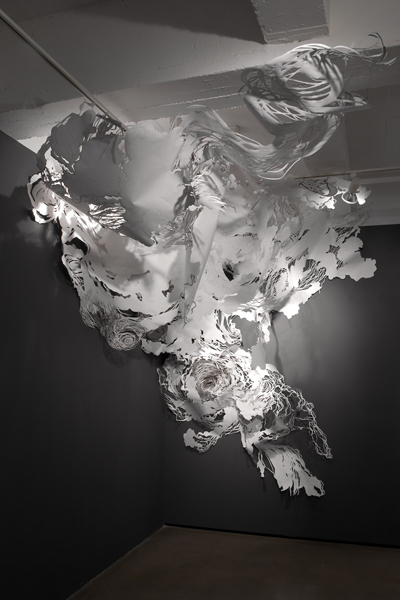
Pearlman got her BFA from Cornell University in 1996. Most of her works are non-representation and freeform. The drawing was done with India ink on roll paper. She cut out the negative shapes between lines which guiding to the next cut. Her work process is very spontaneous. Because she doesn’t want to end up recreate the work like the way the might end end in her studio, the installation is mostly done in the gallery space intuitively. If the work needs to be transported, she would roll them with the drop cloth and fit them in a tube to check with her baggage. She hasn’t had any sketches of how the installations should turn out. However, she would measure the dimension of the space and work from there instead. The works are in a quite large scale in order to represent the idea of bigger forces or powers, including her inspiration from nature, in the universe.


These are some examples of Pearlman’s works

Pearlman_EDDY_full2.jpg

Mia Pearlman, EDDY, 2008 11′ x 12.5′ x 14′ Sears Peyton Gallery, NY


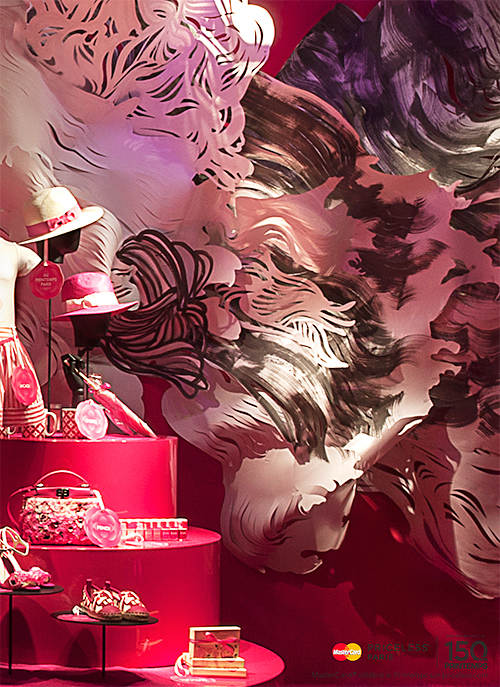
Printemps_det_rt.jpg

Mia Pearlman, Printepms window, 2015


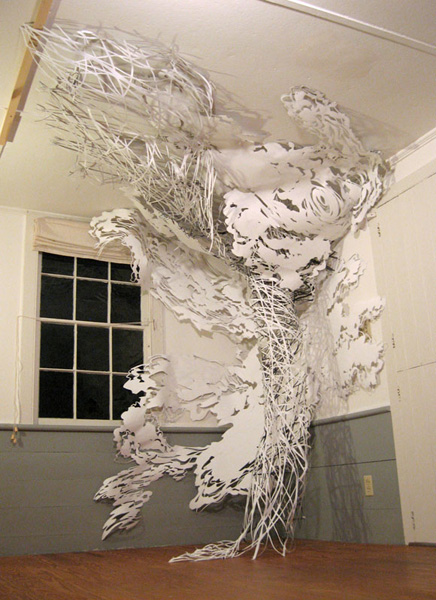
tornado_right2_600.jpg

Mia Pearlman, TORNADO, Paper, india ink, tacks
52″ W x 84″ H x 54″ D, 2007

Official website

http://miapearlman.com/index.htm

Hew Locke

Hew Locke is a British contemporary artist born in Brixton, London, and was born in 1959.  Locke graduated from Falmouth University in 1988 with his B.A. in Fine Arts, and then in 1994 he received his M.A. in sculpture from The Royal College of Arts.  Locke is best known for his sculptures and visual art.  Locke drew attention to himself in 2000 when he won a Paul Hamlyn award and the EASTinternational award.  Locke uses an extensive amounts of materials, which includes, but is not limited to: painting, drawing, relief, fabric, sculpture, casting, collage, and found objects.  In the beginning of Locke’s art career he derived from and was inspired by colonial and post colonial history.  This early inspiration, being that the topic was so broad, stemmed off into much more symbolism, motifs, and ideas than Locke originally had anticipated.  Even though all different ideas have stemmed from the colonial and post colonial period his main focus was power.  Early works of his included portraits of queens and monarchial figures, and other upper class figures important to the government; in order to give it contemporary and commercial relevance.  Recently another focal point of Locke’s art work is ships and what they symbolize.  He claims that ships represent trade, culture, and warfare.  Locke says that if he had not pursued his career in art, his obvious alternative career would have been a historian.

“Hew Locke.” Hales Gallery. N.p., n.d. Web. 31 Jan. 2016. <http://www.halesgallery.com/artists/15-Hew-Locke/overview/&gt;.
“Hew Locke Home Page.” Hew Locke Home Page. N.p., n.d. Web. 31 Jan. 2016. <http://www.hewlocke.net/Homepage2ndsite.html&gt;.


The Wine Dark Sea : BB, detail, 2016. Mixed media with hand embroidery, full size 76 x 33 x 98cmwinedarkseaBBdetail1

Janet Echelman

Janet Echelman is an artist that deals with large, massive scale and lets the wind and environment change and effect her work. She combines old technique and new technology to create her stunning artwork.

Her TED talk has been translated into 34 different languages and 1 million views. She is popular in many different counties and has been recognized for her architectural artwork several times.

She’s moved several times in her life, born in america, lived in hong kong and then Bali,Indonesia until a fire took her house. She experimented with materials from painting to bronze until one day she was watching fisherman working with their nets and wondered if that could be a new way to do sculpture without all the heavy materials.

Today Echelman has constructed net sculpture environments in metropolitan cities around the world. She sees public art as a team sport and collaborates with a range of professionals including aeronautical and mechanical engineers, architects, lighting designers, landscape architects, and fabricators.

Phil Ashcroft

ashcroft 5

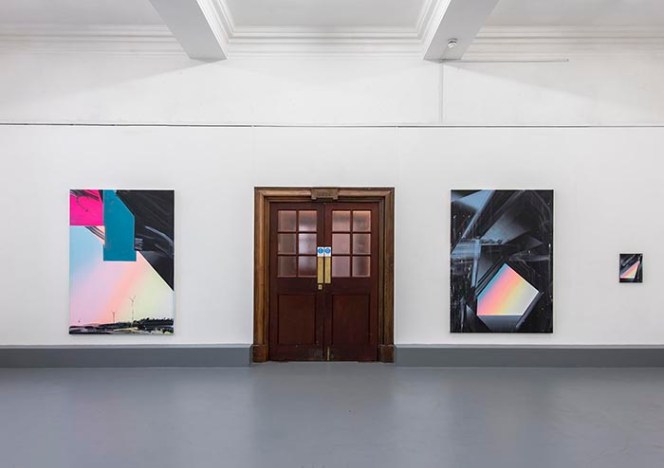
Cave Paintings, installation view, 2015. Photo: Tom Horak http://www.philashcroft.com/site/wp-content/uploads/2015/11/DSC_1442-HDR-2s_700.jpg

Phil Ashcroft is a London based painter and graphic design artist. Ashcroft completed his illustration degrees at Harrow College of Art & Design and continued to post-grad work at St. Martins College of Art & Design in London. Much of his work draws influences from abstract expressionism, landscapes, and street art.

Ashcroft’s most recent exhibition Cave Paintings was held in 2015 at the Lewisham Arthouse in London. This work uses both color and grey scale in the abstract landscapes. The paintings have a unique divisions of the picture plane through lines that create geometric shapes, which suggests push and pull in the space. The dividing lines combined with the expressive paint marks relates to drawing in space because of the depth they create and the illusion of space. The painting below, Nexus 7, part of the Cave Paintings body of work, uses lines, edges, grey scale, and expressive paint strokes to create a landscape of abstract expressive paint strokes.

ashcroft 1

Cave Painting (Nexus 7), acrylic on canvas, 121 x 91cm, 2015. Photo: Tom Horak http://www.philashcroft.com/site/wp-content/uploads/2015/11/DSC_1427-HDRs_700crop.jpg


The view below of the installation shows Ashcroft’s attention to space and placement between the artworks in the exhibition itself that also relates to our theme outside the picture planes.ashcroft 2
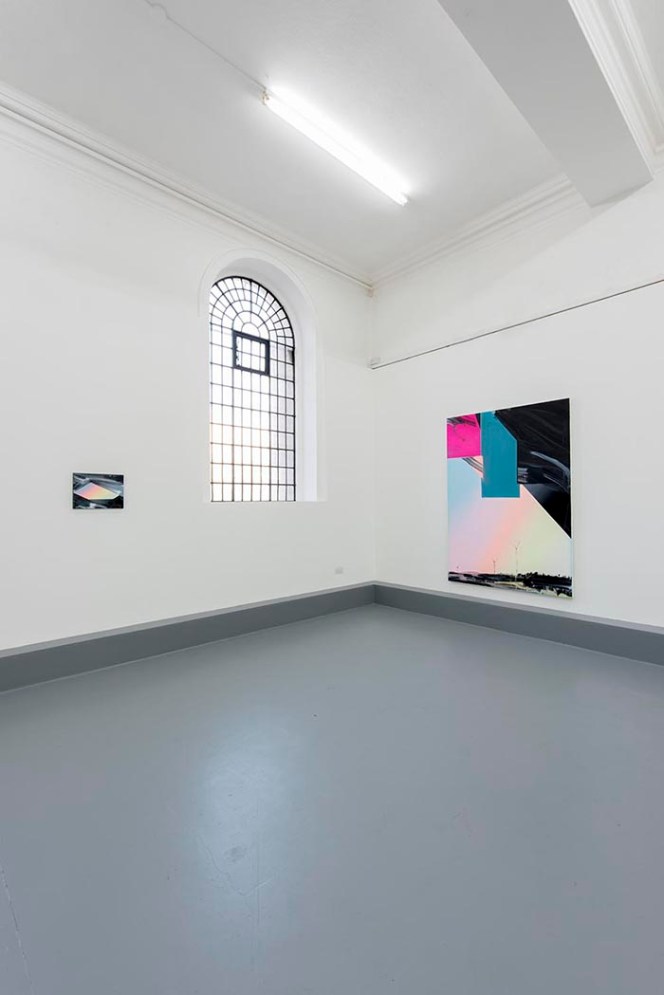
Cave Paintings, installation view, 2015. Photo: Tom Horak http://www.philashcroft.com/site/wp-content/uploads/2015/11/DSC_1397s_700.jpg


Below are more works by Ashcroft for Cave Paintings.
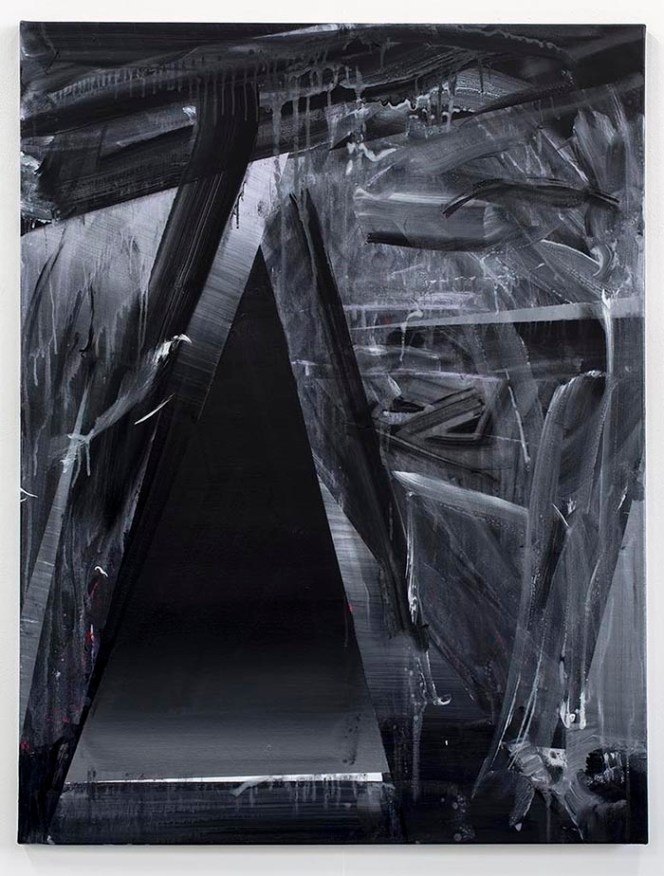
ashcroft 3

Cave Painting (Nexus 9), acrylic on canvas, 121 x 91cm, 2015. Photo: Tom Horak http://www.philashcroft.com/site/wp-content/uploads/2015/11/9_700px.jpg


ashcroft 4

Cave Painting (Small Sunset Variation 4), acrylic on canvas, 41 x 31cm, 2015. Photo: Joe Plommer http://www.philashcroft.com/site/wp-content/uploads/2015/06/DSC1531_700px.jpg


Citation: www.philashcroft.com/site/


Dale Chihuly

Dale Chihuly is a multimedia artist with a concentration in 3D art. His preferred media of choice is glass, he was introduced to this media at the University of Washington while taking interior design. After graduating he started taking classes to learn how to create with glass.

He has created a number of well known series of works, some of them being Baskets in the 1970’s, Seaforms and Persians in the 1980’s, and Fiori in the 2000’s. He has created many glass sculptures for factories in Finland, Ireland and Mexico, he than installed them all over the canals and piazzas of Venice.

Tim Shumate

Tim Shumate is an illustrator and tattoo designer that lives in Chicago. He takes old disney characters, pixar characters or historical figures and changes them up with his own personal style. He typically draws his characters inside frames and has the breaking the planes in certain areas to create depth.
heycaptainHe uses a mixture of media, pen and ink, graphite and color with some digital to portray his work. While his works are small and usually sketchbook paper size, they are very detailed and show the sense of a figure and objects in space. tim shumate 2

His portrayal of figures is unique, he takes something that has a preconceived idea about it and changes it to fit his own definition.

tim shumate 3

Yusuke Asai’s Mud Paintings

Yusuke Asai is an artist that primarily uses mud to create his massive murals. The thing about Asai is that he specifically uses the dirt and water from the area that he is painting at, in a process he calls “earth painting”. Using material from the earth, Asai considers his art to be “alive” like a giant organism with all its inter-working cells colliding. His paintings consists of multi layered intricate paintings of creatures and characters surrounded by patterns and motifs resembling that of Gustav Klimt. With this Asai creates an imaginative whimsical world of intertwining oddities. From the bottom of the floor, to the ceiling, and everything in between, his painting span the size of entire room as well as on the floor. As mud as his only medium, it’s almost as if he is creating modern day cave painting, making the connection of using a natural pigment and the subject matter of animals. 24184646416_91753e77ed_b23842895219_50f5a9273d_b

Source: http://hifructose.com/2016/01/06/yusuke-asai-uses-mud-to-create-his-large-scale-earth-paintings/

The Fantastical Landscapes of Rob Alexander

Rob Alexander is a Canadian illustrator who is mostly known for his drawings and paintings. In them, he depicts massive, colorful landscapes that convey an amazing sense of depth and scale. He has produced artwork for various venues, including concept art for videogames, illustrations for books, and art for many different tabletop trading card games (most notably, Magic). While most of his works are incredibly fantasy based in nature and subject, Alexander says he is most inspired by working from real life landscapes. Mountains in particular are the biggest influence, particularly the Canadian Rockies, before Alexander moved to the Pacific Northwest. He continues to work as a freelance illustrator to this day. I believe his paintings and drawings relate well when discussing ‘Drawing into space,’ because the work itself showcases the idea of space and distance and perspective so beautifully.

Some examples of Rob Alexander’s work:

Alexander, Honors Vale, Painting.

Alexander, Natural Rhythms, Painting.

Alexander, Underground Sea, Painting, 1993.

Alexander, Last Light of Day, Painting, 2000.

Alexander, At the Bottom of the World, Painting.

Alexander, Atlantis, Painting.

Official Website: http://www.robalexander.com/index.html

Amelie Chabannes

Blog3

Amelie Chabannes was born in France and studied Architecture and Fine Arts at a French Art school called ENSAD.”I first aspired to associate the exploration of the self with archeological procedures.  My recent installations have stood as excavation sites and their sculptural objects were submitted to raw and meticulous recovery in which debris and artifacts are observed as remains of our individuality.” Chabannes soon began to explore identity through excavation which then transitioned to exploring the close relationships of others. The images in her series that visually represent relationships seek to blur those borders between two individuals.

blog 3b

Chabannes technique involves a drawing which is then layered with 20 to 30 of the same drawing on tracing paper. The drawings are flipped and transferred on a wooden surface where then the artist carves into the surface to destroy the areas where the two figures connect to continue to blur the borders between them. The work explores the limitless sense of identity and the destruction of such is an act of defiance. The original image is a single contour drawing that is then layered and overlapped. The original contour outlines shadows and highlights, in a movement similar to continuous line.

blog 3a