Seung Mo Park

This Korean sculpture’s are something to be marvelled. His work seems to have an existentialist kind of thematic. He studies how all parts of something as a whole makes up the actual object. For example, one of his pieces is a grand piano beautifully covered in aluminum wired. This questions whether the piano is still a piano if it is not able to do it’s function.

My main focus with Mo Park is his work with wire mesh. His wire mesh portraits and landscapes are a force to be reckon. This work have an ethereal aspect to it. The different layers of mesh are placed in such a matter that it created a very intricate crosshatching. After that, he substract little by little to bring the whole image  out.

Final Installation

I ended up very pleased with our final product. It came together very nicely with our color choices and the way we brought colors from one piece to another. We made it so no yarn end was clearly visible and everything was draped as loops or pulled straight but it was very uniform and I believe all of us were quite satisfied with the final result. It was a wonderfully fun group project and I got to learn about how to work better as a team with all my group members and watch as our efforts bloomed into a beautiful collaborative piece. The work itself showed both literally and metaphorically how we all came together and came out of our personal comfort zones in order to work as a team using all of our individual strengths. As a first gallery installation and exhibition I have definitely taken a lot of good learning experiences from it and and glad I was able to be part of it in such a meaningful way.


Post Exhibit

Week of the show/week after:

20160316_122458 20160316_175522 20160316_161049

Monday was spent working on the installation yarn piece, which we were able to set up the base for the installation. We were unsure, as a group however as to what the installation should look like. By the end of Monday Rachael and Hollis had started the design, which gave us an easy day on Wednesday in order to work together as a team and put up our yarn installation. I believe that our time management was really successful, as a team we knew what we wanted to do and we worked hard during our class time.

2 Weeks until the Exhibit

Week 2 of project:

20160312_104400

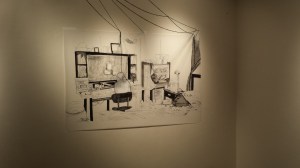
This week I began to use a projector in order to outline all the objects in my room. On Monday I was able to complete 50% of the drawing and then Wednesday I completed the outlines and began the detailing.

Spring Break: This was spring break week so I spent Monday and Tuesday working on finishing with the lithograph crayon in order to add more mid-tones to the drawing.

20160314_113253

3 weeks until Exhibit

Week 1 of project:

20160302_163624

20160229_094540

I began my project with preliminary drawings and sketches, before renting a projector from Storrs and then projecting a grey scale image of my bedroom onto the drafting mylar which I will talk about in my second week. So my first step was to do some sketches to draw out conceptually what the piece would look like.

Wassily Kandinsky (research)

Wassily Kandinsky is one of my favorite painters and the one I draw a lot of my inspiration for color, composition and style. His paintings for one explore a vast array of colors that I hope to use and explore myself as I advance in the Painting BFA program. He also creates such engaging spaces with dynamic uses of simple lines and shapes. It is the nonobjective that I find personally stimulating, it is something that can engage me as a viewer without relying on a preconceived notion of what it is. The painting on the left really makes use of a chaotic order that builds and builds upon itself while filling the space and almost leaping out towards the viewer. The openness in the background is created by a tactful use of an yellow ochre tint that gives the viewer the crucial areas of rest for their eyes. This is something that I wish to emulate in my own paintings to come. The painting on the right is an example of some of his more regimented and ordered works. It still is open and nonobjective but it has more clearly defined shapes in more recognizable geometric patterns. However he is still able to create an open floating space with perspective lines and open moments for the canvas and the viewer to breathe. I hope to be able to see one of his works in real life so that I can really experience his work.

Andy Goldsworthy (research)

I first learned of Andy Goldsworthy in my Conceptual Practices class with Professor Rothrock. We were doing an assignment that dealt with nature and manipulating it in someway. I think his work, and specifically the ones I picked, really exemplify a spatial drawing. Andy almost always only uses materials that he finds on location so the work is impacted heavily by what the space provides. In the first one it appears he used a thing grass or vine of some kind to enunciate the circular contours of the stones and draw attention to the space they fill. There is a sense of movement that is reminiscent of orbital charts that I personally enjoy about it. The second image relies heavily on the colors available from the fallen leaves of nearby trees. The glowing contour that is created by the yellow leaves totally changes the way the tree stands in the space. The final image is a motif of sorts he replicates in various mediums but this one is exquisite in its own right because it is a loose construction of twigs that create a full circular form due to its reflection off the surface of water. We perceive a tunnel like space yet its all just an illusion that will change over the course of the day. Another aspect of his work that I find really intriguing is how impermanent they are. Their essence is captured in the one photo but as time goes the leaves or sticks will blow away or decay, surely changing the aesthetic and maybe even the concept of the original work. He is manipulating the space but not attempting to tame or contain it.

Progress 3(Final): Reflecting Dream

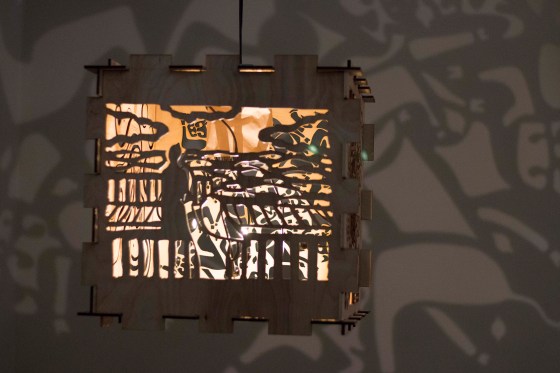
This week, as we were installing the work, we ran into a huge problem with the light bulb. We couldn’t get the perfect crisp shadows on the walls due to the incorrect wattage as well as the size of the bulb. The shadows appeared blurry and not focused. We thought part of it was because of the brightness in the room that is affecting the sharpness of the shadow.

So we went with the reading LED light with the USB adapter and project each light onto each panel so ended up using 6 lights in order to cover the entire cube. Yet the images on the walls were still not clear. However, we managed to install black curtains to block out the excess light from the gallery.

As far as how the concept goes, I think that we manage to communicate our ideas to the audience successfully. In order to install the cube, we glued ever side together except the bottom panel in case anything goes wrong which I think is a good call. We measure the distance from the wall out to the center of the space before we install the cube. The sheet on the ceiling was stretched tightly so when we project the image there won’t be any wrinkle or distraction.

On the reception day, we present the the cube by having slightly moved so the shadows could move around the entire space we create. The motion of the shadows reminded me of a child’s bedroom since the images are created to be dreamlike.


Dreaming into Space (Progress 2)


Once we had the space shrouded, the ceiling canvas stretched and the cube hung our main issue was which light bulb(s) would work best for our projections. Our first attempts were with a single bulb and we were finding that some were either not strong enough to project clearly or the bulb was too large and the projections were blurred and hard to make out. We knew a light source that was projected in a specific direction would create the clearest image. Hollis was able to find an ideal solution with a light fixture that could support multiple USB plugins. We plugged six manipulatable LED mini-spotlights into the fixture and then the challenge was how to project each side clearly without distorting the other panels too much. Jenny and Hollis proved to be quite adept at this stage in the process and since it was already night at this point the projections were quite clearly recognizable. The orientation they finally settled on worked well and allowed for the piece to really create the dream space we had hoped for. The difference in images also created a dynamic space since the amount of light being let out varied from where you stood and as the cube slowly turned. In the end I think it was successful and the last minute drapes were the final touch it needed to close of the space.

Dreaming into Space (Progress 1)

IMG_3602

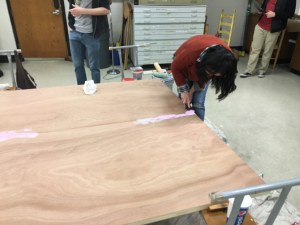
The early goals and obstacles for our project were to build the pieces we would need to help create the specific space for our installation. We knew we would need something to block out the light from the gallery so our projections would be clearly visible. After acquiring the hollow core doors we connected them together with screws, tape and puddy. After sanding and painting we were able to hang it where it concealed a good deal of light. However we realized we may need more to block the open spaces beside the wall for a better shadow.

One of our main objectives from the start however was getting each group members panel cut. We had the wood and I took it to the wood shop and ripped it down to fit into the laser cutter. After that it was a matter of signing up for a chance to use the cutter. Fortunately for our group we had members who were familiar with laser cutting so we were able to get everyones pieces cut correctly and in time for installation. Each panel was supposed to be based on dreams or an amalgamation of specific dreams, mine however was influenced by the night sky and how I associate that with nocturnal dreams. I coupled that with the doodles I frequently do during class while day dreaming. The aesthetic I hoped would emulate a night sky but not a specific recreation of it, like how must dreams are a hodge-podge creation of what may be on our mind that day or week. I had chosen to do the top panel so this image would hopefully help the viewer step into a dream-like world that they could react to on all sides of the room. Unfortunately in the installation process some of the center line work is lost due to the way we mounted the box to the light. I think the piece still conveys its point however.

IMG_3624