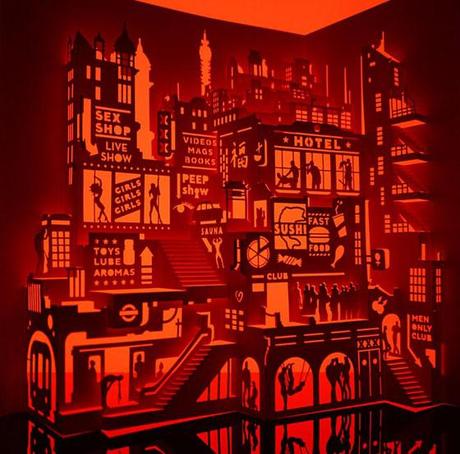
Dream Cube: Post Exhibition

Despite some last minute obstacles (some lighting issues, cube stability, etc.) we were able to finish the piece and have it project all the drawings onto the wall. Brittney’s last minute addition of the blackout curtains was the perfect finishing touch in creating an atomosphere for our space.

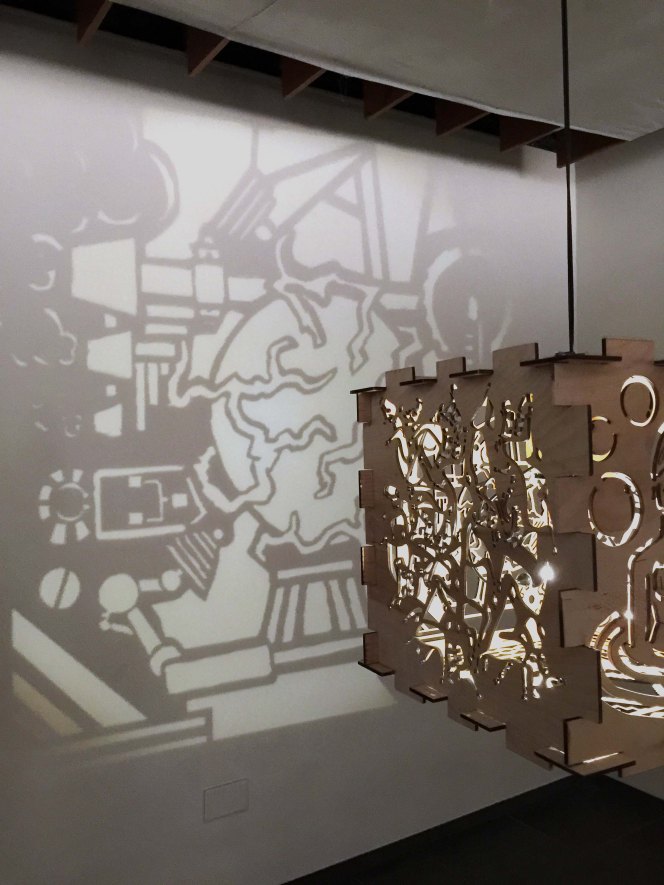
Cube 1Cube 2Panorama

In the end, I think the gallery opening went really well. All the groups had excellent projects that really explored the idea of “Drawing into Space.” It was interesting having a panel discussion, and getting to watch other people interact with the work that we had spent so long making was incredibly rewarding. As this was my first major gallery opening/installation exhibition, I really value the experience and hope it is something I will get to do again in the future… after a rest period first.

Week 2 Group Project Progress

This week, the group moved onto a more constructive phase. We each had the opportunity to cut our panels with the laser cutter, and we began construction on the extra wall that will hang in the gallery. We attatched two door panels together with brackets, and spackled them together. From there, we began priming and painting the wall, as well as assembling the cube and testing the lighting.

We are on a steady roll for the final week!

Week 1 Project Progress

Being a part of Brittany’s cube group, we all began the week by attending a training course for using the laser cutter. After the planning phase, I began sketching out my ideas for my panel. As the concept behind the piece is dreams, I drew up several sketches pertaining to the absurd and often disturbing nature of my dreams.

Ranging from murderous, middle-aged chickens, and endless staircases, I eventually settled on one of my more abstract dreams about machines and nuclear power. I then began work on my final drawing and planning for the illustrator file. The plan is to have the file ready for cutting this week so that my panel can be cut before break.

Line Installation Project 5

By: Giovanni Maldonado and William Woodruff

Tape 6

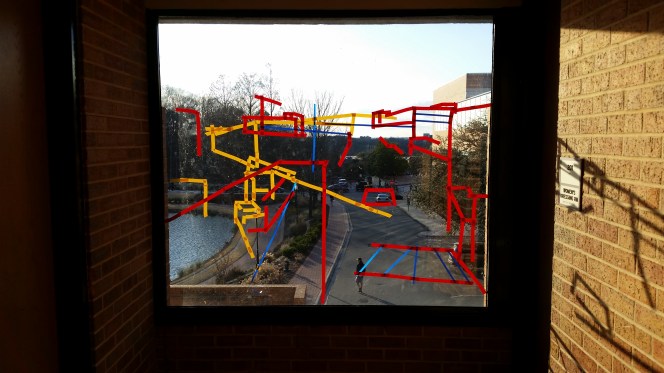
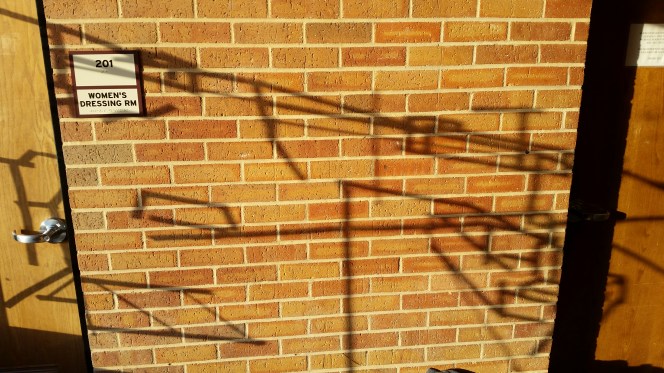
For this project, we wanted to explore line and its use in different viewer’s perspectives. Gio drew the skyline from his perspective with yellow tape, and I drew my perspective with red tape. When combining our two drawings together on the window, it created a new, unique abstract drawing. The tape also cast a shadow line drawing from the sunlight, adding an interesting 3D element.

Tape 8

We wanted to have the lines coming out of the window and onto the walls to create literal 3D lines, however, as we chose to set up in a busy hallway, it made this virtually impossible to do without blocking doorways. If we had the opportunity to do this again, we would definitely choose to set it up on a picture window in a more secluded area.


Cardboard Project #6

Cardboard Penguin 4

For the cardboard project, I decided to go with a more illustrative creative approach. After experimenting with the cardboard, I ended up making something that looked like a penguin. I chose to go with this idea and create a piece that was both representational and abstract. To top off his basic form, I also gave him a little baseball hat.

For the drawings on top, I wanted to explore using a graffiti-like style of line work to add color to the piece, instead of just using a flat color. The result ended up creating an almost tattoo effect on the penguin. Overall, I think using drawings instead of flat color made a nicer, more textured effect on top of the cardboard.

Rebecca Ward: Lines and Vectors

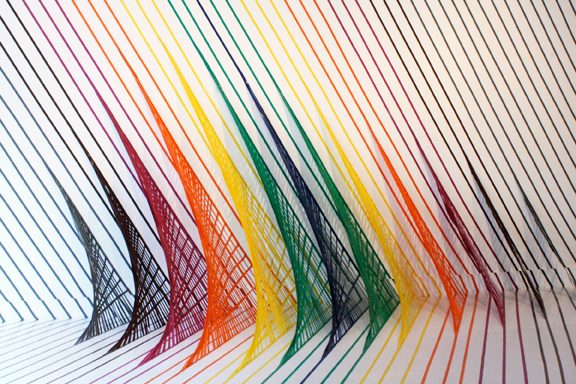
Rebecca Ward was born in Texas in 1984, and now currently is working in New York. While Ward has a very diverse and interesting portfolio, I specifically wanted to focus on her large scale, and occasionally three-dimensional line and vector drawings. Her work (best seen in the installation Seventeen is Sharp, 2009) features 2d and 3d lines that interact with the wall and space of the location she creates the installation. Using colorful electrical tape, she gives life to flat lines, bringing them out to create abstract forms. Her use of line in 3d space reflects principles of two dimensional drawing, which brings additional depth and texture to her pieces as well. A series of diagonal 3d lines in space takes on the life of hatching from a 2d perspective, while creating visual texture from alternate views. Ward has a variety of other installations and pieces, but I think Seventeen is Sharp best demonstrates the idea of drawing into space.

Here are some examples of her work in Seventeen is Sharp:

Ward, Seventeen is Sharp, electrical tape, 2009

Ward, Seventeen is Sharp, electrical tape, 2009

Ward, Seventeen is Sharp, electrical tape, 2009

Official Website: http://rebeccaward.net/

McColl Open House – Thoughts

I found my visit to the McColl Center Open House to be very unique and interesting. This is the first major opening event for a gallery I have been able to attend that wasn’t necessarily UNCC related. Being a part of the bustling, jazzy atmosphere and getting to look over all the artwork was very intriguing. Seeing Hollis’s studio was particularly cool, as I got to look at some of the work she had shown us in class in person (I especially liked the large-scale graphic novel). I also enjoyed the oil paintings of Vicente Hernandez, whose large, colorful, and detailed paintings were rather impressive. All in all, I think it was a pretty cool night, getting to have social interactions with peers outside of the classroom, as well as seeing all the new work from up and coming artists. I’d definitely like to attend events like this in the future.

Matthew DiVito’s Moving Art

Matthew DiVito is a motion graphics artist from Somerville, Massachusetts. While having a very diverse range of skills (from game design, to music video collaborations), DiVito is most well known for his motion-based GIFs. For those who don’t know, a GIF is a series of images played in rapid succession and looped to create short animations. In fact, the vast majority of DiVito’s work consists of GIFs. However, what makes his GIFs unique – and most relevant to this blog – are how he utilizes movements and abstract forms to interact with and transform space. Using the programs After Effects and Cinema 4D, DiVito crafts three-dimensional objects that, while in motion, completely alter the viewers perception of space.

While wanting to specifically focus on DiVito’s GIFs for this blog post, I think the possibilities of GIFs projected into a space can bring a whole new aspect of this idea of drawing and interacting with space.

Here are some examples of DiVito’s GIFs:


DiVito, ribbon, video art, 2012


DiVito, rough_seas, video art, 2012


DiVito, globulus, video art, 2013

cubic_tunnel

DiVito, cubic_tunnel, video art, 2015

vertigo

DiVito, vertigo, video art, 2014

Official website: http://cargocollective.com/matthewdivito

Tumblr Blog: http://mrdiv.tumblr.com/

The Fantastical Landscapes of Rob Alexander

Rob Alexander is a Canadian illustrator who is mostly known for his drawings and paintings. In them, he depicts massive, colorful landscapes that convey an amazing sense of depth and scale. He has produced artwork for various venues, including concept art for videogames, illustrations for books, and art for many different tabletop trading card games (most notably, Magic). While most of his works are incredibly fantasy based in nature and subject, Alexander says he is most inspired by working from real life landscapes. Mountains in particular are the biggest influence, particularly the Canadian Rockies, before Alexander moved to the Pacific Northwest. He continues to work as a freelance illustrator to this day. I believe his paintings and drawings relate well when discussing ‘Drawing into space,’ because the work itself showcases the idea of space and distance and perspective so beautifully.

Some examples of Rob Alexander’s work:

Alexander, Honors Vale, Painting.

Alexander, Natural Rhythms, Painting.

Alexander, Underground Sea, Painting, 1993.

Alexander, Last Light of Day, Painting, 2000.

Alexander, At the Bottom of the World, Painting.

Alexander, Atlantis, Painting.

Official Website: http://www.robalexander.com/index.html

Marc Hagan-Guirey and the Art of Kirigami

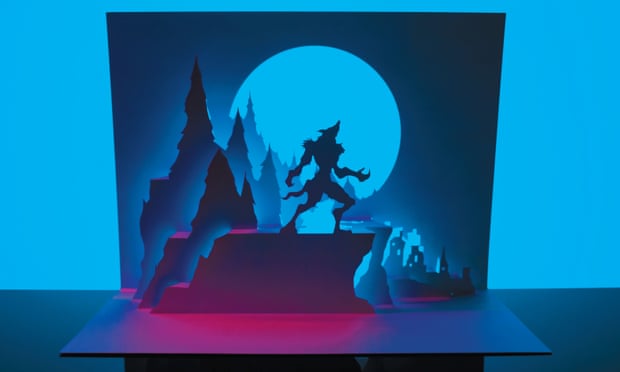
Marc Hagan-Guirey (also known as “Paper Dandy”) is a contemporary digital and paper-cut artist, most famously known for his skill in the craft kirigami. Kirigami is the process of cutting intricate shapes into a single sheet of paper that, when folded, create detailed, 3D dioramas and spaces. Guirey’s first exhibition Horrorgami, was a collection of these small paper cuts all revolving around popular horror iconography. His more recent (and well-known) exhibition Cut-Scene, Inspired by Star Wars, opened last spring on May 4, 2015, featuring intricate scenes replicating famous moments from the Star Wars film franchise.

While kirigami may not appear to have many similarities with traditional 2D drawing, the two are actually quite compatible in process and how kirigami relates to drawing into space. Guirey’s work has him “drawing” into the surface of paper with an Exacto-knife. The results, when lit properly, are dioramas that create a real and perceived space from the cut drawings. If possible, it would be interesting to see kirigami on a large scale in which the audience could observe or explore the finished work in and around the piece.

Here are some examples of Marc Hagan-Guirey’s work:

Hagan-Guirey, Soho Uncut, Paper, 2014.

Hagan-Guirey, A Kirigami Palace for Decorex International’s 2013 Campaign, Paper, 2013

Hagan-Guirey, Howler, Paper, 2015

Hagan-Guirey, from Cut-Scene exhibition, Paper, 2015.

Official website: http://paperdandy.co.uk/