3D Project

For this project I had a fun time creating something abstract which is something that I normally don’t do. I find it difficult to not plan everything out, and not have a set figure in mind. After looking through the slideshow of the 3D sculptures, I took the most inspiration from the figures that were the least identifiable.

To create this piece, I started cutting cardboard into random “blob” shapes. As I moved on, my shaped became more and more alike and I generated a plan in my head. I wanted to interlock the cardboard pieces together like a puzzle simply because I though it was the easiest and it reminded me of those plastic shapes in elementary school that interlocked with each other. I knew I wanted to spray paint the pieces a certain color just because I work with spray paint so often. After I spray painted the pieces with two shades of green I was very content with it. I didn’t actually love it. I wanted to add more. Later on, I came up with the idea to pierce the cardboard with wire to create piercings. After doing this many times my structure resembled a sort of abstract cactus. Someone in the class said it looked like a “punk rock leprechaun hat” which I loved. After completing this project I realized that I don’t absolutely hate creating abstract work.

**it’s not letting me add pictures and I’m not sure why but I can upload a link that directs to the photos of this project**
Team Project

For our team project proposals, we each proposed an idea of an idea for an installation space that includes a drawing into space aspect. For this project, we each individually proposed an idea. After voting on which idea we wanted to contribute in, we were able to choose which project we wanted to participate in. I enjoyed the freedom of being able to choose which project we wanted to help out with, rather than being forced to do something we didn’t want to do.

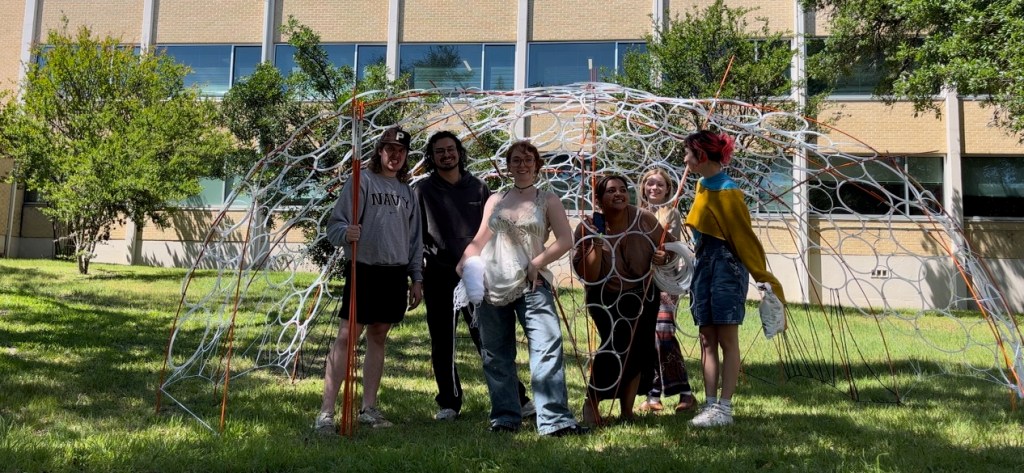
For our group’s project, we decided to create an interactive sculpture where people could walk inside. After we decided to create a cave-like structure, we bounced around ideas that would help this go smoothly. For the base infrastructure, we used long flexible rods, connected with zip ties, and stuck into the ground. The best shape for the “cave” was a sort of quarter sphere. Meg’s initial proposal included a honeycomb-like patter. To achieve this we used plastic tubing creating circles of varying sizes connecting pig panels together with zip ties.

This project was a very minimalist structure in that we used very few materials to create something that we were happy with. I love minimalist art, sculptures, etc. When done correctly I think they’re very effective and so I think ours was effective with what we wanted to create.

Individual Project

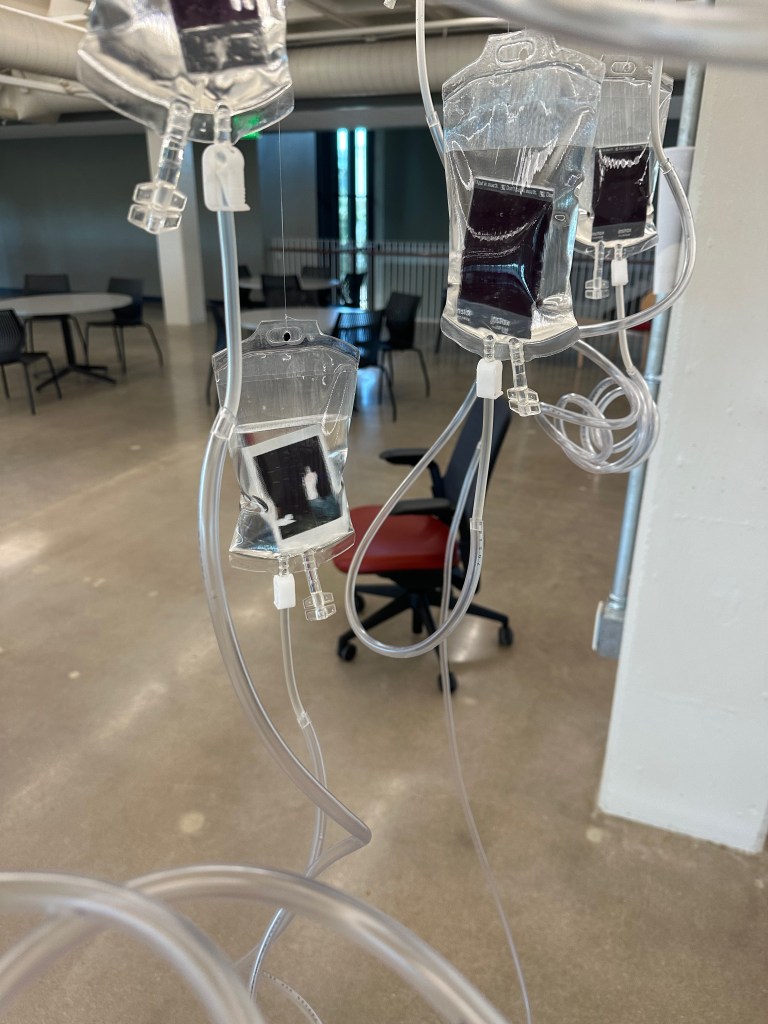
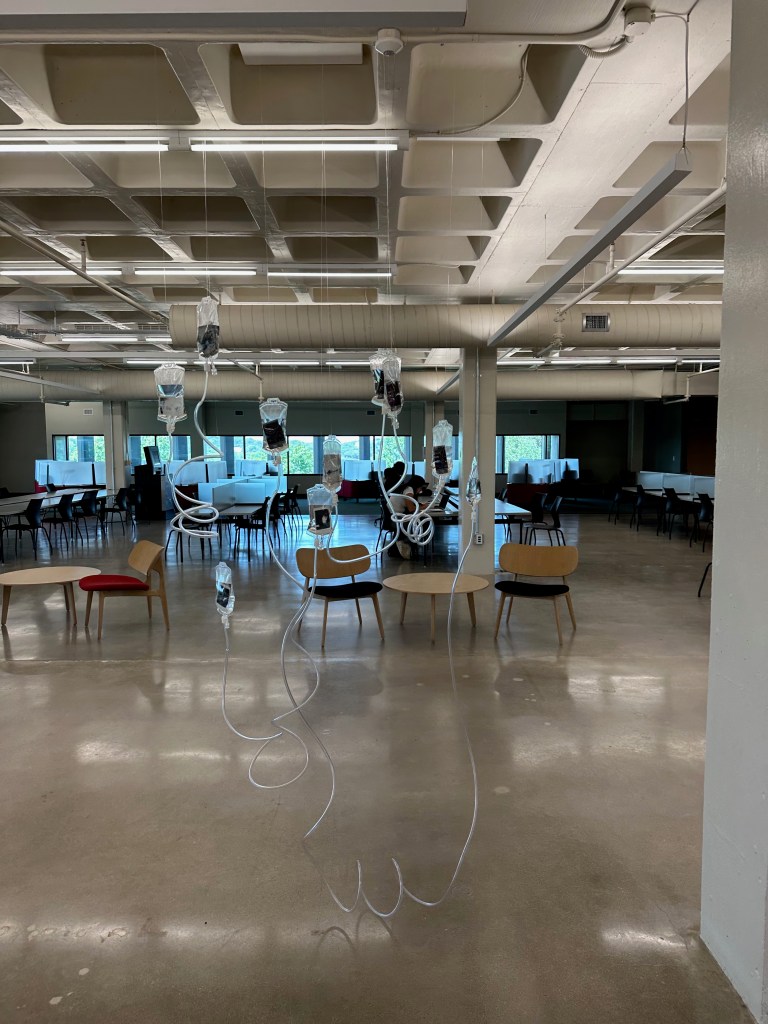
I wanted to create an installation that represents the connection between life and the absolute necessity of human interaction. Going into this, i didn’t have much planning other than I knew I wanted to hang the IV bags and have polaroids inside them. Taking the polaroids were definitely the most challenging part of this installation. I wanted to get genuine interactions of people, and that was difficult given I had ti get very close with the camera.

I feel this project addresses drawing into space by using all of the plastic tubing to create different shapes, patterns, and designs. I think meticulously connecting them to certain bags gives it that spatial drawing aspect.

The groups that used yarn, wrapping it around trees, really helped me figure out how I wanted to configure the plastic tubing. Yes, I could’ve just connected them to anything or not even used them at all, but I wanted to expand the feeling of connection.

One thing I would definitely do differently would be to use a camera that has the capability to zoom in and make it easier to take pictures, especially since I am definitely not a photographer. One thing I considered was to maybe add more bags. Initially I wanted to install around 20, but I think it’s actually still successful with just the 10 that I have.

Research Post # 8

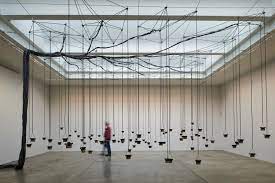
This week I chose to research Michael McLoughlin. McLoughlin is a visual artist from Ireland who’s been making sound work, sculptures, and installations since the 1990’s. The majority of his work examines mechanisms of social interactions and the infrastructures that support it. He explores contemporary art typically through public spaces. His most famous installation is titles An Audio map of Limerick. It comprises of 60 speakers hung from the ceiling that allows the audience to walk through and listen. On the speakers are audio conversations between people in the city, that McLoughlin recorded, representing society’s in its broadest form.

There are two reasons I was drawn to Michael McLoughlin. The first is because of his use of human interaction within his works. Over the past couple years, my interest for human interaction, expression, emotions, and communication has grown strong with my art. Of course I have my own views and opinions about how I think art and interactions are related, but artists like McLoughlin are the very artists I love to research and try to understand. The second reason I was fascinated with him was for his use of audio in his installations. Audio installations aren’t something I’m typically drawn to and I haven’t had much experience with them.

An Audio map of Limerick, 2016

Research Post #6

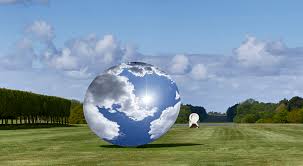
This week I chose to research the notorious Anish Kapoor. Anish was born in India and attended the prestigious boarding school: The Doon School. He later moved to the UK to attend Hornsey College of Art and the Chelsea School of Art & Design where he began his sculpture career. Kapoor became famous in the 80s for his signature geometric sculptures using simple materials. In 1995 he began working with reflective materials. He is most well known for his Cloud Gate sculpture in Downtown Chicago, also known as ‘The Bean’. His large-scale mirror-like sculptures canoe seen all over the world.

The main element that led me to dive deep into Anish Kapoor was his signature style. I was unaware of all of the sculptures he has created that resemble The Bean. As an artist who is somewhat trying to find my own style, I am envious and can deeply appreciate any artist who has a recognizable style/ trademark. I am also naturally drawn to large-scale art.

Sky Mirror, 2013

Turning the World Upside Down, 2010

https://en.wikipedia.org/wiki/Anish_Kapoor

Research #10

This week I researched Architect and Artist, Suzanne Lovell. While I was looking for artists to research, I wanted to find a more architectural approach rather than strictly spatial art.
Suzanne moved to Chicago in 1980 after finishing her professional degree in architecture. In 1985 she started her own company, Suzanne Lovell Inc. focusing on residential architecture and interior design. Her firm also includes a fine art collection advisory. She is widely recognized as an expert in fine art, textiles, and design. Suzanne Lovell Inc. has received national and international design awards and has been published many times by Architectural Digest, The Wall Street Journal, and Forbes just to name a few. Her art, as well as the fine art she chooses for homes, creates both a comfortable and engaging experience with the viewers/ residents. Her art advisory offers customized visions and strategies around art collecting. They, “create collections that bridge various periods and are anchored by significant works that epitomize the ideologies of their time.” I love this “strategy” strictly because of the fact that they are bridging time periods. I feel too often collectors are so focused in one time period of style.

This won’t let me add pictures so I’ll add url links.

Go back

Your message has been sent

Warning

Research Post #7

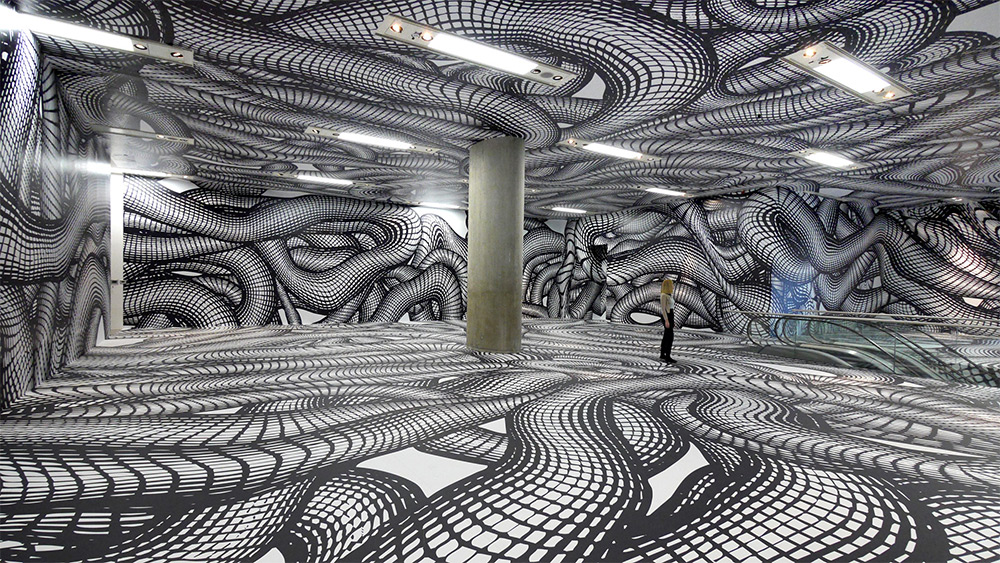
This week I chose to research the artist Peter Kogler. Peter was born in 1959 in Innsbruck, Austria. He was mostly inspired by the 1970s where that was a period of growth in the arts. He is internationally known, holding exhibitions all over the world such as: Galerie Sylvane Lorenz, Paris, Galleriea dell’Ora in Rome, and Museum Moderner Kunst Stiftung Ludwig in Videnna.
Peter is widely known for his hypnotic room installations, taking architecture and creating it into surreal environments. He uses paints and projections to create his own wallpaper on spaces that are often forgotten, like stairwells, corridors, and entrance halls. He states in a 2014 interview, “I have always been very interested in the question as to how far my visual or artistic idioms can be transformed by technological developments and moves to different media”. His concepts create optical illusions that play with time and space.
I enjoy his work because it’s interactive. I feel that any work or installation that allows the viewers to interact, or be a part of it, help engage them more. It’s as the audience is a piece of the work. The rooms would feel incomplete if no one was able to walk around them.

Line Project

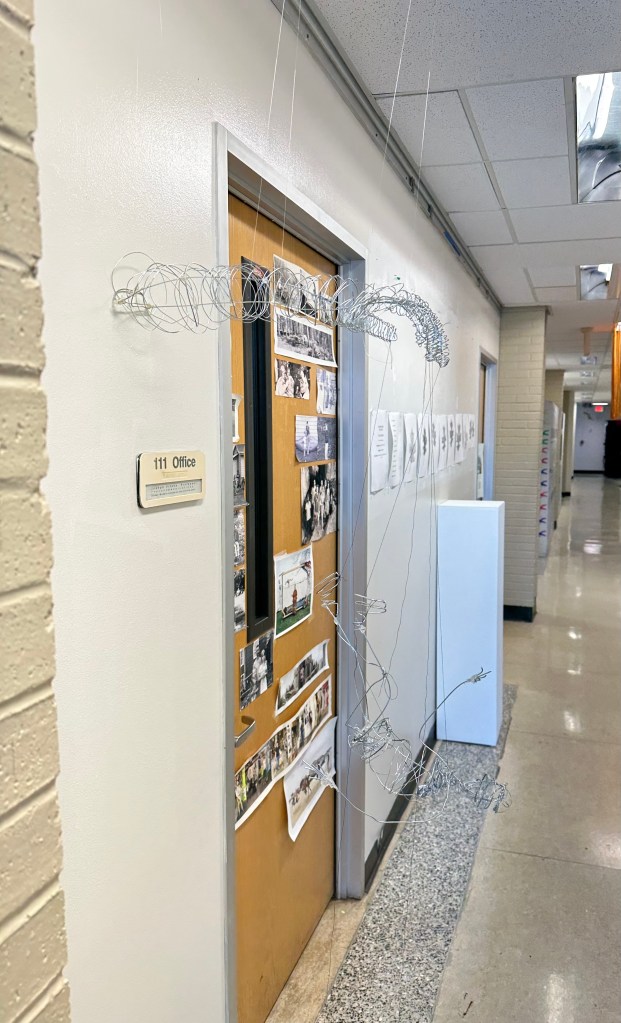
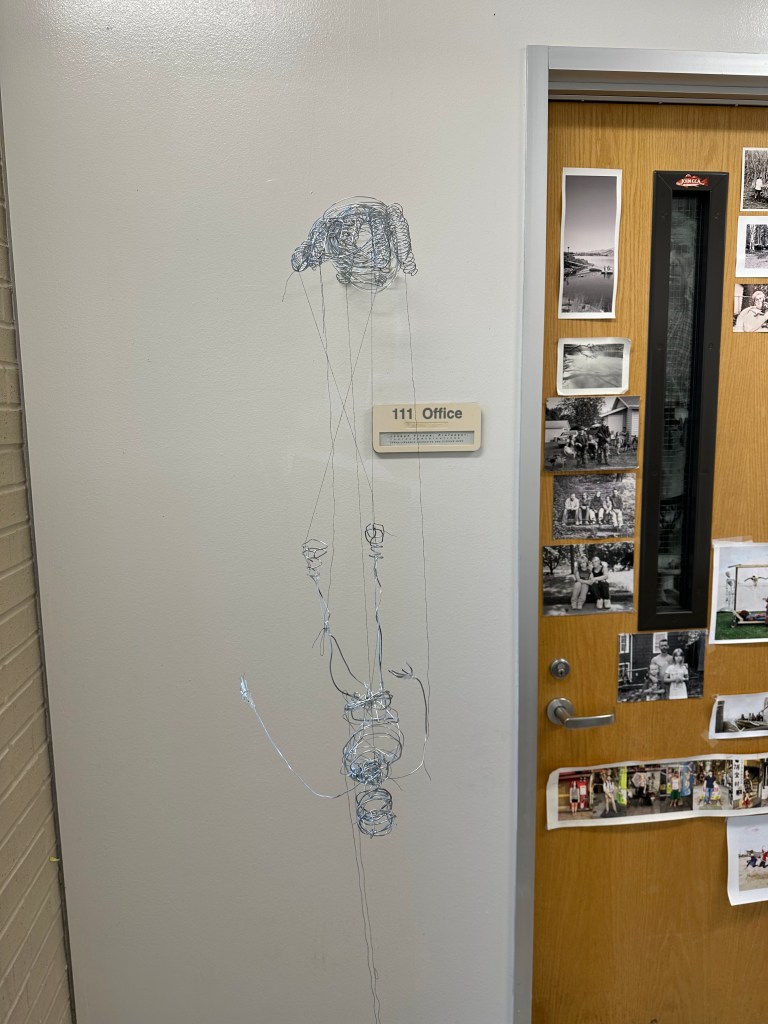
Our idea for this project was to create a story through a hand “controlling” a puppet. The puppet figure is sculpted to be falling down with some strings cut from the hand. This demonstrates the puppet escaping from their controller. We wanted to use line both in the strings as well as the wire figures. We went with a continuous line sort of blind contour style for the figures to give it more “line” qualities. We had initially wanted to install this just laying on a surface with a counter weight in the arm. We then had some help coming to the conclusion that it would look better coming out of the wall. We reinforced it with fishing string holding it from the ceiling, as well as thumbtacks holding it to the wall.

Layers Project

In most of my works I enjoy going big. This project allowed me to do so. I enjoy graffiti art and the controversy behind it. Throughout the week, I was watching the artist RISK do graffiti and was inspired to do something along those lines for my next project. There may or may not be graffiti around austin that I have participated in. I had an easy time constructing this project because I was able to line up the shower bracket things. One thing I wish I would’ve changed was the material of the shower curtains. The paint began to chip after it dried.

Research #4

This week I chose to research Arturo Herrera. Arturo was born 1959 in Caracas, Venezuela. He studied art at both the University of Tulsa as well as the University of Illinois at Chicago where he received a MFA. In 2003, he moved to Berlin for 11 years for a residency through the German Academic Exchange Service.
Arturo’s practice consists of collage, sculpture, relief, wall painting, photography, and felt wall hangings. He uses fragments of imagery from pop culture. His work is almost in between legible and abstract. When finding and using elements such as books or comics, he enjoys giving the materials a “different” life. Herrera wishes to evoke a memory and recollection from his partially obscured images. His work can be described as both “provocative”and “open-ended”.
Herrera has received many awards such as a Deutscher Akademischer Austausch Dienst (DAAD) Fellowship. He also has many solo exhibitions: Dia Center for Arts, NY, Whitney Museum of Art, NY, and the UCLA Hammer Museum just to name a few.

won’t let me upload photos, so I’m adding his website to view.

https://arturoherrera.org/