Individual project

For my individual project I used what I had learned from our past projects that had to do with collage and layering to create this piece that deals with themes of memory. In this project I started off with images already existing in my camera roll and transferred them onto transparent film using a liquid medium. I collaged those images with writings and painted on symbols that I associate with that memory and layered them either on top or on bottom. The reason for their placement being on the bottom was to represent the memories that are no longer as vivid as the ones placed on top.
Group Project

When hearing everyone’s group project proposals for class, I was very excited to join Adriana’s group. What Adriana had proposed, was to create an immersive experience using video and sound. To create Adriana’s vision, the group took over a small room in the back of the printmaking studio and hung curtains from the ceiling going in different angles to create a maze for the audience to walk through. We had two projectors at opposite ends of the room to project onto the curtains to play our video which was compiled of different clips that included the observation of nature.

3D Project

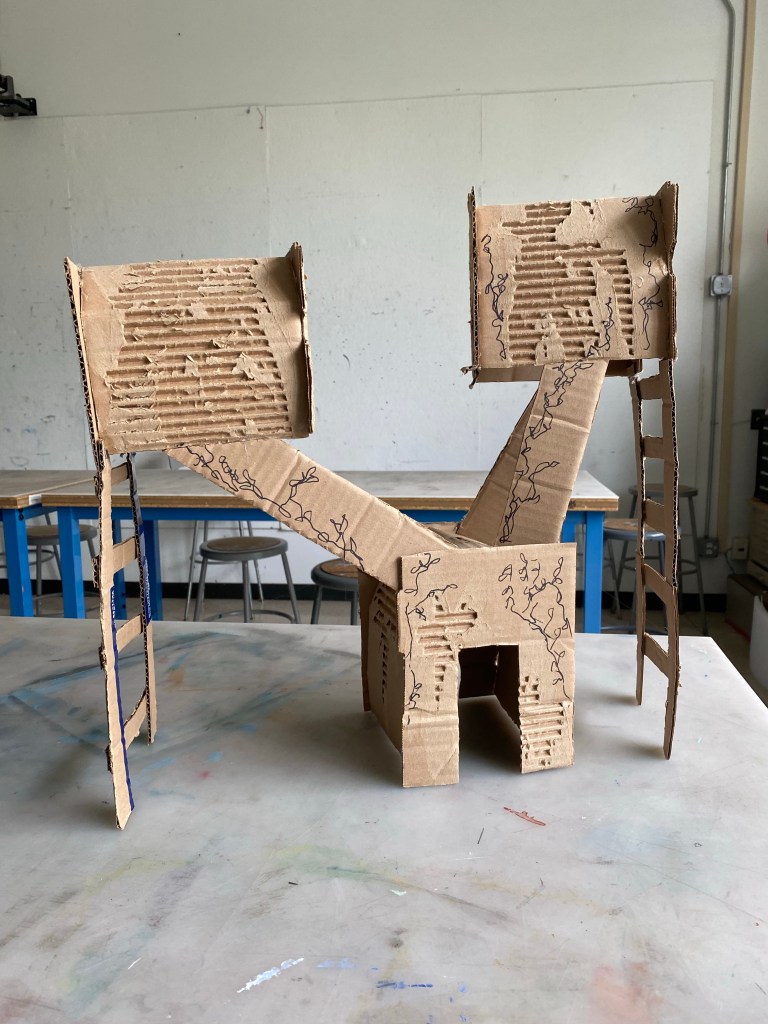
For my cardboard project I did not have an idea for what I wanted to do, so I started out deconstructing a box from the bin hoping that I would find inspiration at some point. While I was cutting, I noticed that the flaps that folded inside the box resembled a doorway so I used them to start to construct shelters. To meet the size requirements, I decided to put the shelter on stilts, attaching them to one another. They turned into tree houses and to make them seem worn out and overtaken by nature, I decided to distress them by tearing the cardboard to expose the ridges and draw on vines with black marker.

Tanya Aguiñiga

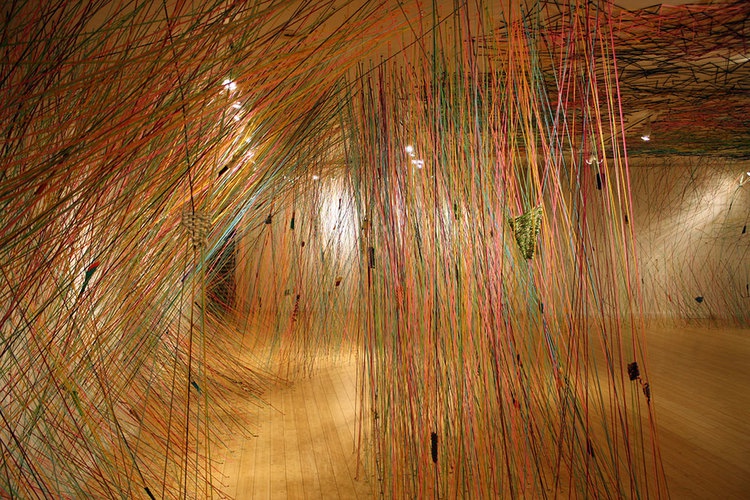
This final research post will be over the contemporary artist Tanya Aguiñiga who is well known for her distinctive approach to sculpture and textile art. Aguiñiga’s work is renowned for examining the connections between social justice, design, and craft. Her art is strongly influenced by her Mexican-American ethnicity and her experiences growing up on both sides of the US-Mexico border. She frequently employs traditional textile techniques from Mexico to produce expansive installations that deal with problems like environmental degradation, labor, and migration. The tactile texture of Aguiñiga’s art encourages the observer to interact with it on a sensory level. Aguiñiga is a community organizer and activist in addition to her artistic activity. In 1988, she assisted in establishing the Border Artists Workshop ‘Taller de Arte Fronterizo’ and has collaborated with multiple organizations that advocate for social justice and support immigrant rights. Aguiñiga’s work stands as a powerful example of how art can be used to address complex social and political issues.

http://www.tanyaaguiniga.com/exhibitions#/crossing-the-line/

Kara Walker

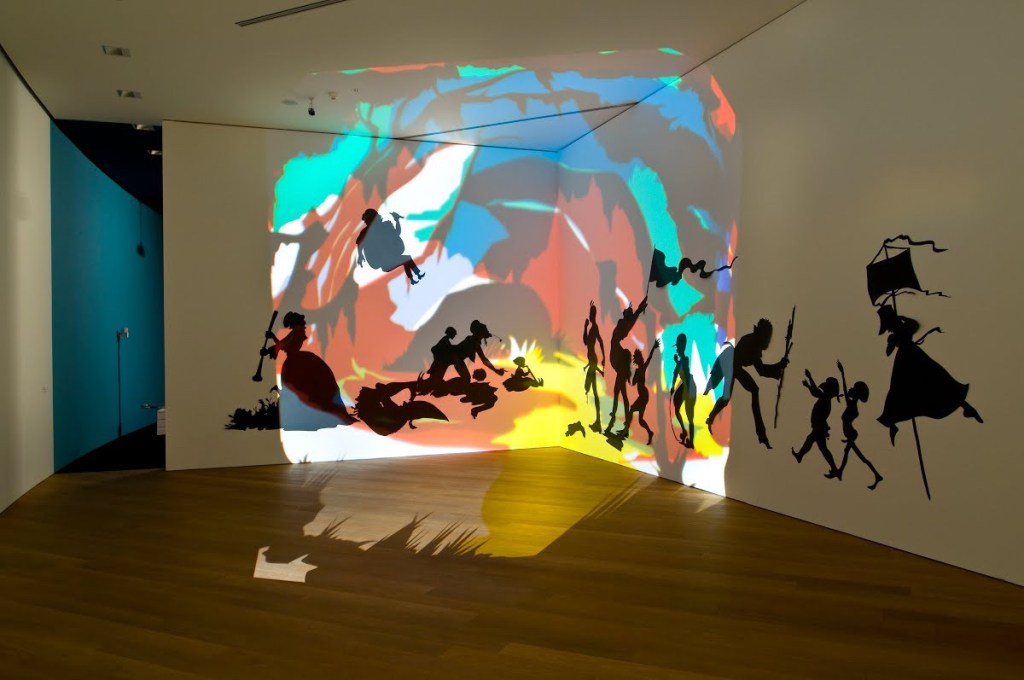
For my research post, I will be covering the American contemporary artist Kara Walker who explores themes of race, identity, gender, sexuality, and violence in her work. Walker works with a variety of mediums such as painting, installations, film, and printing, and is mostly known for her black cutout silhouettes that fill the space in a room. Walker’s work leads the audience through a critical understanding of the past by exposing the ongoing physiological damages that have been brought on by slavery and its tragic legacy. The first image I have included below is of Walker’s piece titled “Daytime Rebellion”, 2001. This piece includes a projection of colors and shapes being cast on the wall over her cutout silhouettes made from black construction paper. While the whimsical angles and decorative details may be the first thing the audience notices, the longer you stare you will realize the disturbing nature of the image dealing with themes of sexual subjection and violence. 

http://Kara Walker: Darkytown Rebellion, 2001
https://www.google.com/amp/s/www.mprnews.org/amp/story/2007/02/20/karawalker

Mathias Goeritz

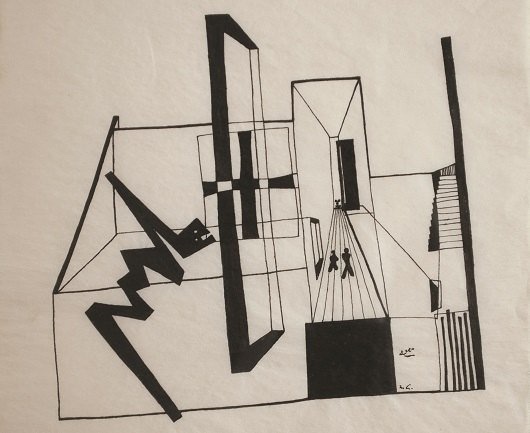
For this week, I will be covering the artist Mathias Goeritz. Goeritz was a sculptor, painter, and architect of German origin who immigrated to Mexico in the 1940’s where he was recognized as an abstract artist after his arrival. Goeritz integrated abstract forms into religious and civic structures which made a transformative impact on mid-century Mexican art and design. He founded the movement of emotional architecture and created massive concrete sculptures which established the conjunction of light, water, and color to highlight the senses and create new atmospheres. The purpose of these works were to incite sensations in the viewer through the use of space, shapes, and volume. Goeritz surpassed the emotionally practical and functional purpose of form by approaching his work with the relationship between art and spirituality in mind. Goeritz was commissioned to create a local entrepreneur’s vision of a cultural space for private purposes. Goeritz made this vision come to life by suppressing function and rationality which was unlike architecture and design at the time. The name for it was called “El Eco” and is considered a cornerstone in the modern art scene of Mexico. The last image I included is of his sketch of the space.

http://www.caareviews.org/reviews/2666#.ZBjoYSVOklQ
https://www.moma.org/collection/works/81856?artist_id=2203&page=1&sov_referrer=artist
https://www.museoreinasofia.es/en/activities/mathias-goeritz-activating-space-art-commotion

Bharti Kher

For this new week’s research post, I have chosen to cover the artist Bharti Kher. Bharti Kher is an artist who is at the center stage of the contemporary art scene in India. In the span of Kher’s nearly three-decade-long career, she has done paintings, sculptures, and installations that have explored the relationship between the body, its narrative, and the nature of things. Kher finds her inspiration from the history and philosophy of India and more so from mundane moments. Using a refined contemporary sensibility, the artist addresses topics of culture and tradition with the use of sentiment unique to India as well as an abundance of color. Kher is internationally known for her signature use of bindi in her works. She explains how most people see the bindi as either a symbol of marriage or aesthetic, but it is actually a representation of the third eye which forges a link between the spiritual world and the actual world. 

http://thirdtext.org/mukherji-bhartikher
https://www.saatchigallery.com/artist/bharti_kher
https://www.designboom.com/art/bindis-and-the-indian-artist-bharti-kher/

Line Installation

For this line installation project, my partner Leilanie and I decided to create a house. We wanted to create this house in a childlike manner by having the structure a bit whimsical with objects of what you would see in a house hanging down, mimicking mobiles in baby cribs. To create the structure of the house we took garden wire and put it through black rope. We each then created drawings of furniture, decorations, and other household objects, making sure to color on both sides so that they can still be seen when they rotate in the air.

Xu Bing

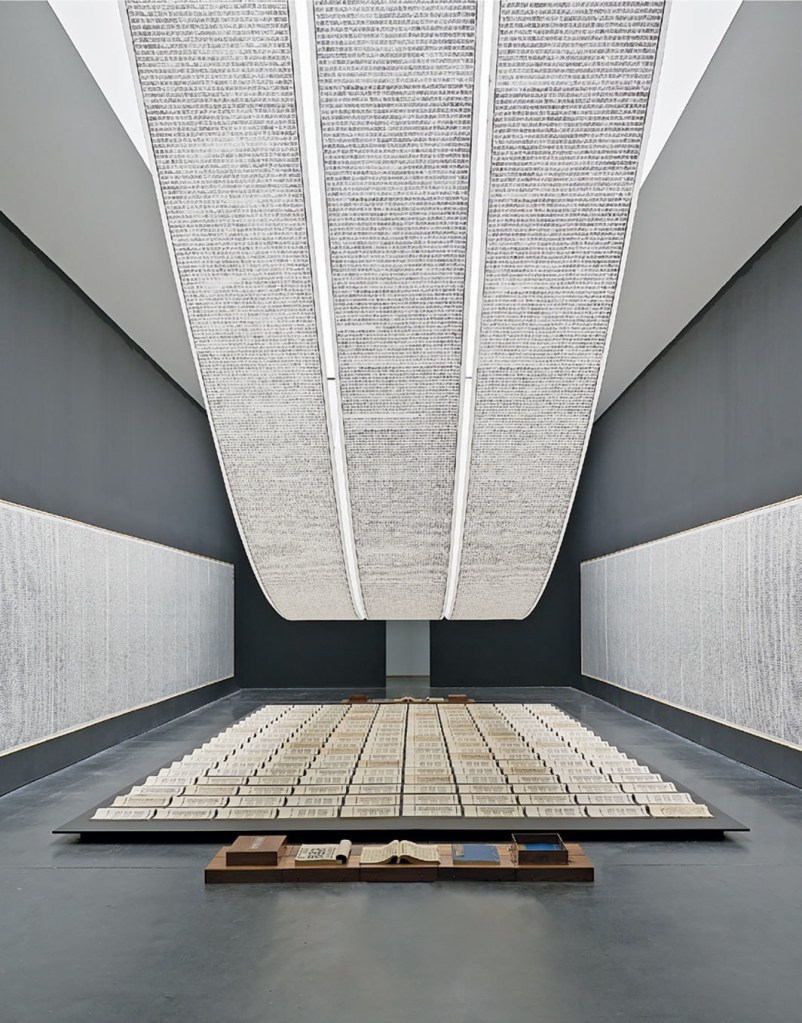
For this week’s research post, I have chosen to talk about the artist Xu Bing. Xu Bing is a pioneering Chinese contemporary artist who grew up in Beijing. Bing takes his fascination with visual and written languages to create his mix-media installations that deal with not only language but upending expectations and perception as well. Through his installations, the artist takes the audience on a journey that considers how cultural backgrounds, including those that have been shaped by language, are the foundations of how we view the world. Bing explains this link as the “cognitive structures of the mind”. The first image that I included below is of his installation titled “Book from the Sky” which was displayed at the Blanton Museum in Austin from June 2016 to January 2017. This piece has been exhibited globally, receiving praise for its provocative power and for its ability to engage the audience beyond its original context.

https://www.artforum.com/print/reviews/201809/xu-bing-77280
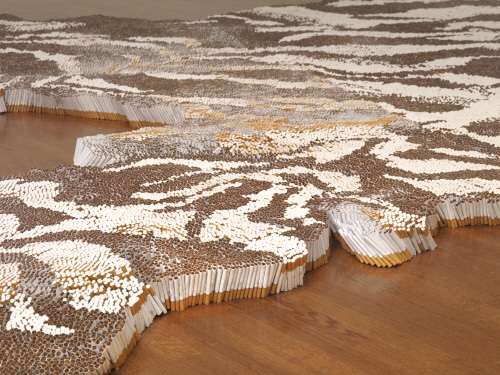
https://magazine.art21.org/2012/02/10/ink-contemplating-nicotine-xu-bings-tobacco-project/?amp=1

Sopheap Pich

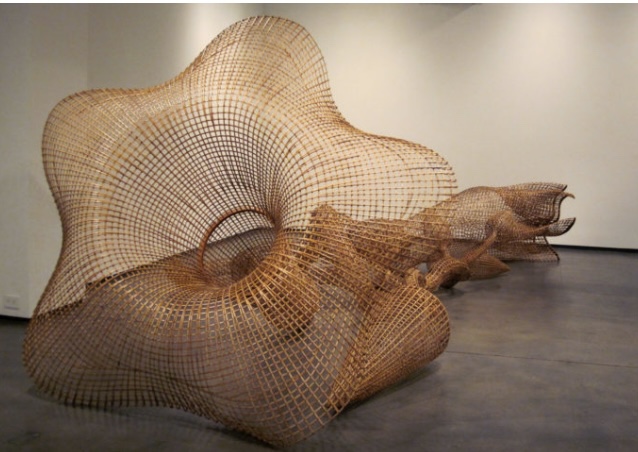
I chose this week’s research post to be about the Cambodian American contemporary artist Sopheap Pich. Towards the end of the Khmer Rouge’s reign in Cambodia, Sopheap Pich and his family fled the country and eventually immigrated to the United States. In the desire to reconnect with his childhood memories and experiences, Pich went back to the country in 2002. His sculptural practice is sculpted by the experiences he endured from the Vietnamese invasion and having to witness all of the devastations that come with war. Sourcing materials from rattan and bamboo as well as other indigenous sources, Pich creates three-dimensional objects which poetically simulate reconstruction. Pich’s art is the embodiment of his memories, culture, and place through both their medium and form. Rattan and bamboo are integral to everyday life in rural Southeast Asia, and the techniques that Pich uses to interweave the material are derived from Cambodia’s craft tradition. 

http://www.trfineart.com/artist/sopheap-pich/#artist-works