Individual Project

For my individual project I decided to make something that was hanging because I enjoyed making the earlier translucent assignment, so I wanted to explore making a larger version. Like with that project I wanted this one to also be monochromatic and blue. With the lines on each panel I wanted to play with the idea of something that felt like it flowed and and also was entangled which is why I chose to also use yarn that would hang and be bunched up on the floor.

I decided to have five panels total three with cyanotype and two that I would paint on. I later changed this so my final piece ended up having 2 cyanotype panels and three painted panels. Below is my initial sketch of the project.

The first thing that I did was research what fabrics work best with cyanotype and found that cotton is one of the better materials to use. From there I purchased the fabric and began experimenting with painting on the fabric. I used watered down acrylic paint to paint on the fabric. On these panels I also glued on yarn as more lines that would then hang down to the floor.
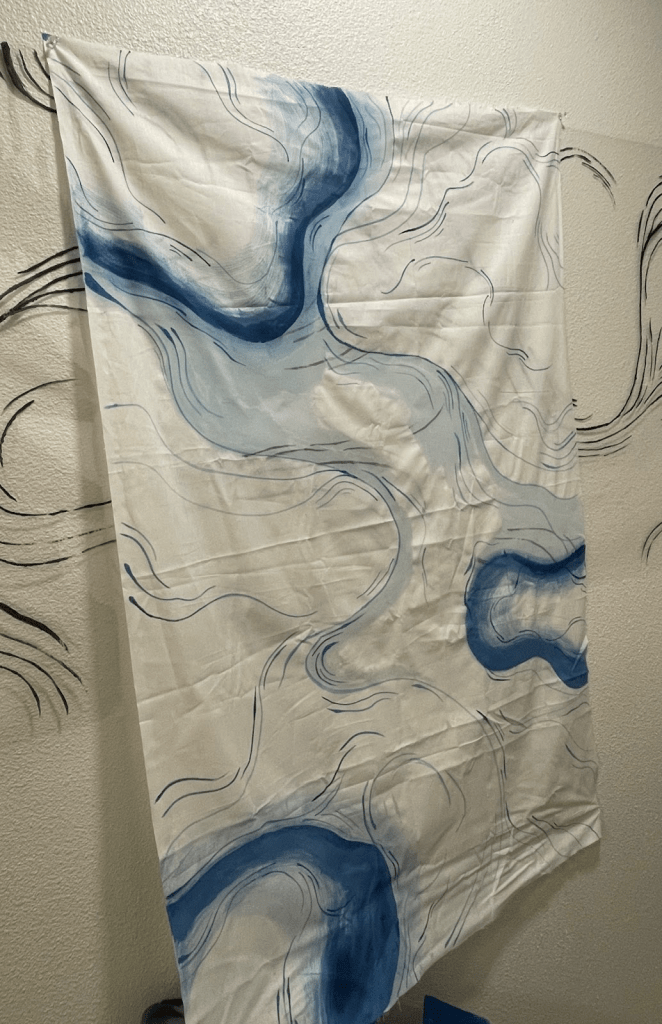
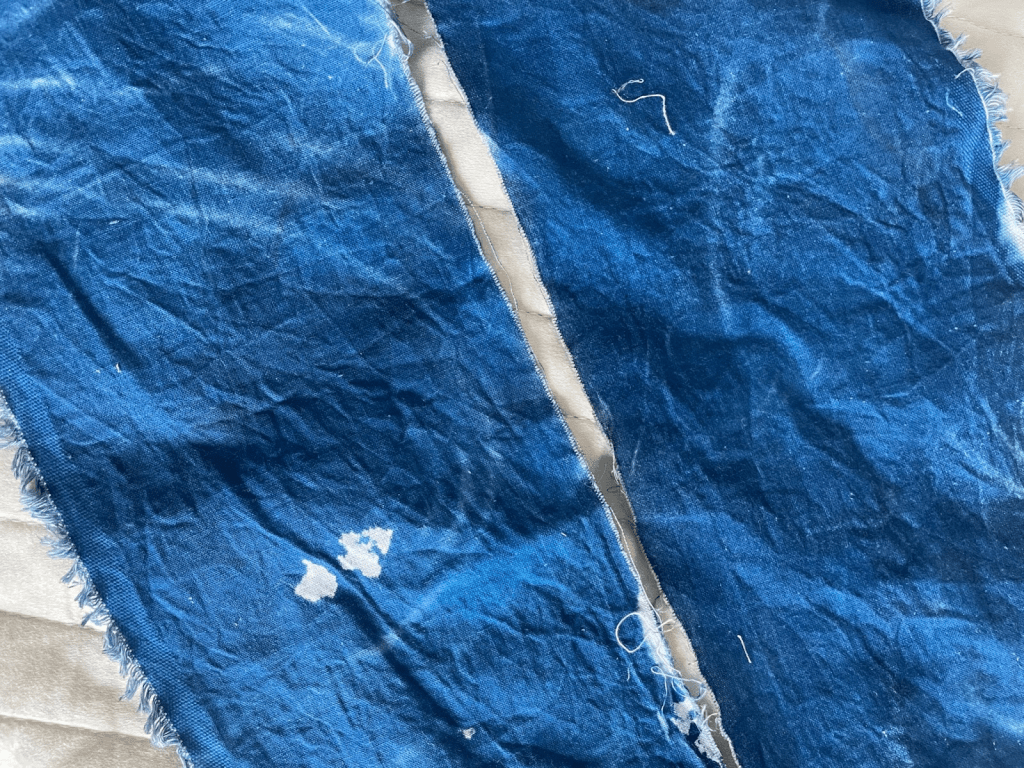
Before exposing my large cyanotype panels I started by doing a smaller test run.
I then moved on to the bigger panels, to make my negative that I would lay on top of the fabric when exposing it I painted on cellophane with acrylic paint.

After exposing rinsing and letting the panels dry there were parts of them that I didn’t feel like enough of the lines transferred so I used some white acrylic paint to fill in those areas.
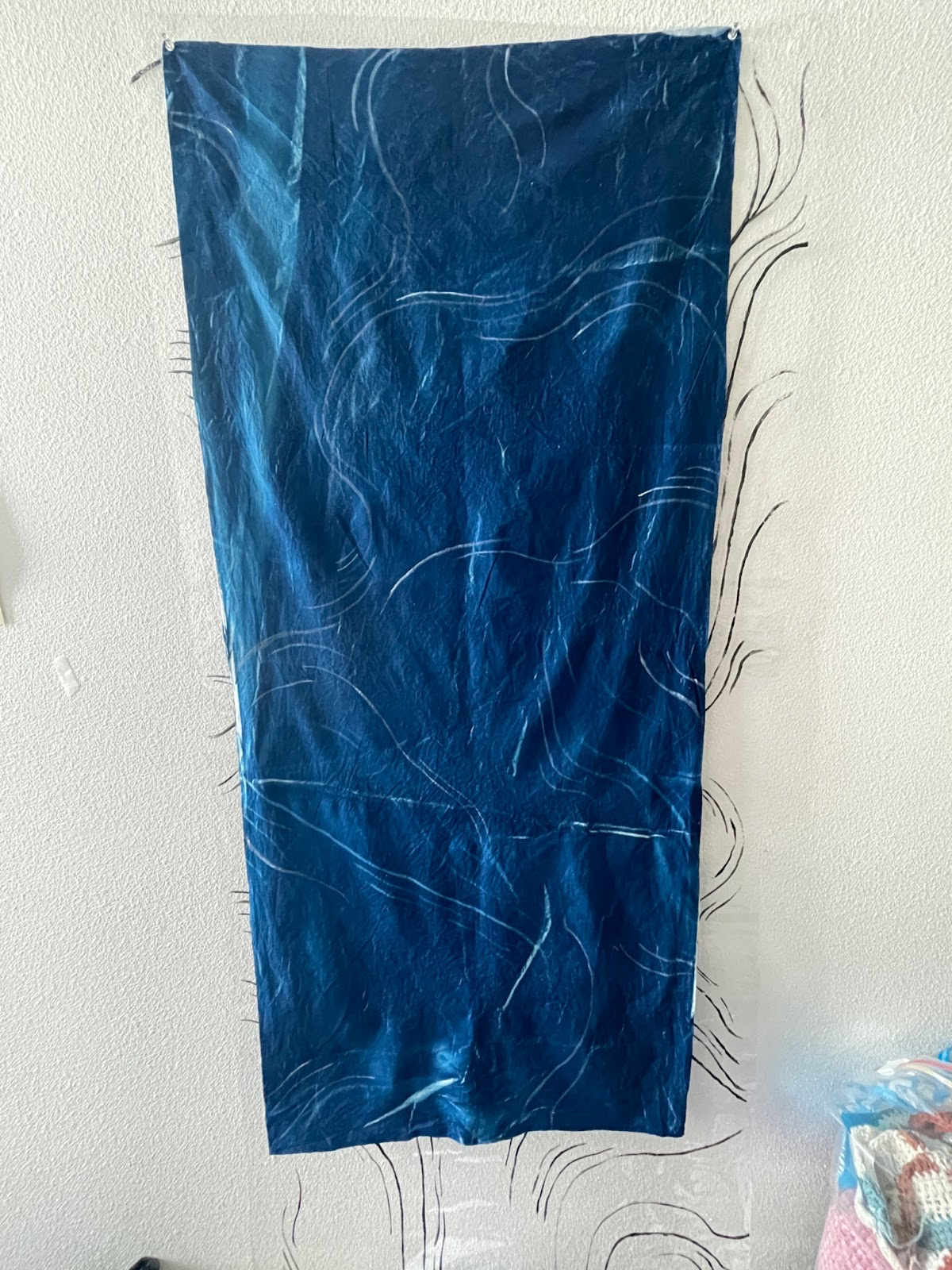
Once all the panels were finished I made a casing at the top of each one so that I could run a wooden dowel through to hang them. The wooden dowels each have screw eye hooks on each end to use fishing wire to hang them. 
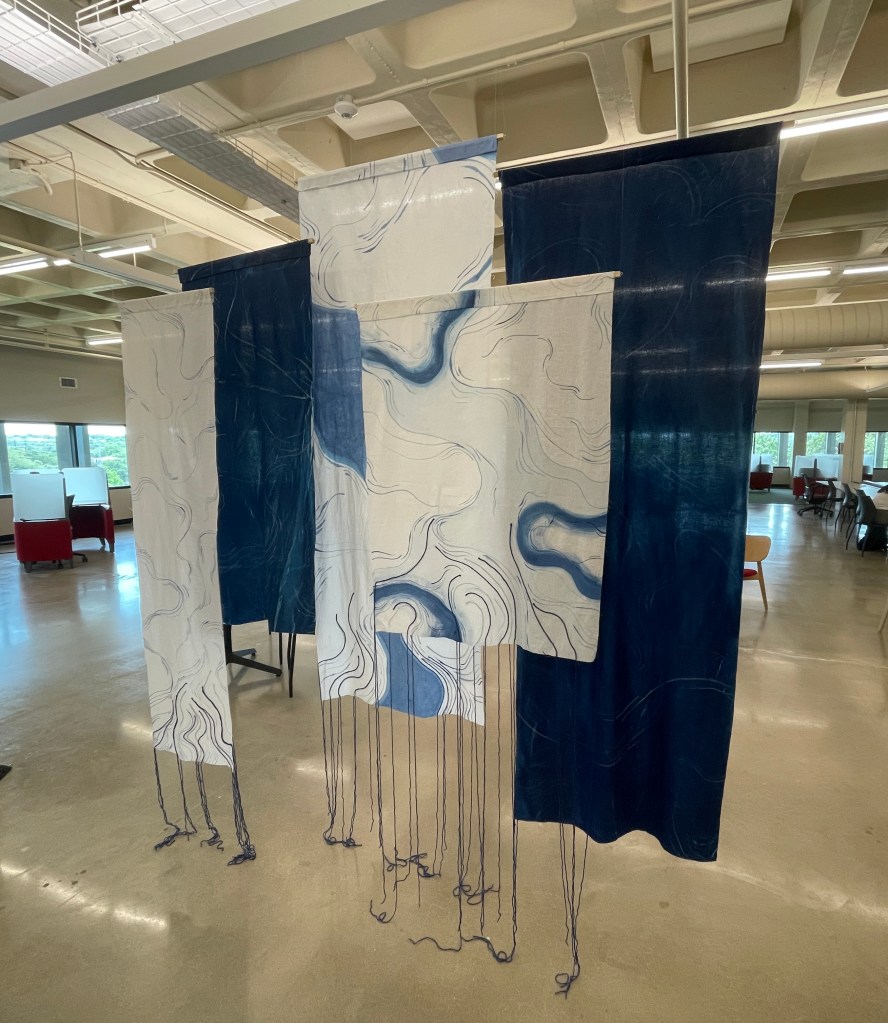
If I were to improve something about this project it would have been my approach to the cyanotypes a little differently. I would have purchased plexiglass so that I could have had my negative been compressed down on the fabric better I think then the lines would have come through stronger. Though with that said overall I really enjoyed working on this piece and am happy with how it came out. I explored drawing into space with this project with my use of lines, and more specifically using the yarn to have the lines come off of the panels into the space.
Group Project

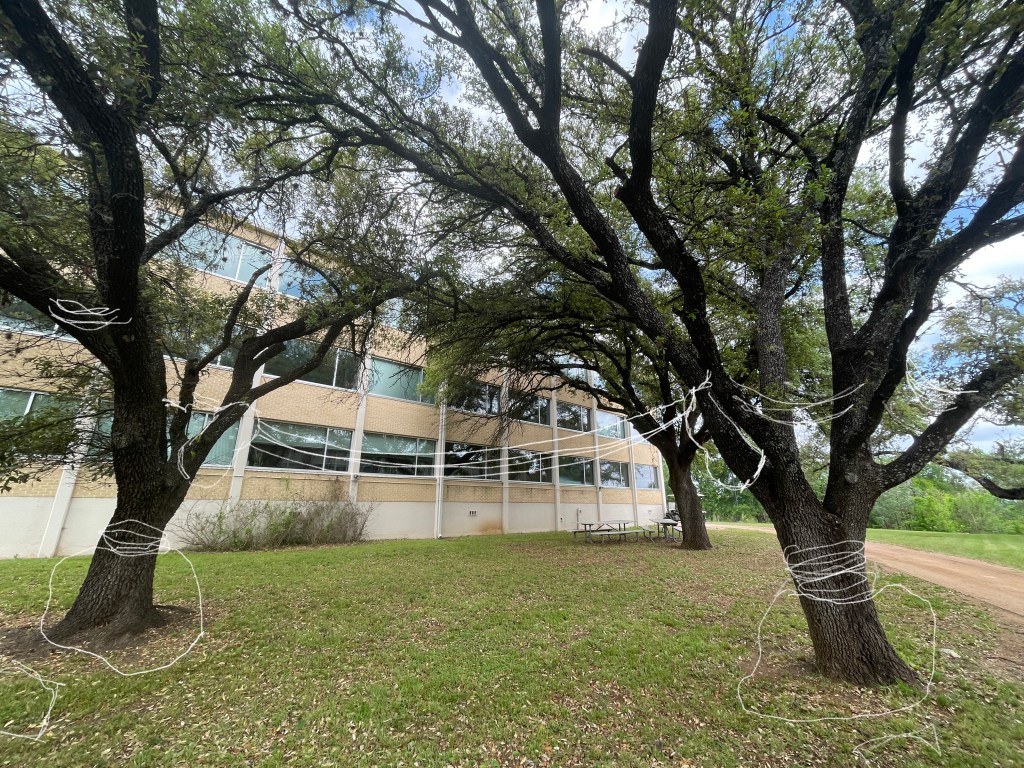
To start this project my group and I started out by scouting out a pair of trees that we would build our installation on. Once we decided on a location we took a picture of the site and brought it inside to make a rough sketch/plan before we started on the real thing. 

From there we began the process of wrapping each tree with yarn. We wanted to cover a good amount of each tree so that it would both be visible during the day and also be better off when it came to having blacklights pointed at them. We used bright neon yarn so that it would glow. After the trunks and branches of the tree were decently covered we began the process of connecting the trees with draped yarn. While some of us continued wrapping yarn others began to work on making the chicken wire forms that we would later attach to the tree.

Making these forms was probably the most challenging part of this process. I struggled to mold the chicken wire in the way I had originally planned. Because of this we had to move a little away from our original sketch and make the forms somewhat smaller. Once I shaped the forms my other group members began to spray paint them white. We did this so they would be more visible once attached to the tree and hopefully would also glow under the blacklight. After the forms dried we began the process of attaching them to the tree. Once attached I found that they didn’t have as much volume as I originally wanted them to so I decided to buy some white tulle that we would then put on the inside of each form.

Our final step was adding the string lights in the tree and also setting up the blacklights.

My contribution to the group was that I wrapped yarn on the trees and made the chicken wire forms.

Nike Savvas

Nike Savvas is a sculptor and installation artist from Australia though she is now based in London.  In her works she uses a variety of materials and varies greatly in scale. In the work seen below it is constructed using string and wood frames. In this series of work Savvas was inspired by the mathematical origins of art, to create the works she uses geometric formulas.

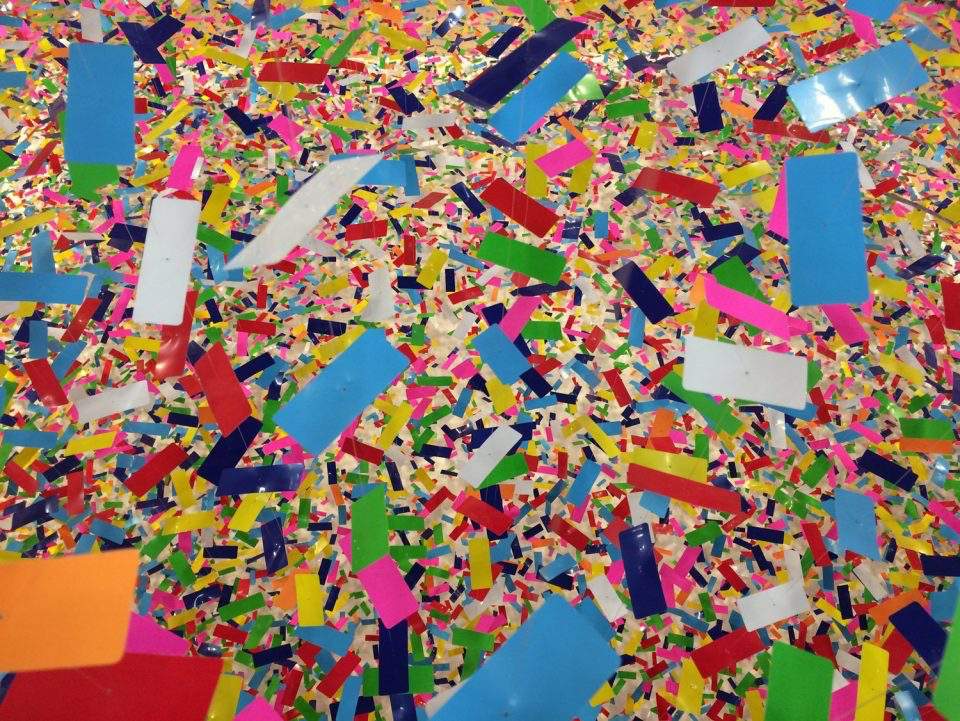
In her work she also enjoys playing with light and space. In another series of her work she uses pieces of colorful plastic and in another spheres strung together and installed into the space. Looking specifically at the installation using confetti like plastic, she has described it as a 3D painting. This is an interesting point to note because Savvas formal training is in painting. 

Nike Savvas – Finale: Bouquet, 2020, confetti, nylon wire, electric fans, installation view, Museum of New Zealand Te Papa Tongarewa, Wellington, New Zealand

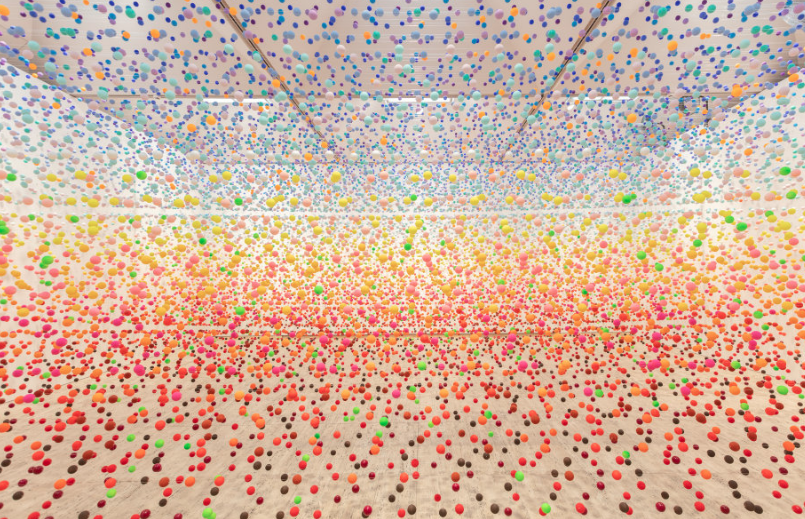
In this installation below it is created using spheres that have been strung on nylon and each side of the string attaches to the wall. Her intention with this work was for the spheres to represent the structure of any element. 

Atomic, full of love, full of wonder

Works Cited

https://ocula.com/artists/nike-savvas/

https://nikesavvas.com/about/

https://www.tepapa.govt.nz/discover-collections/read-watch-play/art/finale-bouquet/about-nike-savvas

https://artpattern.altervista.org/nike-savvas/https://www.mca.com.au/artists-works/artists/nike-savvas/

Tara Donavan

Tara Donavan is a sculptor and installation artist. She creates large-scale work using household objects, some examples being styrofoam cups, straws, buttons.

She has spoken about how her work somewhat mimics the ways of nature without becoming representative of anything specific. In fact she doesn’t give titles to most of her work so that she is able to make sure that it is able to exist without being associated with a specific idea that may not even be accurate. She wants everyone to have the opportunity to interpret the work differently. Below is an example of one of her works that has a title.

Tara Donovan, Colony, 2005, pencils, 4″ x 136″ x 113-1/2″ 

When creating she finds that what works best for her is to jump straight into experimenting with the materials and often doesn’t preplan or sketch. Something interesting to note is that while people often assume that she is trying to comment on the environment and mass production through her work though she has stated that that’s not her intention with her work.

Tara Donovan, Untitled, 2014, acrylic and adhesive, 10′ 1/2″ x 14′ 2″ x 12′ 10-3/4″ 

Works cited

Tara Donavan Interview: Sculpting everyday Materials

https://www.pacegallery.com/artists/tara-donovan/

https://ocula.com/artists/tara-donovan/

3D Cardboard Project

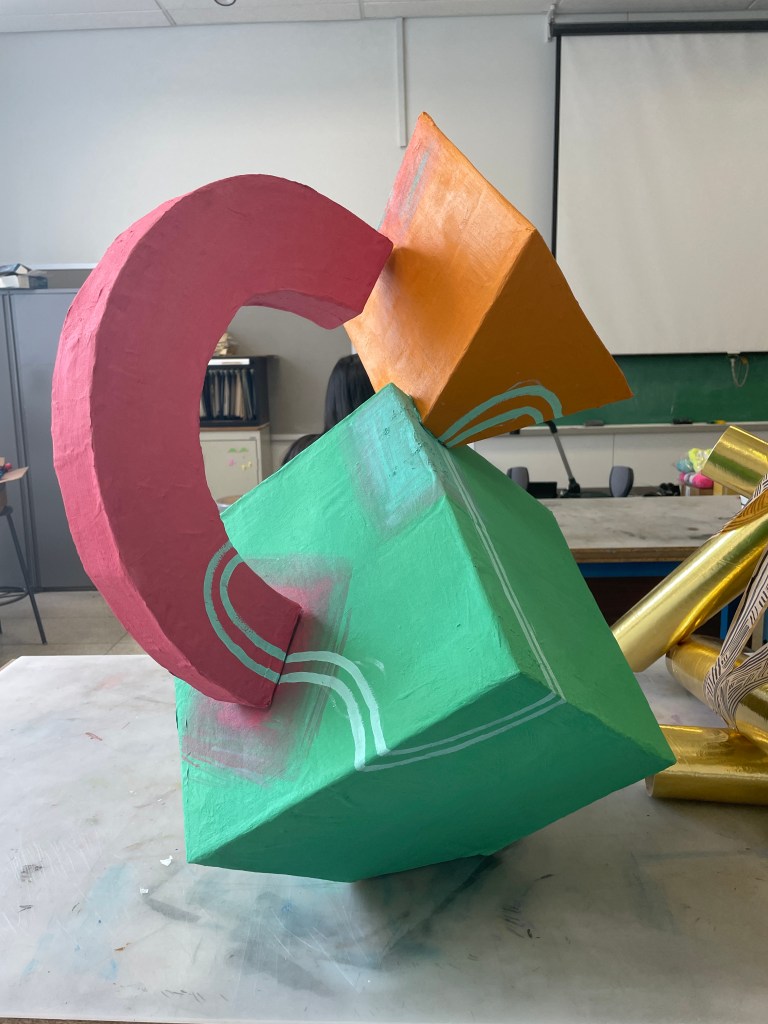
When starting this project the two things that I had in mind was color and balance. I wanted the sculpture to be sort of topsy-turvy. I first started by making the base cube of the sculpture and then cutting a corner of it so that it would be able to sit flat. I then began the process of making the triangular shape and cutting a slot in it that would allow it to sit on top of the cube. Finally I made an arch shape.
From there I began the process of covering the surface of each of the shapes. I put a layer of glue on each side of the shape and then placed a large sheet of paper on top of the glue ( a sort of quick version of paper mache). Once that was done and the glue dried I mixed acrylic paint and baking soda and painted each form.

The final step was assembling the pieces, during this process I had to make some adjustments so that the piece was still able to stand and one side wasn’t too heavy. After the shapes were assembled I painted a set of lines that would wrap around the entirety of the piece.

Dan Lam

Dan Lam is a sculptor who is originally from the Philippines, when she was young her family relocated to Texas. She received a BFA in fine art at the University of North Texas and a masters from Arizona state university. She currently lives and works in Texas.

In her work she uses polyurethane foam, resin,  pigments, and paint to create blob-like forms that appear to be dripping. She enjoys using bright colors and highlighting texture.  She works in a variety of sizes, some of her work small enough to fit on a phone case and some large enough to stand under. Lam has been in a number of group and solo shows. Her work is currently being installed in a branch of Meow Wolf, a business that creates large scale immersive installations, that is set to open in Grapevine Texas.

Lam considers her work something that feels that it has a connection to nature without being a direct representation. She has spoken about being interested in the idea of allowing people to decide what the work reminds them of. She enjoys hearing what people come up with because for her that means that she is doing well at pushing the boundaries of the medium used.

Works cited

https://www.maakemagazine.com/dan-lam

https://www.artsy.net/artist/dan-lam

https://bydanlam.com/

Lynda Draper

Lynda Draper is a ceramicist whose work pushes the limits of the medium. In her work often you will see narrow  tubular forms that have been described as drawing like. Draper studied education and ceramics at UNSW, she is currently head of ceramics at the National Art School.

Draper is quite process oriented, finding that her best works evolve as she works allowing herself to exist in an almost subconscious reverie as described by Sonia Legge in an article titled “Home and also somewhere else very far away: Lynda Draper”. Taking this into account draper often will only create preliminary sculptures when she is without clay. Looking at the construction of the work itself Draper uses a variety of enamels, glazes and lustres on the surface of works. To build the works she uses handbuilding techniques such as coiling and pinching. Due to the delicate nature of the forms that she creates she often builds directly on a shelf that can be placed in the kiln to be filed.

A final interesting aspect of Draper’s work is that she has spoken about how some of her work is brought about by memories/personal experiences. She has spoken specifically about how some of her works were brought about from revisiting her childhood home and how working on the pieces allowed her to confront objects of her past that were once distressing to her. This is interesting to know because her works and the shape and colors used in them evoke different emotions.

Sources

http://lyndadraper.com/bio.html

https://artistprofile.com.au/lynda-draper/
https://issuu.com/sullivanstrumpf/docs/summer_2020/s/11305982

Line Project

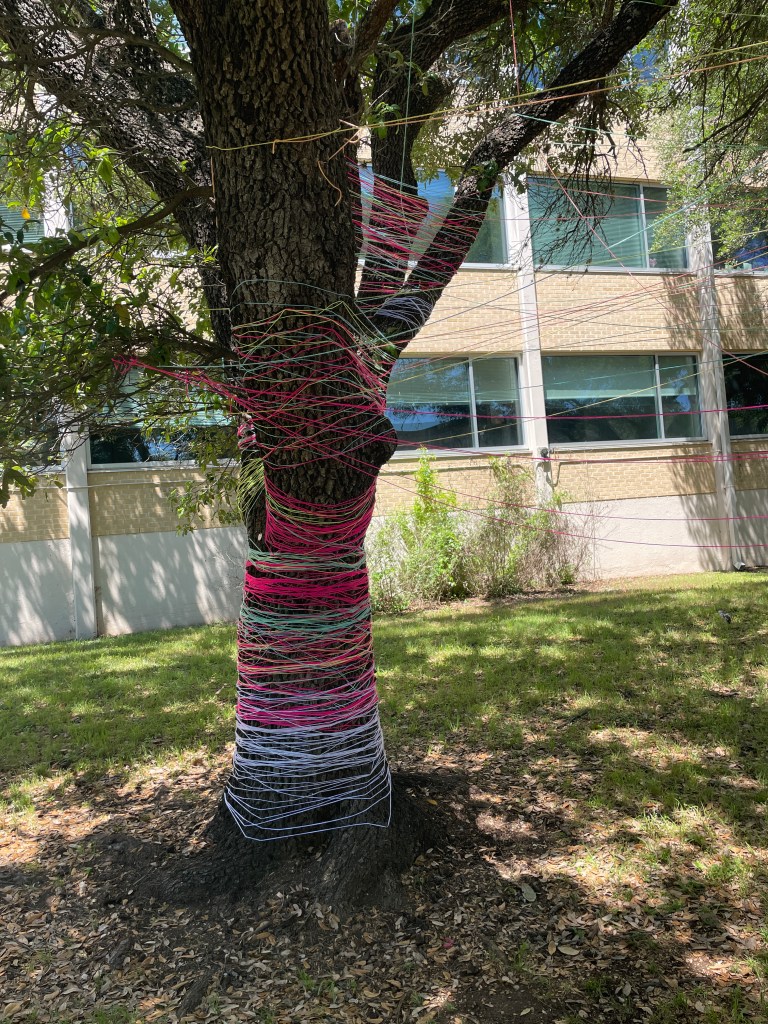
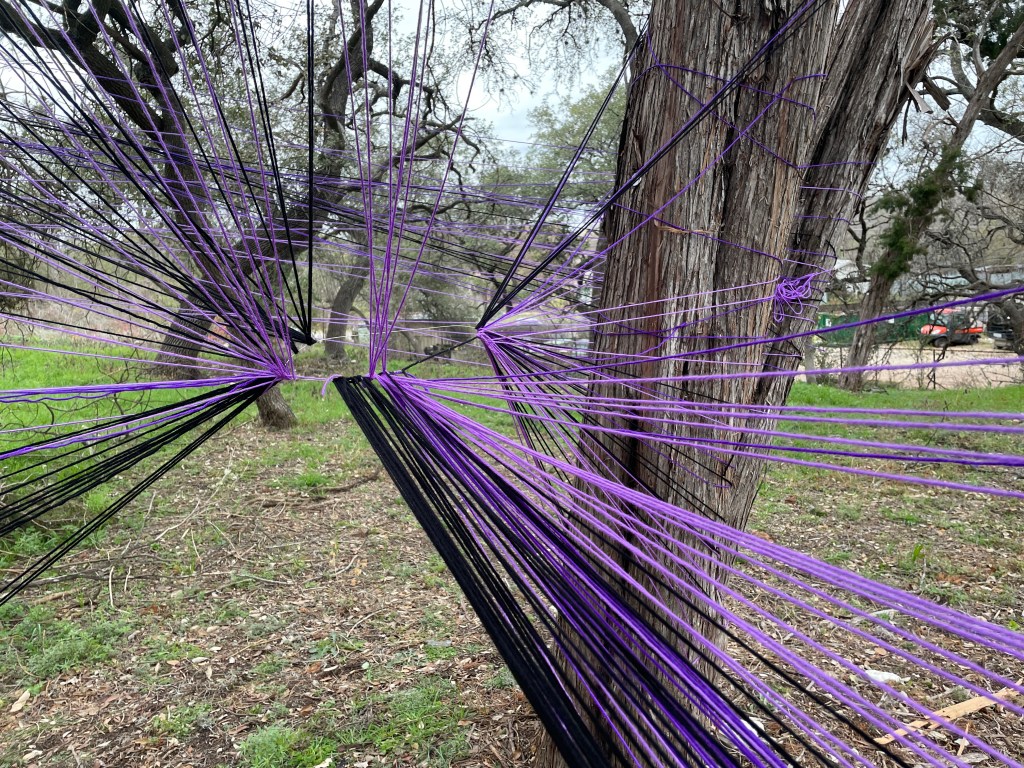
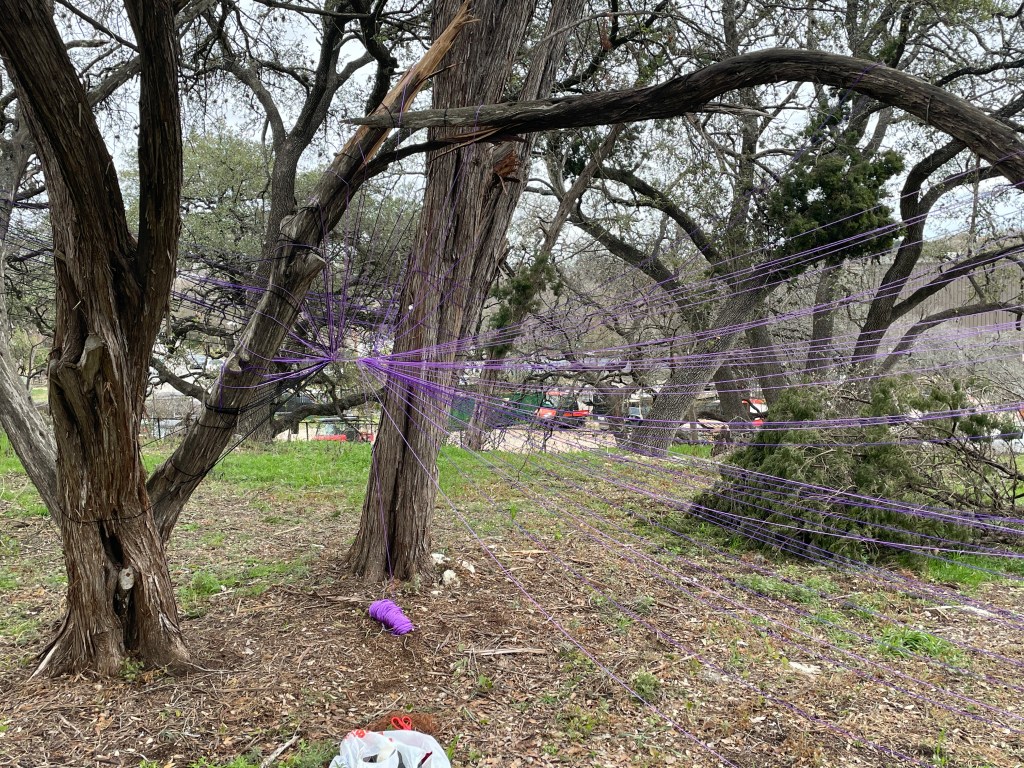
When beginning this project Clara and I talked about the works that we like best from a presentation show in class. We both really enjoyed the ones that were installed in nature. With that in mind we decided that we wanted to do something outside and use a tree in some way. Once we found our sight we started by brainstorming what colors of yarn we wanted to use and landed on using colors that would stand out from nature. We wanted to create a sort of portal between two trees. After gathering materials we began by first making a wire loop and tying it between the two trees and after starting to wrap the yarn. As we worked we started to expand from just wrapping on the two tree trunks. 

After working on it the first day it wasn’t standing out enough so we decided that we would get more yarn, specifically neon colors. Our primary strategy was to wrap as much yarn as we could because it made it more visible from afar. After returning from the weekend we found that the wire loop had broken and a good amount of the yarn had fallen. We decided to hang the yarn that had fallen on the broken branch above. We also decided to add more of the little knots we started to add the week prior. We also added some more yarn in areas that felt empty because of the fallen yarn. The final thing that we did was wrap black yarn around the center air loop so it was extra secure and acted as a central point for the piece.

Overall I really enjoyed the process of working on this project and ultimately think that it breaking made it more visually interesting with the contrast of the tight and more droopy yarn.

May Tveit

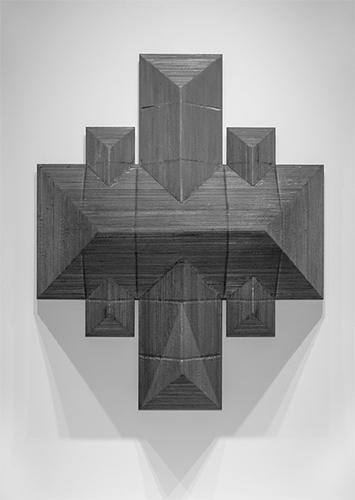
May Tveit is an artist that makes large sculpture and installation work. The work shown in the images below are specifically from a series Tveit created titled Universal Boxes. The medium of this work is cardboard. With this body of work Tveit wanted to explore the transformation of this everyday somewhat ignored material.

Her interest in cardboard began during a residency she completed at the Lawrence Paper company. During her time there the factory workers would make large sheets of cardboard for her which she would cut using their prototyping table.

While some may not believe that cardboard hols any special meaning as Tveit worked more with the medium she described that she began to think out it in a more metaphorical way. As cardboard is something that holds, protects, and transports things. Looking at this work you can see that there are numerous layers of flat cardboard that have been cut. Tveit has spoken about how her decision to work with flat pieces of cardboard is because she was intrigued when at the factory looking at the flat cardboard boxes because they had yet to fufill their purpose.

I enjoy how her work transforms the cardboard into a new sort of cleaner appearance where it also takes a second to realize what it is. It is also interesting to hear the concept and motivations behind the work.

Citations

https://www.kcur.org/arts-life/2018-01-05/working-in-magical-cardboard-a-kansas-artist-finds-herself-in-a-universal-box

https://www.maytveit.com/bio

Youtube: May Tveit – Universal Boxes

Gabriel Dawe

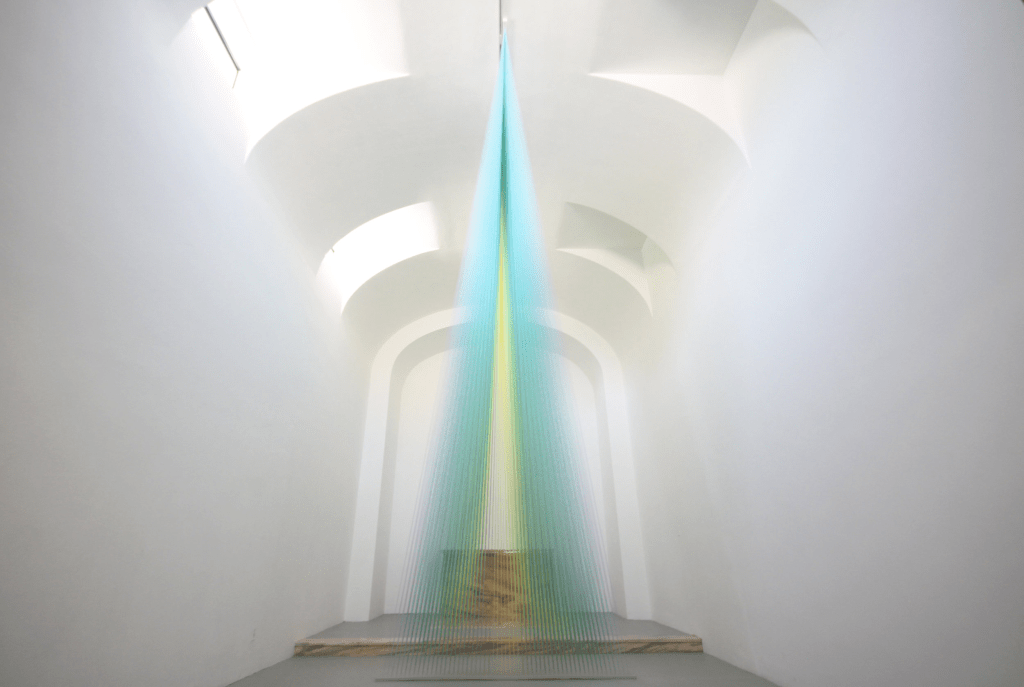
Using a variety of colored embroidery thread Gabriel Dawe creates installations that mimic the appearance of light. Dawe is from Mexico city and his work is heavily inspired by his childhood. As a young boy he watched his grandmother embroidery and showed an interest in it, unfortunately he was teased for this interest. Once grown Dawe went on to get a bachelor’s degree in Graphic design and after some years working in the field found he didn’t enjoy it much. He then decided to get his masters degree in Fine art from the University of Texas.

After getting his masters degree is when he began working with embroidery thread. In the early stages of working with embroidery floss he explored themes of his childhood and his frustrations he faced when his was younger. In his new workers as you can see in the images on this post he is working with rainbows. Often because of that people tend to assume that he is doing it to symbolize the LGBTQ community, Dawe has said that this is not his intention with the work. Instead he hopes to simply signify the feeling of light which is an idea that can feel unifying without making a tie to a specific community.

Citations

https://americanart.si.edu/exhibitions/wonder/online/gabriel-dawe