Inner-Twined

On top of the basic principles established in my first post on this project, as a group we were really able to build on our concept and develop its execution. We noticed that there was an increasing prominence of the theme of connection; there was the link between the six of us in our cooperation as well as literally through the connection of yarn from each of our pieces, to the union of dissimilar elements (two-dimensional space versus three-dimensional, personal and public space, representational subject matter and abstract, tangible versus intangible…) We decided on the name “Inner-Twined” for our piece as a play on the word “intertwined” to reflect these connections. (And also because yarn is kind of like twine, and they’re both fibers. So inner-TWINED. Get it?…)IMG_0414

Inner-Twined in early development.

Overall, I’m extremely pleased not only with the end result, but how we all managed to work together well. I feel privileged to have had the chance to work on exhibit before I graduated and with people who were as enthusiastic (or even more so) about the project as I was. I also really liked how the experimental quality of the projects over the course of the class still allowed us all to work in ways that were signature to our style and how we want our work to look as professional artists.

Spring Break Progression

It’s interesting how my contribution to our group’s concept was emphasis on the environment before figures were introduced, and yet mine is almost solely focused on the figure. I went with the first juxtaposition that popped into my head when we were proposing what we wanted to create on the drafting film once our group was settled and haven’t deviated much from it (the original thumbnail was improvised on the chalkboard, then translated into the pencil thumbnail from last post). I think the execution–a figure that is obviously me perched in bed with a ghostly gaze and hand clasped over my mouth with a laptop in front of me–stems from that I have the tendency to get myself worked up without ever leaving the house. Social media platforms and certain blogs can be a source of stress for me, and yet they’re a habit of mine that’s hard to quit.

IMG_0396

As much as I enjoy the end result, I can’t help but contemplate what it would have been like for me to do something more similar to my other group members’ more relaxed, dreamy portraits that featured things that made them happy. Then again, it probably would have been the exact same picture, only with a different expression, as I’d likely be playing a computer game (with my kitty cat sprawled out beside me and all).

Extension of Personal Spaces

Our project elements wound up being a combination of both mine and Morgan’s; her idea was to work with the figure and use yarn or string as a three-dimensional element to branch off into space, whereas mine was to use messy rooms or personal spaces as a highly-detailed still life on frosted mylar. From this, we developed a method of each of the six of us–Morgan, Ari, Rachel, Rebecca, Mollie, and myself–to include 1) a figure (or implied figure), 2) a bedroom or personal space, 3) ink and grease crayon on a frosted mylar surface, and 4) the use of yarn embroidery in the image that is meant to extend outward somehow.

My work in progress based on the initial thumbnail.

While the concept is a work in progress that we are continuing to develop, we consistently come back to the idea of a personal space/safe haven extending and branching outward into public space, done via a transition from two-dimensional media to three-dimensional. Each of the works is cohesive in our aforementioned “rules”, but remains reflections of the each of us and how we approach creating an artwork.


Repetition

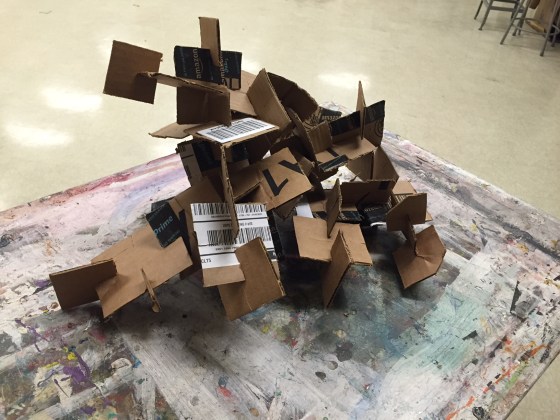
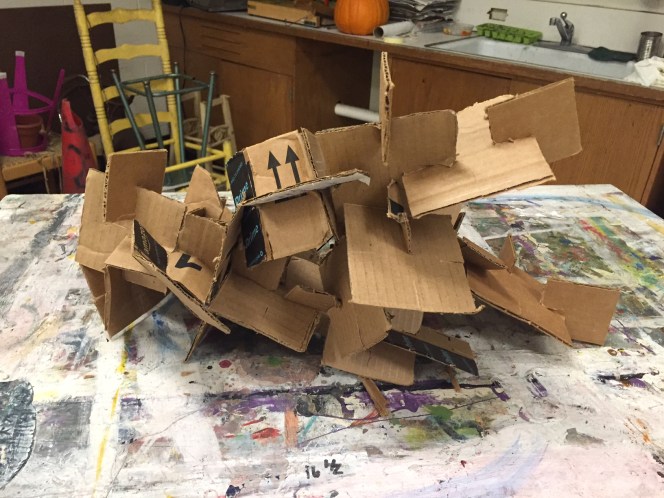
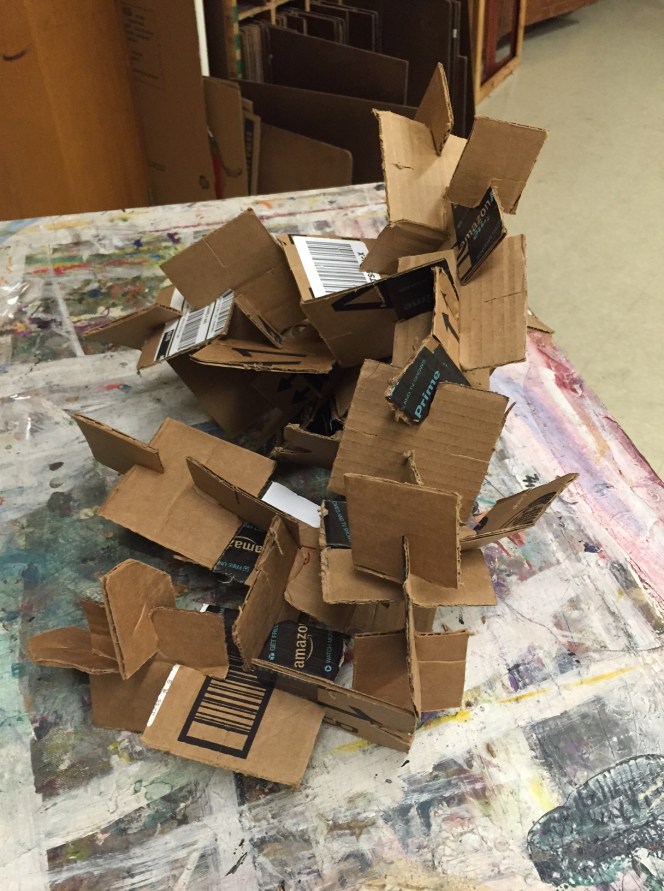
The cardboard sculpture assignment given was reminiscent of 3D-Design for me, both for its rudimentary materials and for the fact that I am bad at sculpting. With these in mind, I dove right into the project with time and objective in mind. In respect to basic foundations studios, I decided to go with the theme of repetition, a principle of art.

IMG_0316IMG_0318IMG_0317

This was completed by cutting up pieces of cardboard into uniformly-sized squares (that then began to include different-sized squares as well) and cutting slits into the sides of them. The squares were then configured together by using the slits to interlock them. As the pieces were imperfect and made for unequal distribution of weight, the sculpture had a fluidity to it that was flexible when moved and made for a varied, almost crystalline-like structure. Through this method, the sculpture could essentially go on and on by adding more pieces.

Stick Figures

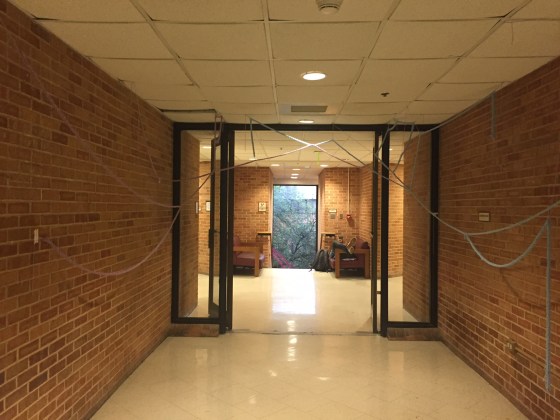
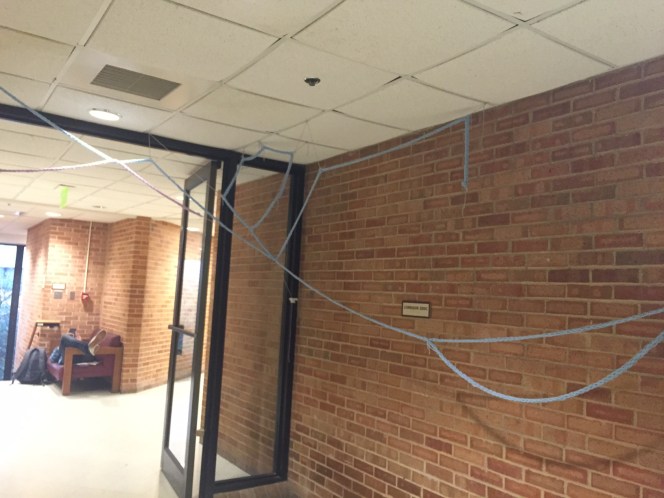
Ari and I constructed these stick figures in the second-floor hallway in Rowe as a group effort for our installation project. We played with the idea of figures occupying space, both of whom became interestingly warped and distorted as the project came to fruition. The subject matter was Ari’s idea, whereas their means of construction was mine.

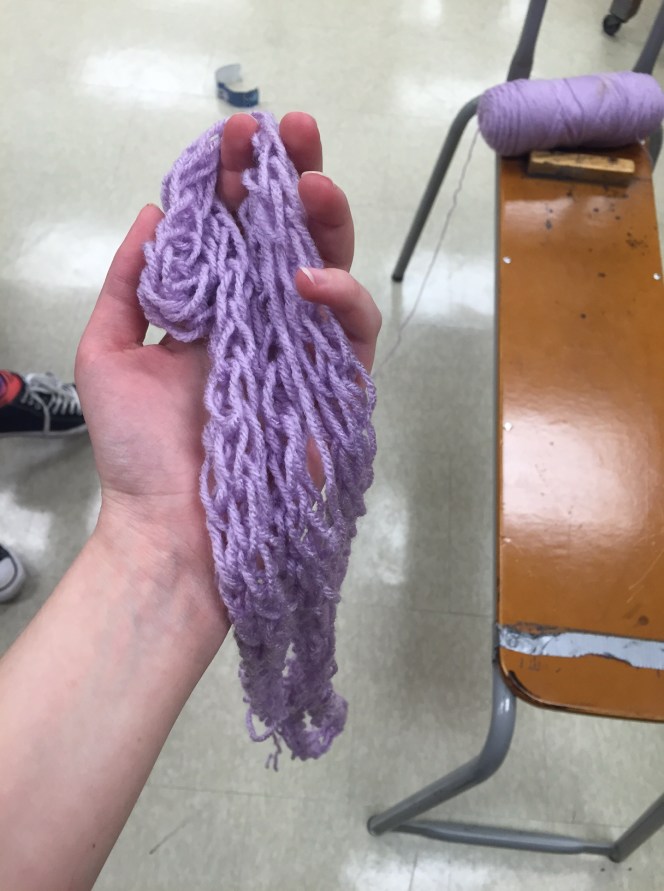
We used a process referred to as “finger-knitting” (or “finger-weaving”), which was essentially using our hands as a loom. This was easy to learn and efficient, allowing for us to quickly make colorful structures that were just thick enough to be viewed from afar.

IMG_0064IMG_0065

There seems to be a theme of having mysterious/imposing figurative sculptures throughout the Rowe building for various classes (such as the hand coming out of the ceiling and my own crocheted dolls, each from last semester for Fibers 1). The figures were intended to be standing, but we’d made them so big that we elected to have them float in the air. I think it makes for a nice effect in that their “imposing” nature may stem from taking up so much space in a narrow hall.

IMG_0103IMG_0102


Eske Rex’s “Drawing Machine”

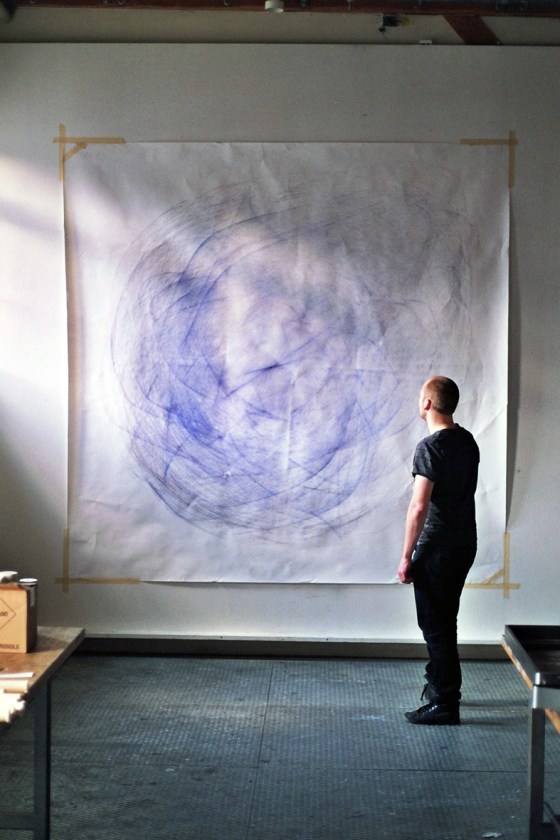
Eske Rex is a Copenhagen-based artist who explores the values of craft and design through his novel sculptures and installations. Most notable of his work is his “Drawing Machine”, a man-powered mechanism fitted with weights and pendulums that produces giant spirograph drawings. Rex aimed to analyze the potential for a machine to function as a sculpture and installation, and as an investigation into the relationship between time and movement.

Drawing Machine. Wood, metal, concrete, venyl, ballpen. 650 x 650 x 300 cm.

The drawing machine is constructed as two nine-foot tall pyramid-shaped pendulums that may be weighted to produce bigger or smaller circles. The structures are connected at a point where a ball-point pen is affixed atop a piece of paper; once triggered by hand, the pendulums begin to swing and continue to do so for however long each others’ kinetic energy lasts. The images produced can be up to nine by nine feet in size and, due to the nature of being powered by hand, no two images are alike.


Wöhlk, Nina. “On Rex’s Works In General.” 2015
http://www.eskerex.com/?page_id=1159

“Drawing Machine.” 3 October, 2009.
http://www.eskerex.com/?p=464

https://www.artsy.net/artist/eske-rex

Wendy Deschene’s Intervention

Canadian-born Wendy Deschene is a multi-media artist with an MFA from the Tyler School of Art and repertoire as an art activist. In response to  the constraints and limitations put on art displayed at traditional institutions and museums, Deschene has adopted an interventionist approach to linking the forces of the audience and artist as well as to critique the art world. A lot of this is accomplished through rogue means–such as installing artwork on the street or even within institution walls without permission–or, most notably, though community outreach.

She has initiated collaborative projects such as WYSISYG–“What You See Is What You Get”–that has toured to 11 different locations including the Art League of Houston, Minnesota State University, the Art Academy of Cincinnati, and The Henry Street Settlement in New York. WYSISYG is, essentially, a massive wall drawing with accompanying hanging frankensteins composed of old toys and stuffed animals. Members of the various communities would arrive to contribute to the wall drawing; the largest gathering was that of The Art Academy of Cincinanati, Ohio in 2006, which attracted not only students from surrounding colleges, but participants from the community as a whole, those from various other universities as well, and even an entire elementary school from the next state over. The purpose of the project was initially Deschene’s “personal exploration of cute, which [she] was using to parallel art history.” She pointed out the contradiction between the dangers of a grizzly bear and the fact that so many parents give teddy bears to their babies, as well as how an Impressionist painting that might have been considered obscene in it’s time now makes its way onto coffee mugs and other museum gift shop paraphernalia. Collaborators’ contributions of both drawings and materials are spun into a bizarre and spectacular art piece that varies by location in its size and contents, and seemingly-universal memories are spun and re-contextualized in a provocative way meant to garner a critical reaction from the audience.


http://www.2deschene.com/#!bio-cv/ccoo

WYSIWYG. “The Art Academy of Cincinnati, Ohio 2006.”
http://www.wysiwygexhibition.com/Cinncinati.html#14

http://www.wysiwygexhibition.com/Statement.html

Cannon, Elizabeth. Campus News FAU. “Art Questioning Art and/or Stuffed Animals Guts”. 17, February 2006.
http://www.wysiwygexhibition.com/Press_Blog/Entries/2006/2/17_Entry_1.html

Hew Locke’s “The Nameless”

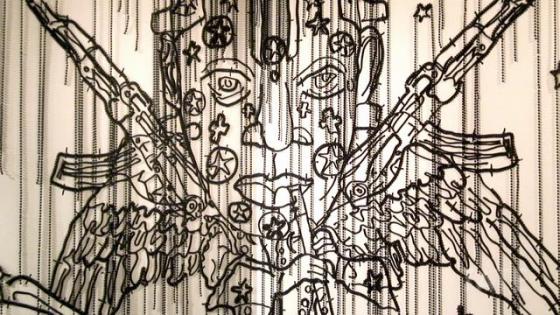
Hew Locke is a London-based, multimedia artist known for his wall-covering installations made from objects such as beads, cord, and tape. He received a B.A. in Fine Art in Falmouth and an M.A. in Sculpture at the Royal College of Art in London, and has won both a Paul Hamlyn and an East International Award.

The Nameless detail

The Nameless
2010, dimensions variable
Cord, plastic beads, glue gun, gaffer tape

According to Locke, the conception of The Nameless was executed in a way that was “out of necessity”. He couldn’t afford to ship over a large installation to an installation in Atlanta, so, instead, he approached the problem as having to fill up the walls. He made drawings that were then enlarged and applied to the walls, and then outlined them with cord and Halloween necklaces (that reflected his current budget. Though he states that the drawings themselves aren’t approached at a particular political angle, he did wish to reflect both of his English and Guyanese identities, and how the imagery of the two don’t necessarily “fit” together, yet persist to coexist as a mish-mash of cultures.

//players.brightcove.net/1854890877/4811b2e3-75b4-4489-b1a5-21a18a61075e_default/index.html


http://www.hewlocke.net/CV2ndsite.html

http://www.tate.org.uk/context-comment/video/tateshots-meet-artist-hew-locke 7 January 2010

“As If It Were Already Here” by Janet Echelman

Janet Echelman is a multimedia artist whose focus and experimentation on the other side of the globe led to some fascinating mastery of installation art. Specifically, it is her colorful nets that hang between buildings and/or in public spaces that capture attention and wonder. In addition to this notoriety, Echelman has been the recipient of multiple honors of public recognition, such as the Guggenheim Fellowship, the Harvard University Loeb Fellowship, a Fulbright Lectureship, and the Aspen Institute Crown Fellowship. She also conducted a TED talk–“Taking Imagination Seriously”–that has since been translated in 34 languages and has been viewed over a million times.

The installations–net-like sculptures woven from materials like polyester twine and polyethylene ropes–are designed to be strong yet effortless, and are suspended in place between rigid buildings as they respond to natural occurrences such as weather and sunlight. She was inspired to use nets as a new approach to volumetric, imposing sculptures after observing some local fisherman with their nets while in India during her Fulbright fellowship. After collaborating with these fisherman and hoisting the resulting sculptures on poles, she realized that the lightness of the material made capturing the subtle movements of the wind possible. In the installation, “As If It Were Already Here,” the construction of the strands of rope respond to differences between day–when it appears transparent and casts a shadow below it–and night–when it is illuminated and appears as a sheet billowing in the wind.

As If It Were Already Here Boston installation by Janet Echelman

As If It Were Already Here Boston installation by Janet Echelman

This particular work is a reflection of its Boston, Massachusetts location above the Rose Kennedy Greenway. The form of the sculpture is reminiscent of the hill that once stood on the now-flattened site, and the streams of color are a nod to the traffic lanes that used to be a feature on Boston’s elevated highways before being scrapped in favor of an underground highway in central Boston.

De Zeen Magazine. Janet Echelman creates aerial rope sculpture made of super strength fibers. 16, July 2015.

Janet Echelman Portfolio. “About” Section.


Do Ho Suh’s “Rubbing/Loving” and Thread Drawings

Do Ho Suh explores our theme of space through capturing an aspect of the term familiar to all–that is, living space–through intricate rubbings of his old New York apartment and North Korean locales. For his “Rubbing/Loving” project, he and several assistants performed the rubbings of walls, floors, and other surface areas on paper while blindfolded and with various media from graphite to conte. The papers were then arranged on wooden panels and constructed as an exact replicas of the rooms that museum-goers were free to walk through. The project’s namesake is a play on the fact that there are very little to no distinctions between the “r” and “l” or “b” and “v” consonants in the Korean language, so “rubbing” and “loving” come out sounding similar.

Do Ho Suh
Rubbing/Loving Project: Apartment A, 348 West 22nd Street, New York, NY 10011, USA, 2014
rubbing paper on wooden panels
dimensions variable

While the above example is of the artist’s apartment, Do Ho Suh also exhibited his contributions to the 9th Gwangju Biennale, “ROUNDTABLE” from 2012. Gwangju is located in South Korea, and the Gwangju Biennale is held in honor of a 1980 demonstration against an oppressive military regime. Although it was reported that 200 people were killed, an estimated 2,000 people is the reality, and it is this censorship that has motivated contemporary artists to hold the festival since 1995. The themes of the 2012 program were things relevant to the East Asian experience, such as isolation, migration, and “the relationship between group trauma, memory, and history”.

Do Ho Suh
Rubbing/Loving Project: Dormitory Room at Gwangju Catholic Lifelong Institute, 2012
colored pencil (cyan, magenta, yellow, black) on paper, wooden structure, video monitor and player and speaker
154.33 x 131.5 x 105.12 inches
392 x 334 x 267 cm
Commissioned by Gwangju Biennale 2012

This is one of the two projects he had displayed at his “Drawings” exhibition at both of Lehmann Maupin’s New York spaces. The other is a series of thread drawings (“experimental”, as Do Ho Suh refers) in various colors depicting organic and architectural forms. These were a result of the artist’s invitation to Singapore, a testament to his multinational exploits. Having been born in South Korea, been educated at both RISD and Yale, and beginning an artistic career in New York, Do Ho Suh has a focus in exploring his identity in the various spaces he occupies.

Do Ho Suh
My Country, 2014
thread, cotton, methylcellulose
11.5 x 14.5 inches
29.2 x 36.8 cm

Do Ho Suh
My Homes, 2014
thread, cotton, methylcellulose
18 x 24 inches
29.2 x 36.2 cm
frame: 22 x 28 inches
55.8 x 77.1 cm

Chu, Christie. VIDEO: Do Ho Suh Explains His Ethereal Rubbings. Wednesday, September 17, 2014.

http://universes-in-universe.org/eng/bien/gwangju_biennale/2012

http://universes-in-universe.org/eng/bien/gwangju_biennale/2012