Individual Project: La Vilaine Lumière

When starting this project, I had quite a large goal as to where I wanted to go with this project. I found inspiration from an interior designer, Jade Connor Design chandeliers. I had originally had this idea for a project proposal when we were starting our group projects and since it wasn’t used I figured this would be a great opportunity to do that project.

Initially, I wanted to have a tall floor lamp for my base structure however, GoodWill did not have one so I bought a regular table lamp and lamp shade for the base of my project. I completely took apart the lampshade so that I could start tying the yarn to it and create my piece. I then needed to find some yarn and I was really struggling to find a color and texture that I wanted to work with. I finally wandered into the clearance aisle at Hobby Lobby and found what I deemed the perfect reel of yarn for this specific project.

I knew I wanted to use layering as an aspect of my lamp but was not sure to what degree I wanted to use it. I went back and forth as to how I would layer and tie the yarn to make it interesting. I finally just started to cut two different lengths of yarn and tied them around the lamp structure with a pattern as to where the yarn would be tied. Once I had tied everything on and around the piece as a whole, I felt as though it was missing something so, I added another layer of yarn that was longer which kind of emulates the look of a jellyfish.

The final product of my project is interesting. I think that if I added another material, potentially grey pearls it would look really cool. The budget was really starting to come after me so I opted not to do that. Given how much money I was allocating to this project I feel as though it turned out well.

Progress Photo: almost done with the project
The Final Piece on display in the gallery

Team Project

Before starting our team projects, each student presented their idea and as a class, we voted and narrowed it down to a few projects so that everyone could choose which group they wanted to be a part of. The project I presented was not chosen as a group project which worked out to my benefit as I could then use my project proposal for my final individual project. That being said I joined a group that I had not worked with anyone in the group prior to this project which I thought would be good for me. While doing a project I let everyone else take the lead and I just was a little taskmaster.

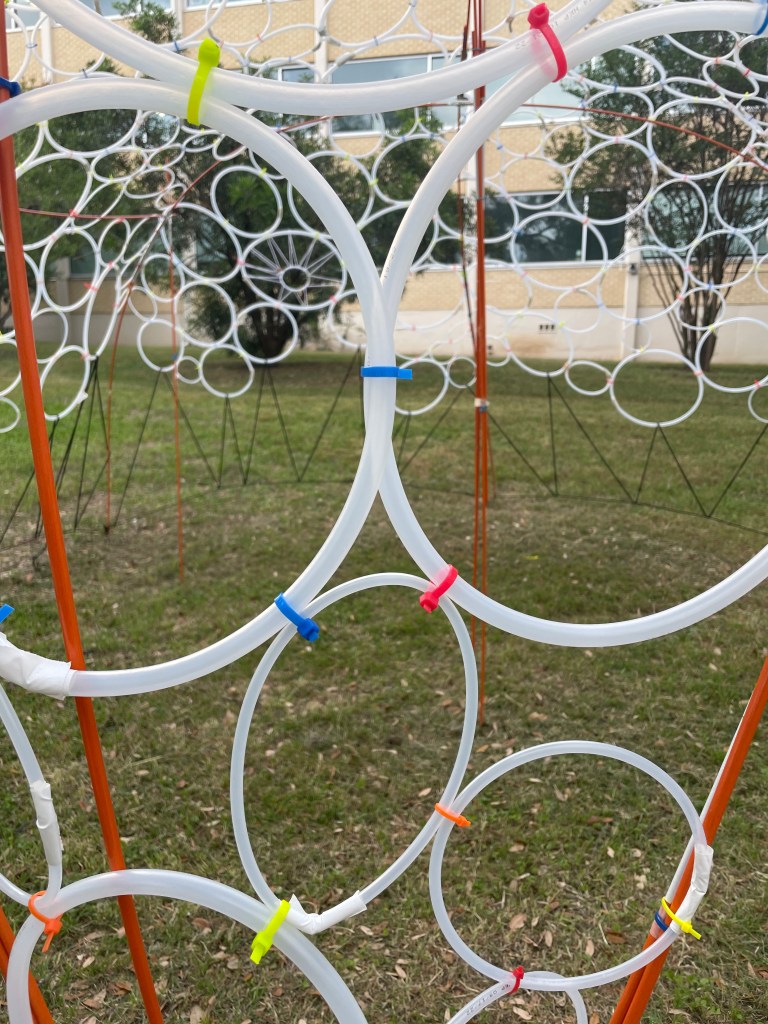
Originally, we started by creating a structure out of tall orange reflective steaks in the ground. We connected these by using bright colorful zip ties. From here we were trying to come up with something that would hold up with the outdoor elements so we created circles out of clear plastic tubing of various sizes. We used white duck tape to seal off the circles and then used bright neon-colored zip ties to connect the circles to then create a blanket-like structure to drape over the top of our foundation made by the steaks.

I think that this project turned out to be very interesting looking. The color zip ties I feel made the piece look much cooler. Without these colors, I feel that the project would be entirely different.

The process of creating the circles.
The final piece/
The colorful zip ties.

Cardboard 3D Sculpture

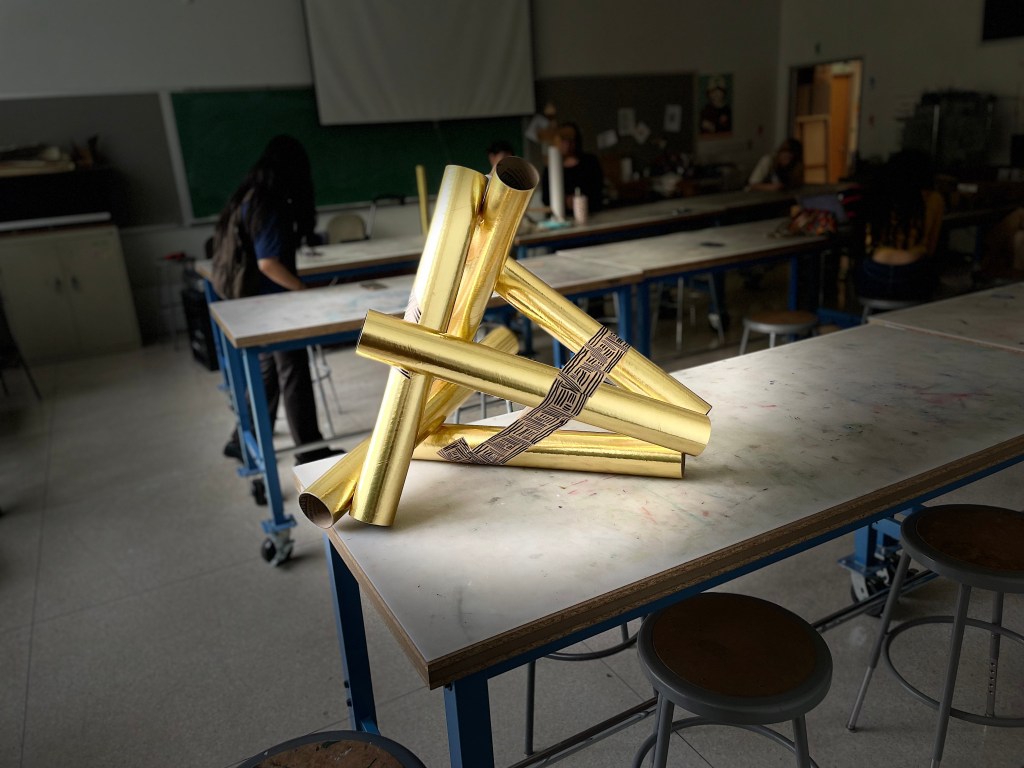
When this project was first introduced I was struggling to find inspiration for what I should create. Hollis brought in a basket of cardboard that we could choose from to create our piece. I came across quite a few cardboard tubes that had a gold foil finish to them which I found to be an interesting material to use for my project.

Once I gathered my materials I wanted to create a piece that was based on my favorite shape a triangle. With that being said, I started to create an abstract sculpture that I found visually appealing. I started with a tee-pee shape of three gold tubes. From there I knew there needed to be something else with the piece so, I added a triangle at the bottom of the original shape to create a chandelier-like sculpture. I got to the end and needed to incorporate drawing in some aspect. I used tape that is the same color as traditional cardboard and I took a sharpie and started drawing lines in different directions to create a pattern incorporating drawing and then draped the tape across the piece.

Roy Lichtenstein

Roy Fox Lichtenstein was born on October 29, 1923, in New York City, New York. His mom was a homemaker and his dad was a real estate broker. He was born into an upper-middle-class both German and Jewish family. When he was finishing up his high school career he applied to take summer classes at the Art Students League of New York where he studied under Reginald Marsh.

After graduating Lichtenstein took his talents to the Ohio State University where he studied fine arts however he didn’t stay there long. He was called to be in World War II from 1943 to 1946. Post-war, he went back to studying, this time with the supervision of Hoyt L. Sherman to which Roy later donated money for the art center to be named after him at Ohio State. Roy received his Master of Fine Arts from Ohio State University in 1949.

Once he got his degree, Roy started to truly make his art. Lichtenstein’s first solo exhibition at the Carlebach Gallery in New York. From this point forward, Roy Lichtenstein worked heavily in cubism, expressionism, and pop art in one point even started to incorporate mickey mouse and bugs bunny hidden in his work. He completed many paintings and sculptures throughout his career. On September 29, 1997, Roy Lichtenstein passed away at the New York University Medical Center with pneumonia just weeks before his 74th birthday. 

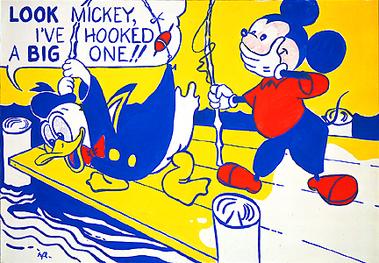
Look Mickey, 1961 with oil paints on a canvas, located at the National Gallery of Art in Washington D.C.
Cap de Barcelona, 1992 multimedia sculpture, located in Barcelona, Spain.

Gustave Eiffel

Gustave Eiffel was born Alexandre Gustave Bronickhausen dit Eiffel on December 15, 1832, in Dijon, Burgundy, France with his parents migrating from Germany before Gustave was born. Eiffel was a very studious student all through his upbringing, he attended college or university at École Centrale des Arts et Manufactures in which he studied chemistry. 

After he finished his education, Eiffel went to work on a railroad engineering project for his first primary paid job. He then went to work on a railway bridge in Bordeaux, France. His most notable work was the Eiffel Tour located in Paris, France which has now become one of Paris’ most prominent tourist attractions. The construction of this structure was started in 1887 and was completed in 1889 in time for the Word’s Fair which was being hosted in Paris that year. Gustave Eiffel died on December 27, 1913, while listening to some Beethoven and was buried in his family’s tomb located northwest of Paris, France.

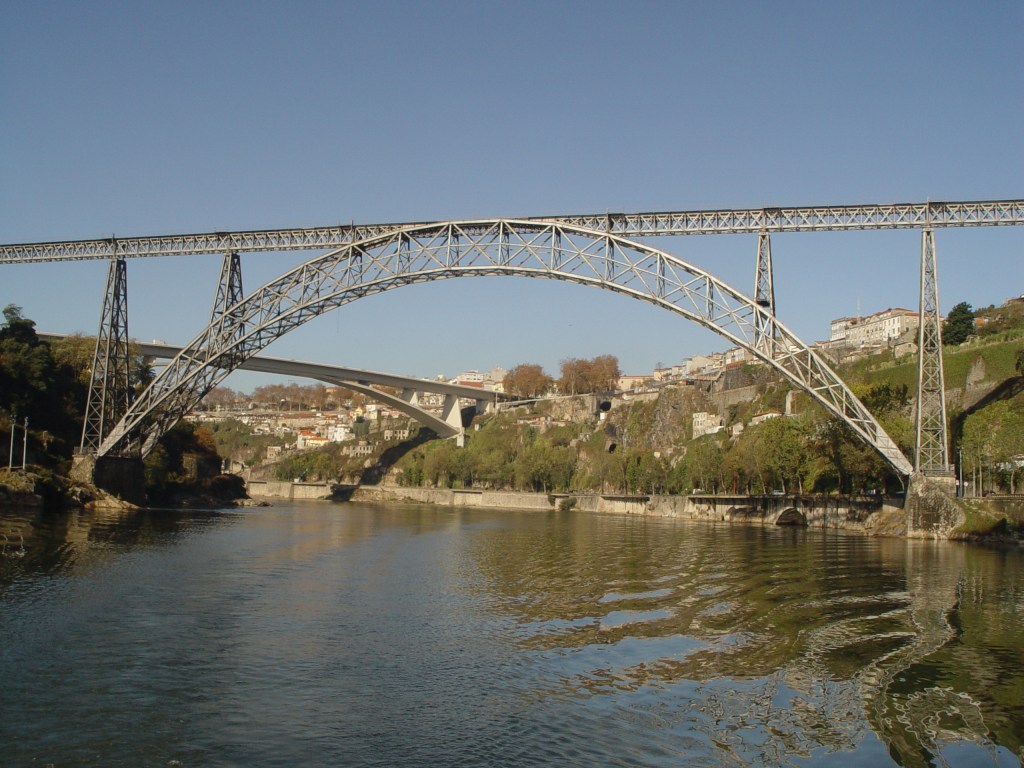
Maria Pia bridge completed in 1877, is located in Douro, Portugal
Eiffel Tower completed in 1889, is Located in Paris, France

Franz West

Franz West was born on February 16, 1947, in Vienna, Austria. His father was a coal dealer while his mother was a dentist who had an interest in art herself. His mother would travel to go view different works of art, especially those in Italy. Even though he had been around art his whole life due to his mother’s interests he didn’t begin to study art with intent until his twenties. 

West began his studies of art in 1977 at the age of 30 at the Academy of Fine Arts Vienna under the direction of the modern artist, Bruno Gironcoli. He first started out with drawing and moved to paint shortly after. Eventually, Franz moved to sculpture where he found the most success in his career. Materials that he would use were, paper-mache, aluminum, wire, and so many other materials. From the 1980s until his passing, on July 25, 2012, he worked on his sculptures and today can be found at the Museum of Applied Arts, Vienna located in Vienna, Austria.

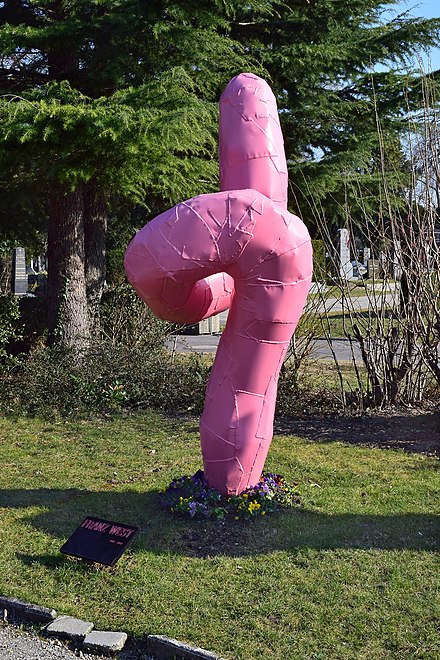
Grave of Honor of Franz West at Zentralfriedhof, Vienna, a cemetery in Vienna, Austria.
Lemurenkopf, 2001, Stubenbrücke, Vienna, Austria, near the Museum of Applied Arts

El Greco

El Greco was born, Domenikos Theotokopoulos on the island of Crete located in Greece on October 1, 1541. His father was a tax collector and there is not much information out there about his mother. Theotokopoulos’s brother was a merchant who did pretty well for himself however he spent the last few years of his life living with his brother.

He went to Cretan School where he studied various types of art. A main focus of study for him during this time was Post-Byzantine Art as well as classics and ancient greek art. Around 1567 he left to pursue an art career in Venice, Italy but soon after moving there, he moved to Rome, Italy. In 1577 he left Italy and moved to Spain where he spent the majority of his life and where he died. He moved to Toledo, Spain where he completed nine paintings for the church of Santa Domingo one of which was The Assumption of the Virgin. Soon after he had done some commission pieces for the king of Spain, King Phillip II. 

From 1597 to 1607 El Greco experienced great success. During this time he painted in the styles of, painting, sculpture, and architecture while later being known for his contributions to Mannerism and the Spanish Renaissance movements. He died soon after this increase in artwork on April 7, 1614, in Toledo, Spain, and was buried at the church for which he did many paintings for.

The Assumption of the Virgin was painted with oil paints from 1577-1579 in Toledo, Spain. You can now find it at the Art Institute of Chicago in Chicago, Illinois.
View of Toledo painted with oil paint on a canvas during 1596-1600 in Toledo, Spain. You can now find this painting at the Metropolitan Museum of Art in New York City, New York.

Line Installation

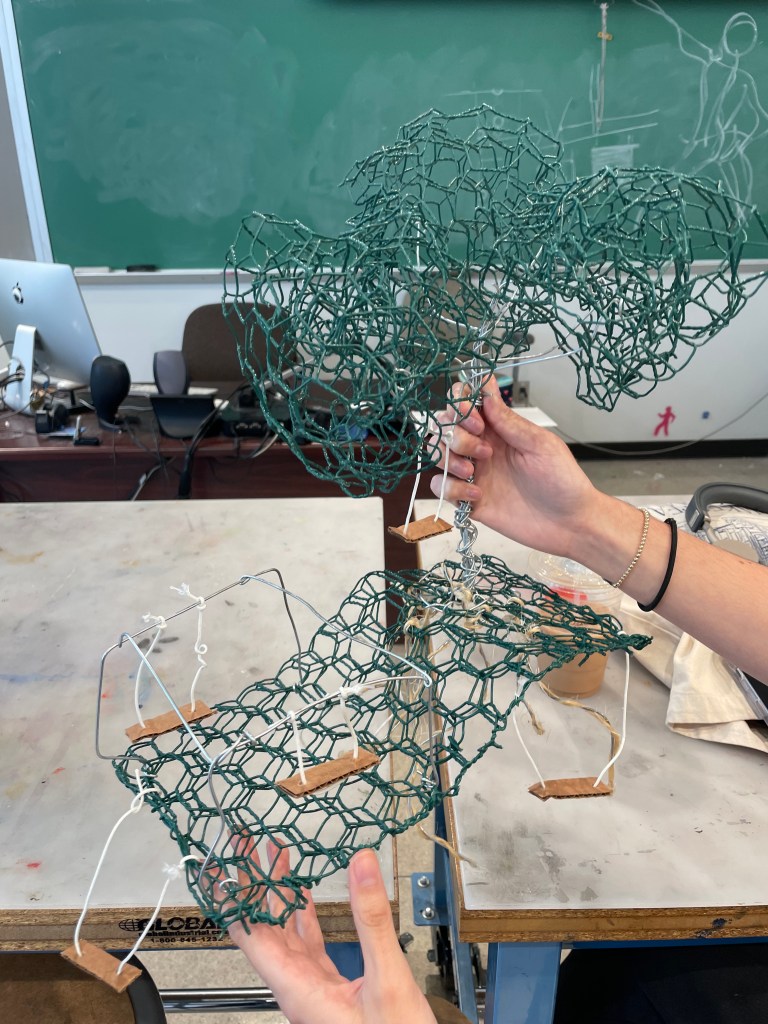
When my teammate and I first started our project we found some inspiration on Pinterest thinking of maybe making a treehouse situation out of wire. From there, we created a tree and were struggling with how we should incorporate a treehouse into our tree. We eventually drifted away from the idea of doing a treehouse and created a swing set. 

The way in which we created the base was by using chicken wire and folding it to make it stronger. The color of the chicken wire is green so, that helped our line installation to represent grass we also rolled up some chicken wire into balls to create somewhat of a leaf-like appearance to the trees. For the trunk and the branches, we used some random silver wire that was pretty malleable. For the roots of the tree, we wrapped twine around some of the silver wire that was used for the branches. We then created some swings that would hand from the tree, the swing set, the branches, and the roots. 

Once we had finished creating the scene we played with names that we could name this piece and we landed on ‘Where Did All The Children Go?’ which is the name of one of the group dances that was performed on Dance Moms. After, watching the dance we wanted to create one figure that would be left swinging on one of the swings that are made of cardboard and white string with the figurine made of wooden sticks and twine.

Before hanging it up, adding the finishing touches and installing the final piece.
The final product of our line drawing into space with the figurine.

Jackson Pollock

Jackson Pollock born, Paul Jackson Pollock was born on January 28, 1912, in Cody Wyoming. While he was born in Wyoming he spent the majority of his childhood in Arizona and California. He was kicked out of two different high schools eventually he went to study at the Arts Student League in New York City, New York. 

The style of painting that Pollock is most known for is Abstract Expressionism. The drip period of painting was when Jackson Pollock became known during 1947-1950. The colors that Pollock would use tended to be on the darker side.

I first was exposed to drip-style paintings in elementary school. In fifth grade, we had Jackson Pollock day where we would go to the high school and do drip-style paintings on paper and ceiling tiles. The ceiling tiles were then put back in the ceiling of our art room to live forever which now looking back I think is pretty cool.

During his later years, Pollock would make sculptures by using wire gauze and plaster. Jackson Pollock died, on August 11, 1956, in a single-car accident while he was driving under the influence. He died in Springs, New York at the age of 44.

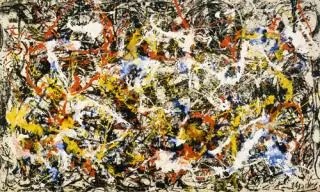
Convergence, 1952, Albright-Knox Art Gallery, Buffalo, New York
Number 1 (Lavender Mist), 1950, National Gallery of Art East Building, Washington D.C.

Fitz Hugh Lane

Fitz Hugh Lane, born Nathaniel Rogers Lane was born December 19, 1804, in Gloucester, Massachusetts, a coastal town on Cape Ann known for its fisherman and salt island at low tide. The focus of the vast majority of his paintings was maritime-themed. His father was a sailmaker which led to him painting many sailboats on the seas throughout his life. During the majority of his career, he would spend time between Boston, Massachusetts, and New York City, New York where he would showcase his work for others to see.

Hugh’s route of education is more of an untraditional style. He completed an apprenticeship in Boston, Massachusetts. His apprenticeship was at Pendelton’s Lithography which is a printing company that printed illustrations that could also be printed again and again. After his career in the art industry, Fitz Hugh Lane went back to his hometown of Gloucester, Massachusetts. He died on August 14, 1865, at the age of 60. His works can be found in museums all over from The New York Metropolitan Museum in New York City, New York to Art to the Amon Carter Museum of American Art, in Fort Worth, Texas.

Lumber Schooners at Evening on Penobscot Bay, 1863
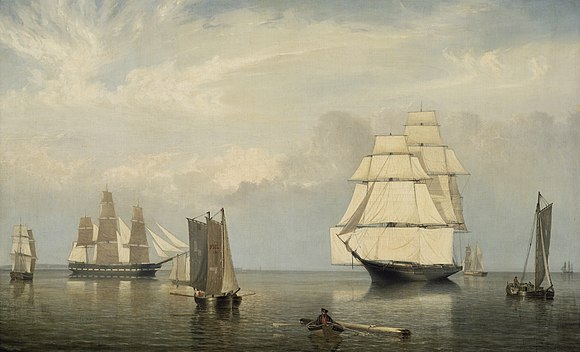
Salem Harbor, oil on canvas, 1853