Group Project

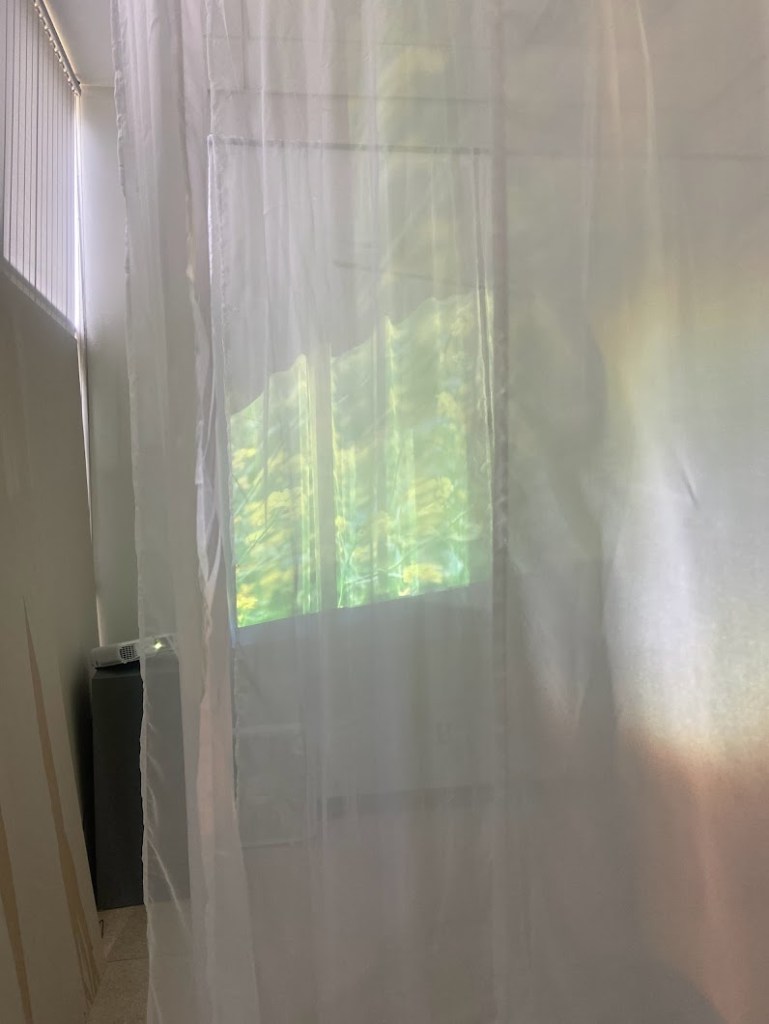
When it came to choosing which project we wanted to work on, I chose this one because I’m a photo major and it seemed the most up my alley. During the planning phase, we ordered the supplies we needed: some sheer curtains and metal rods. Then we got into the shooting phase in which we all shot video footage for the final projection. The concept was to bring nature indoors and create competing senses of both peacefulness and chaos in nature. At first we all shot scenes that were long, quiet and peaceful: i.e. fields of flowers, running water, and clear blue skies. Then during phase two of shooting we decided we wanted to add that chaos element and we all started shooting chaotic things in nature. I tried to focus on bugs and decay for this portion of the project. We then began to compile the footage in premiere. During this period we decided to add smooth transitions to the peaceful portions of the film and add rough and choppy transitions to the chaotic portions. During the editing period we also decided we wanted to mess with people’s senses by making the audio not match up with the clip. This lead to us experimenting with different audio/visual combinations. While the video was being edited we simultaneously were building the installation. We installed the metal rods and sheer curtains in the storage room behind the printmaking classroom. Cleaning that room out for our installation was a process of its own and it took several class periods. After we got all the curtains up we decided to start testing projectors. We brought in pedestals from the hallway to get our projectors at the right height. Once we were happy with how the projectors and curtains looked, the primary focus became getting the film done. Once we got the film done we put it onto the media players and connected those to the projectors. We decided to offset the video the projectors to create a more sensory-warping experience. Overall, This project came out really great and I’m super proud of my team and all the work they put into this. Upon reflection, I would say my greatest contribution to the project was probably the stuff I shot during the shooting phase. I spent a lot of time walking through nature and gathering video and audio clips and I’m glad a lot of them ended up being important to the final outcome of the film.

Cardboard Sculpture

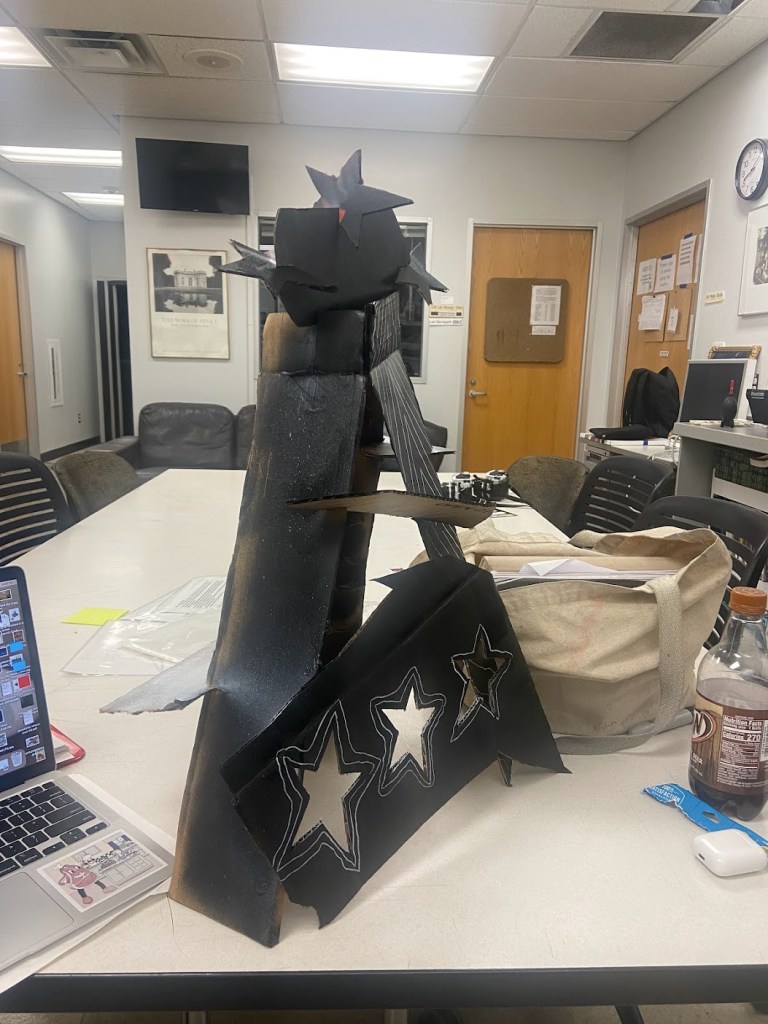
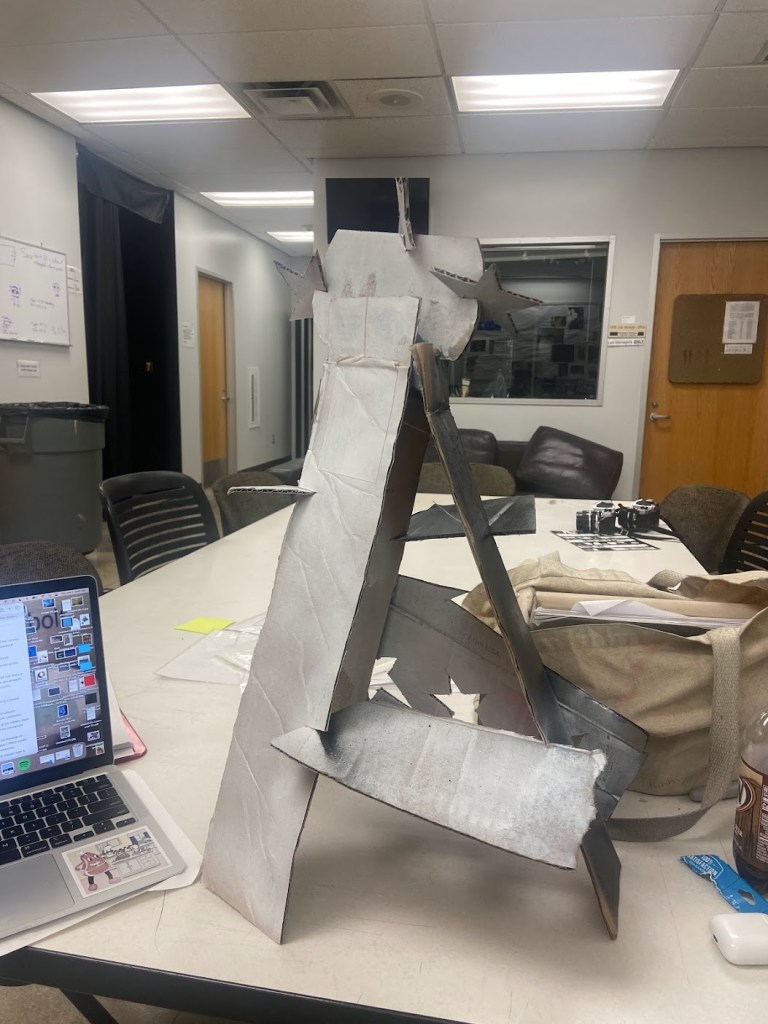
I started by digging through the recycling to find cardboard. Once I found a good box I began to cut it into different shapes. I then connected the different shapes by cutting slits in the cardboard. Then, I hot glued the pieces that needed extra reinforcement. After the sculpture was built, I took it to my partner’s house to use his spray paint. I spray painted half of it black and the other half white because I wanted to create a duality between a light and dark side.

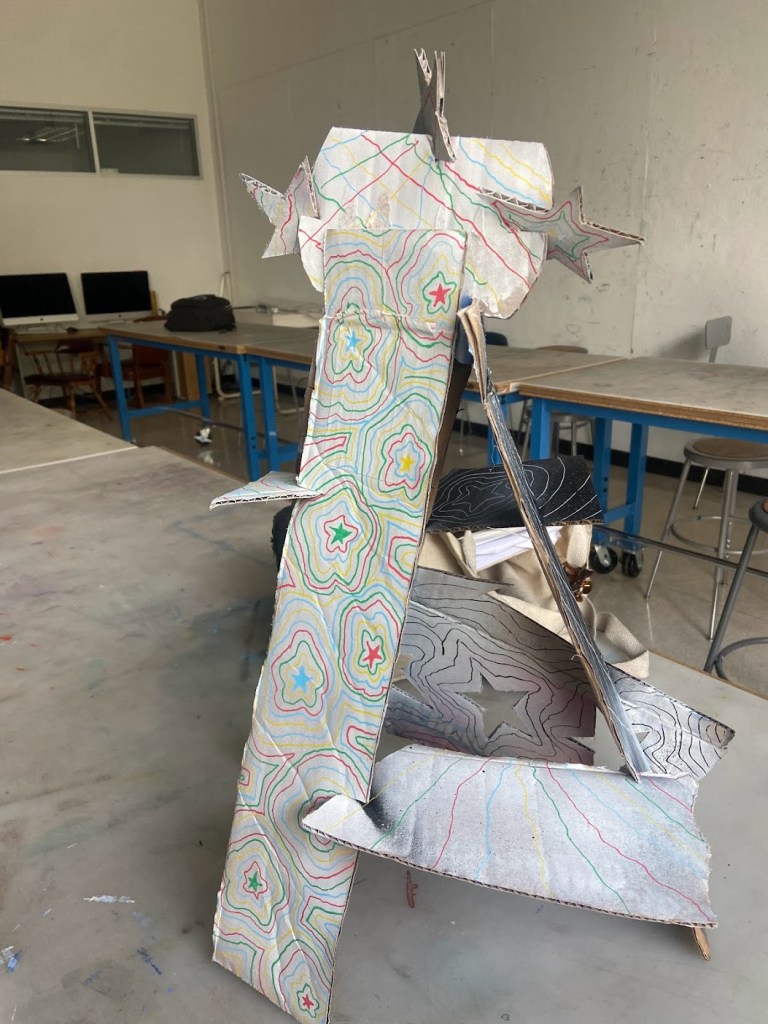
Using posca pens, I drew patterns on each of the different pieces of cardboard. On the black side I drew with white pen and on the white side I drew with red, blue, green and yellow. I was going to make the whole thing black and white but I decided that was too predictable. I really like how the drawings ended up transforming the sculpture.

This was a challenging assignment for me because 3D work is usually way out of my comfort zone. Overall, I’m happy with how it turned out.

Yayoi Kusama

Since her birthday is tomorrow, I decided to look at Yahoo Kusama this week. Kusama is a contemporary Japanese artist who mostly works with sculptures and installations. I also thought looking at Kusama was appropriate this week because she’s known around the world for her site-specific installations and right now we’re laying the groundwork for our site-specific installations.

Yayoi Kusama is from Matsumoto and she studied art at Kyoto City University of Arts. At the age of ten, Kusama began experiencing hallucinations. She described them as “seeing people’s auras” and also seeing lots of dots everywhere. As a result, polka dots became a life long obsession for her. Kusama says creating this polka dot art helps relieve her depression and anxiety that she has around her hallucinations. As an Asian woman, she had a really hard time beginning her career. Kusama moved to New York in hopes of “becoming a star.” She went from living a wealthy lifestyle with her family in Japan to living in poverty in America. As a result, she became a rather aggressive self-promoter.

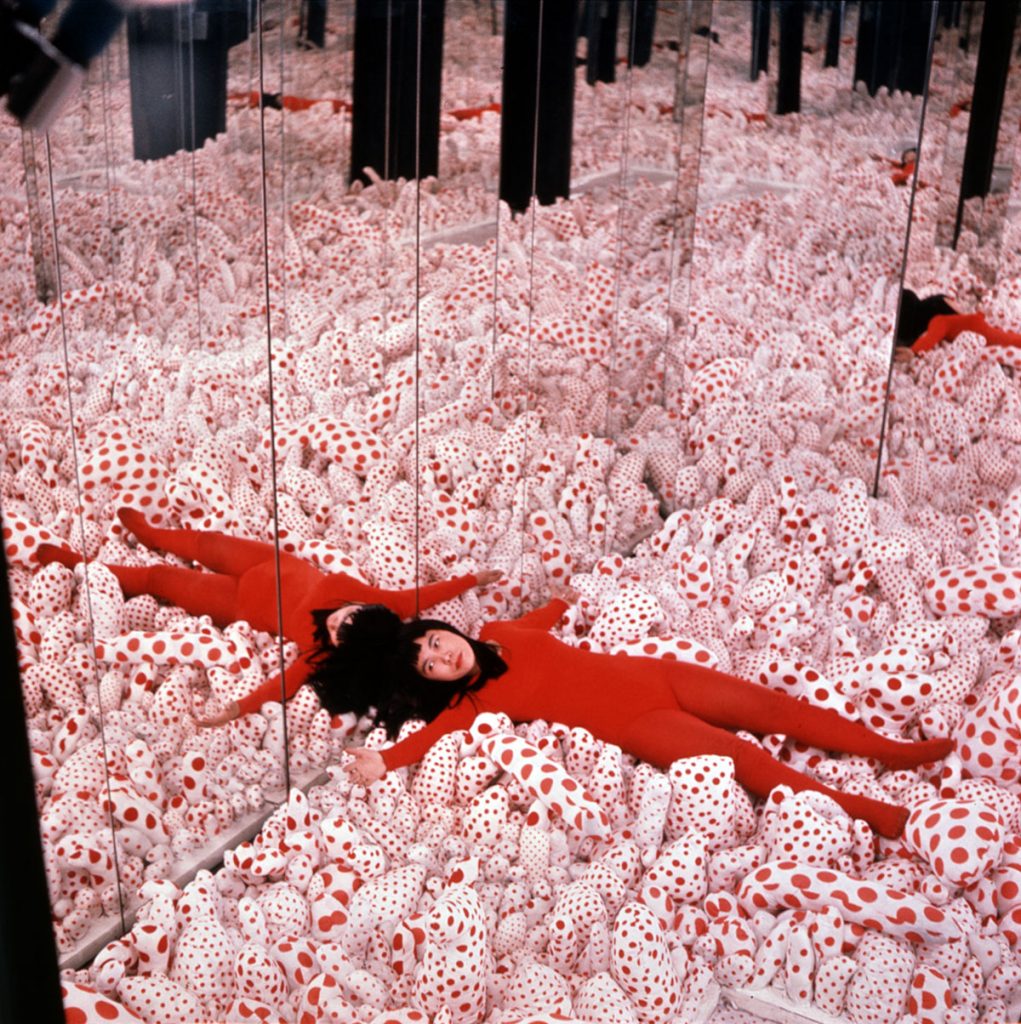
If you’re a social media user, you’re likely familiar with what Kusama is best known for these days: her infinity rooms. Kusama creates these “infinity rooms” by placing mirrors on all four walls of a room as well as the floor and ceiling. She then creates something that will be replicated indefinitely by the reflections. These installations are super popular selfie spots, so that’s probably why you’ve seen one before.

Overall, Kusama is a super inspiring figure; she had lots of battles to fight to get to where she is today and I think we can all take something from her story.

Works cited:

https://en.wikipedia.org/wiki/Yayoi_Kusama

https://www.youtube.com/watch?v=wgSBtXNJjhs

Olafur Eliasson

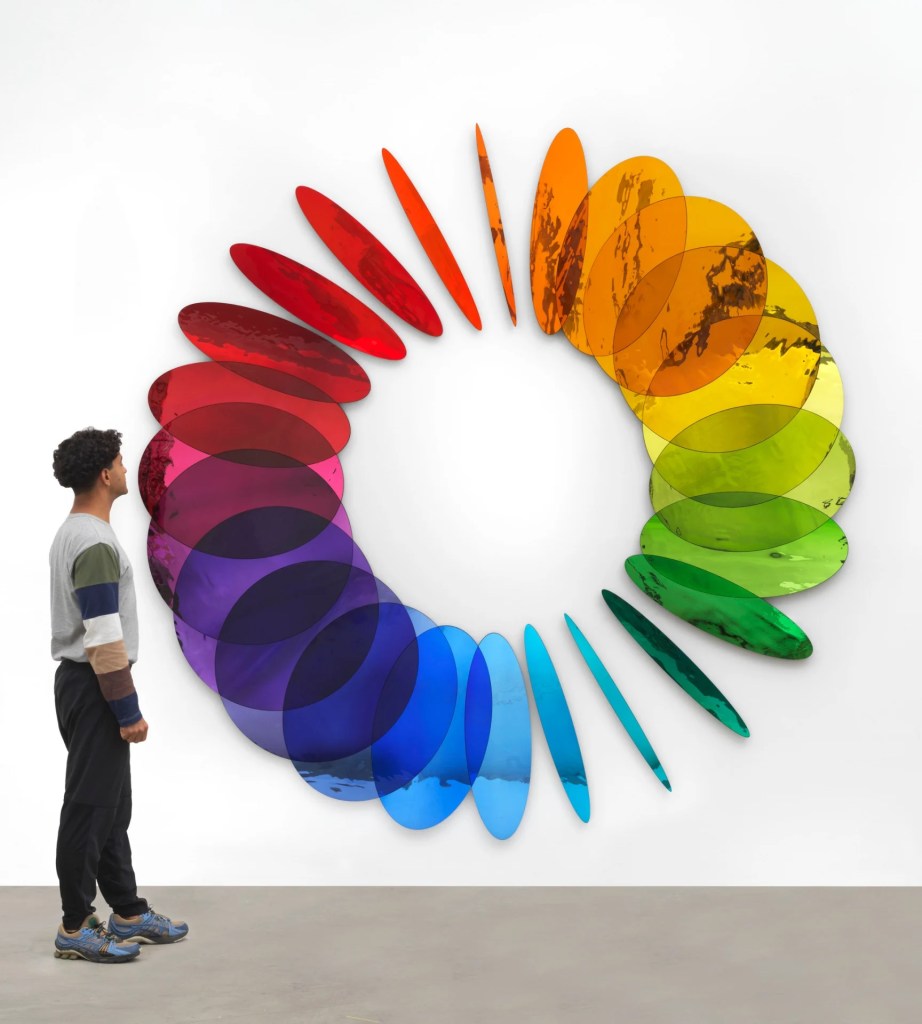
Olafur Eliasson is a multi-media artist who makes works that could possible inspire somebody group project pitch– which is why I decided to talk about him this week. He makes large scale installations, drawings, painting, sculptures and even does photography and film. Born in 1967, Eliasson are up in Denmark where he studied at the Royal Danish Academy of Fine Arts. Since 1997, he’s had solo exhibition in major museums all over the world.

I find these pieces really inspiring when thinking about the group project proposal. He uses handblown colored glass to make his work, so we wouldn’t be able to use those materials but I like what he achieves when he plays with light, color and reflections.

Sources:

https://olafureliasson.net/artworks/

https://olafureliasson.net/biography

https://en.wikipedia.org/wiki/Olafur_Eliasson

Line Project

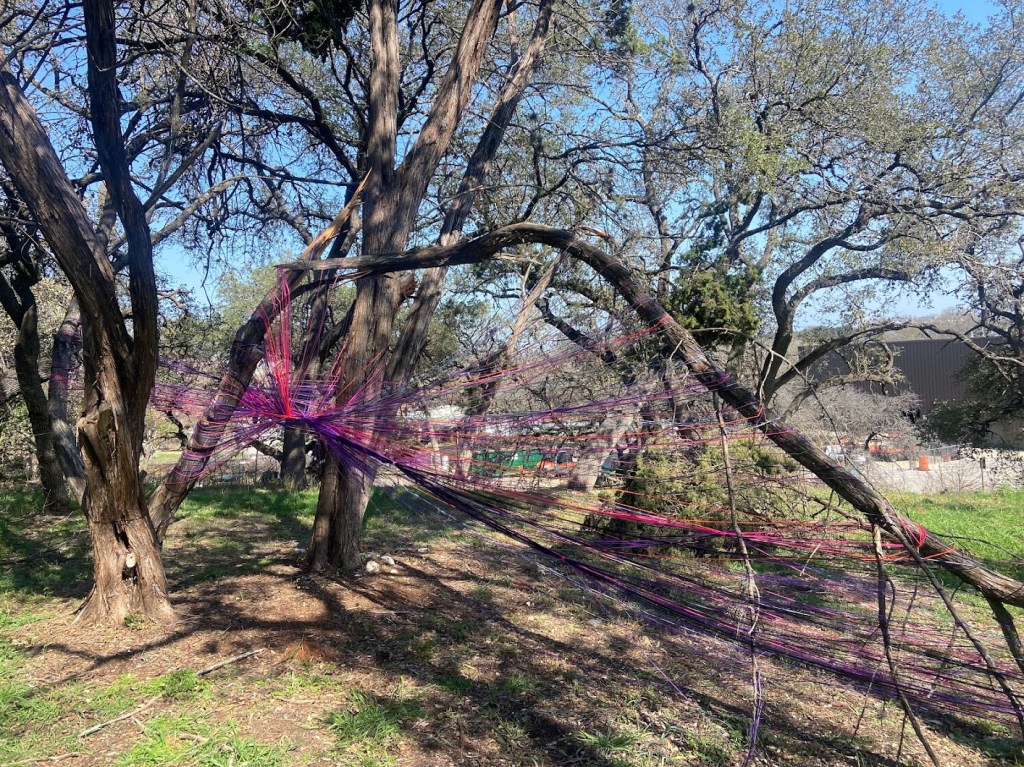
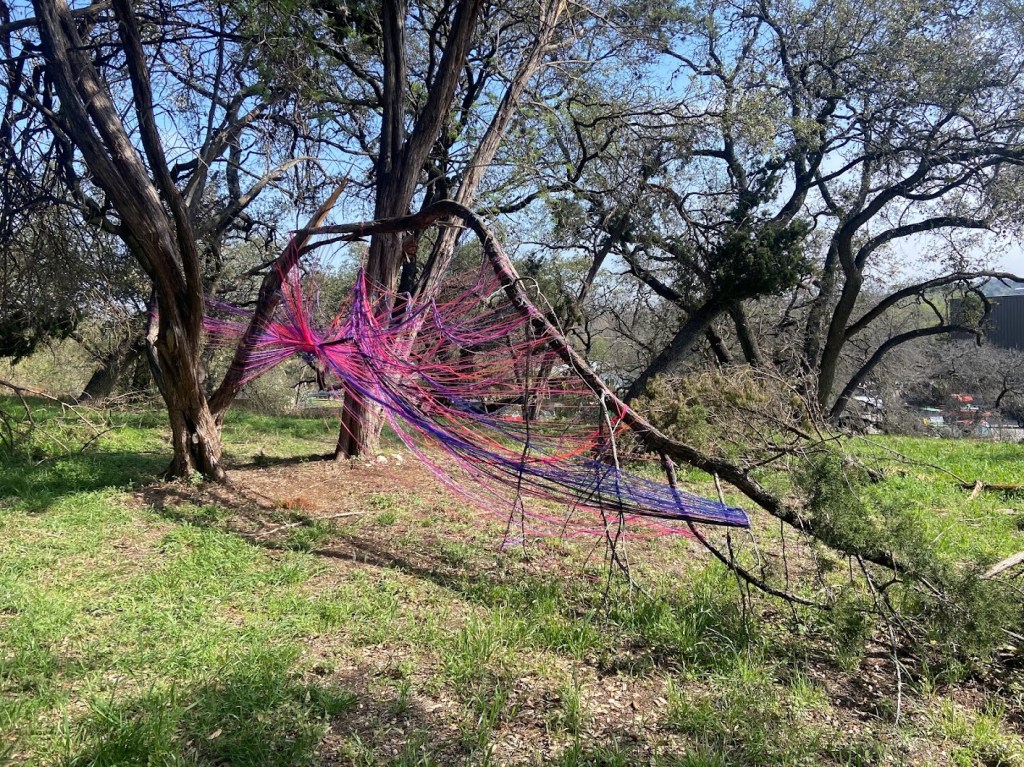
I knew right off the bat that I wanted to work with yarn and a tree so I found a like-minded partner. Together, we came up with the idea to create a “portal.” We decided to use purple and black yarn to contrast the natural green and brown colors of the site. We found a tree we liked (with a broken branch) and decided to do something to mend the broken branch back to the tree.

After one day of working on it we decided we needed to make changes. Instead of just using purple and black, we wanted to expand into other bright colors– specifically pink. We decided to incorporate orange, blue and a color changing yarn as well.

After adding those additional colors, we decided we wanted to play with the lines more so we took little pieces of yarn and tied the longer pieces of yarn together in certain places to shape the mass of the portal. It was at this point when we left for a weekend that the wire supporting our entire wrapping broke. We found it broken on Tuesday and went right back to work. First we repaired it to the extent that we could and then we continued to add more yarn and more little knots.

Overall, I’m super happy with the end result. I think it accomplishes everything we wanted it to accomplish. I think we did a great job of overcoming obstacles and making the most out of the two weeks we had to work on this.

Patrick Rochon

For this week’s artist I’d like to look at Patrick Rochon. Rochon is a photographer and is often known as the master of light painting. For those who don’t know: light painting is a photography technique where you take a long exposure in pitch darkness and then “draw” with a light source. I decided to look. at this artist because nobody’s put up any photographers yet and this photographer’s work definitely relates to the class.

Rochon began light painting in Montreal, 1992, and five years later he made the decision to dedicate his life to mastering the practice. He’s very accomplished now and his work has been published several times. He describes his practice in his bio as the following: “As a light painter, I work in the dark. Intuition and imagination are my main senses. By practicing this art passionately, I’ve come to hear the inner self whisper hints and guides me towards new ideas and insights.” Even though his work requires him to largely use his intuition, I think that’s super inspiring and that we should all trying relying on our intuition while making a piece and see how it turns out (just for fun not for class:)

Sources:

https://www.patrickthelightpainter.com/about

https://rochon.io

Ming-Yi Sung

This week, I was inspired by Ming-Yi Sung. Her work isn’t much like what I’m working on right now, but she uses the same materials that I’m using– yarn. Sung draws with yarn, he work is a lot more objective that what I’m working on.

Sung started school at the Maryland Institute, where she got her bachelors of fine art. She went back to the same school to receive her Master’s in Art Education. Her career began with a publication in Sculpture Magazine, after that she did an exhibition for the Holt Center of the Arts in Maryland.

Besides working with yarn, Sung also paints, draws and makes ceramics:

I feel like her work relates to this class because she is literally drawing into space with yarn. She’s also definitely someone that could inspire somebody’s next project.

Transparency Project

I was sitting in my bedroom watching Twin Peaks, when I started to get bored with the show (if you’ve never seen it, it can be really slow at times.) The idea came to me that I should tape a piece of yupo paper to the monitor and roughly trace the figures as they popped on screen. This was a really fun exercise, the things on the screen moved way faster than I thought they were moving, which made it more challenging that anticipated: but nevertheless I had fun doing it. The resulting image was a bunch of overlapping lines and colors. (I tried to keep the color scheme primary colors plus green.)

After that, I took a piece of vellum and did the same exact thing. On the other side of the vellum: I drew a little self portrait based off an old photo of mine. I glued the vellum to the yupo paper, which made it kinda wrinkly– but I like the texture honestly,, happy mistake. I then trimmed the paper on all sides to give it a cohesive look.

Overall, it’s definitely not one of the best things I made, but I’m happy with it and I had a lot of fun experimenting with transparent paper.

Bridget Riley

Bridget Riley is a drawer/painter best known for her contributions to the op art movement. She was born in London and still lives and works there. Her work is greatly inspired by Neo-impressionists like Seurat. The way that they broke down scenes into colors is the same vision that is at the root of Rileys art and debatably all op art.

Aside from drawing, she’s also done some murals that I find relate to the theme “Drawing into Space” really well. In 2017, she created a striped mural titled Bolt of Colour that covered a U-shaped former army barracks in Marfa, Texas. I feel like this relates to the class because of the fact that the drawing is circumnavigating a physical space. I’m not quite sure what our next “line” assignment is, but I feel like this could also serve as possible inspiration for us moving into that project.

Joey Vermouth

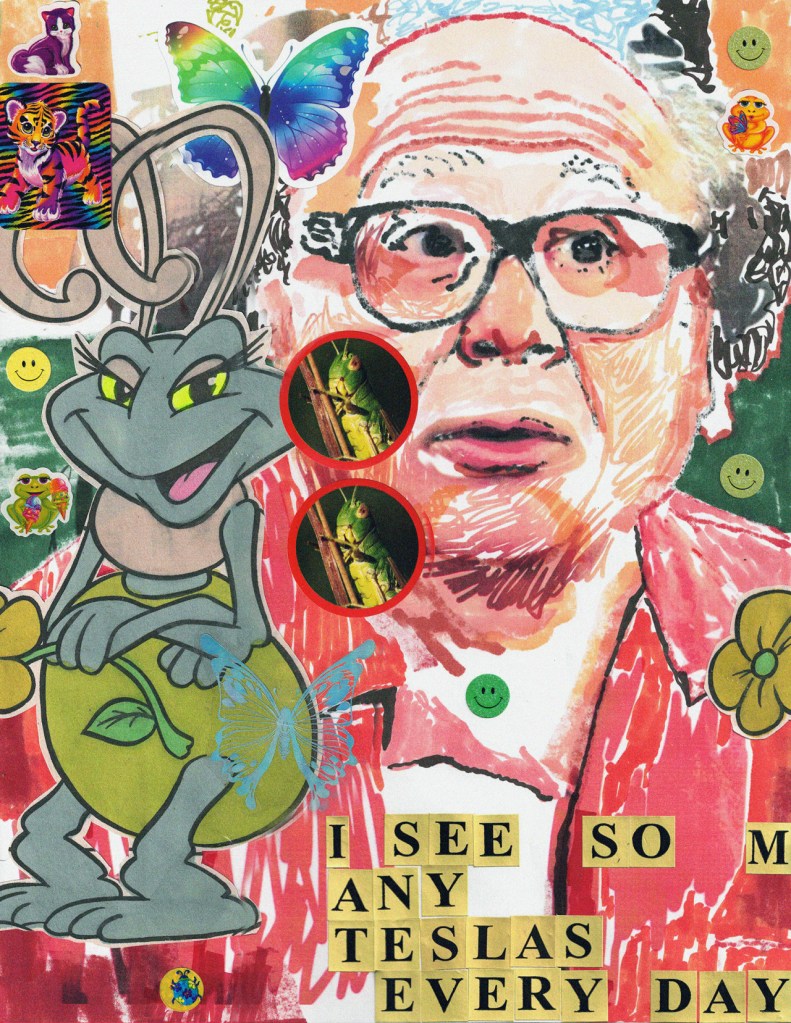
This week, since we’re looking at working with transparent paper, I thought I’d shine some light on a contemporary artist that I really love. Joey Vermouth is best known for his “bug art” on TikTok, you might know him by his username sweetjoeyvermouth. Vermouth’s “bug art” is both the piece itself and the performance that goes into creating it. It’s become quite controversial online whether or not “bug art” is “real” art– but I argue that it totally is. You see, the internet often falls for the misconception that it requires a lot of skill and training to be a “real” artist, but Vermouth’s works prove that art can be made with tracing paper and dollar tree coloring books.

As previously stated, Vermouth’s process is half of the art. He works with materials that can be found at stores like Dollar Tree or Walmart, so it’s a very accessible process. He then traces the image of the celebrity, colors it, squirts it with water and adds stickers. He records his entire process and uploads time-lapses of all of his pieces to TikTok, for the audio he sings a little song about how “you don’t have to like my bug art, it’s ok.”

Overall, Joey Vermouth is an impressive artist and definitely someone to look at moving into this next project.

Sources:

https://freshbugart.tumblr.com