Layering painting

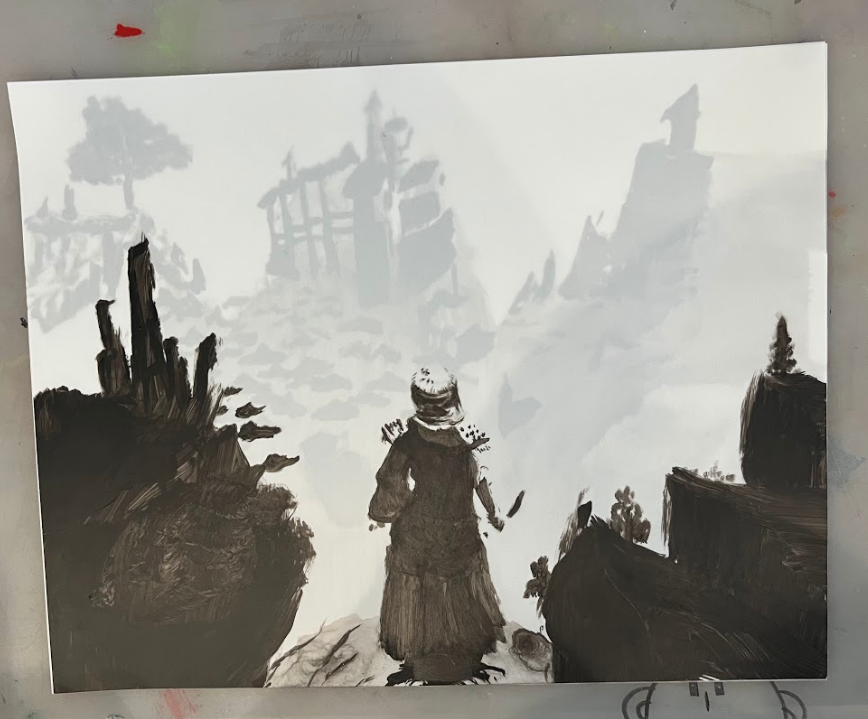
When the project was first introduced I was drawn to the idea in animation of creating a foreground, mid, and background in three separate layers to illustrate the large space when animating, by moving each layer at a different speed across the screen. I saw the translucent paper had the same quality, and wanted to create a scene from a video game to see if the same quality could be mimicked with the idea of layering the two papers. The game I had pulled inspiration from was Elden Ring. In this game, it’s very common to come across these large open spaces that create a desire to explore. I wanted this same quality to exist in my piece so I thought I would be perfect for reference. I used black acrylic paint and began layering onto the paper to build value because I was reducing the color image to black and white. I wanted to really focus on the implied shape of the hair, sword, and landscape without overdoing it. Overall I think this was a great experiment, I would love to in the future go back and add in some highlights of white to help increase the range of values.
Justin Favela

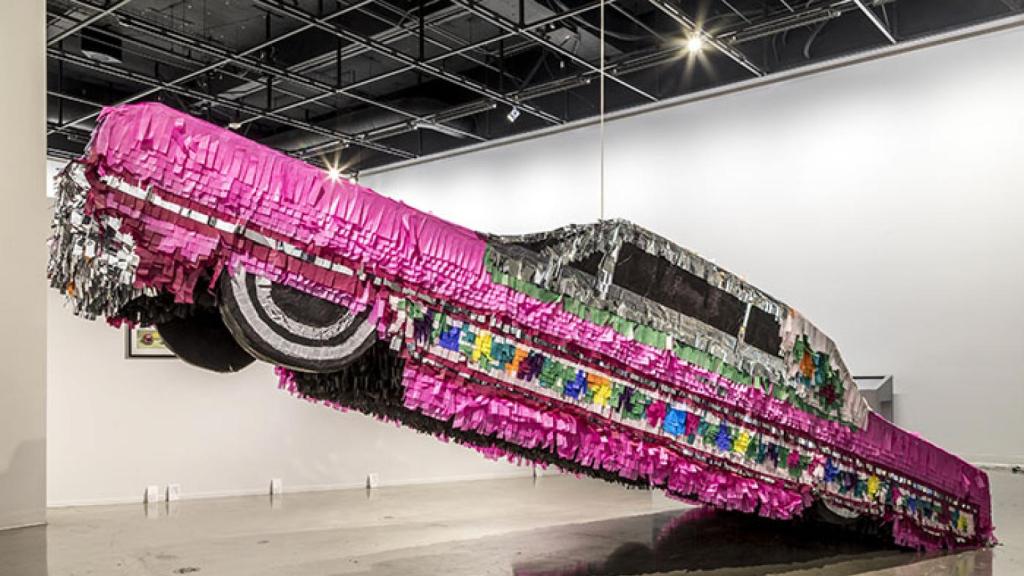
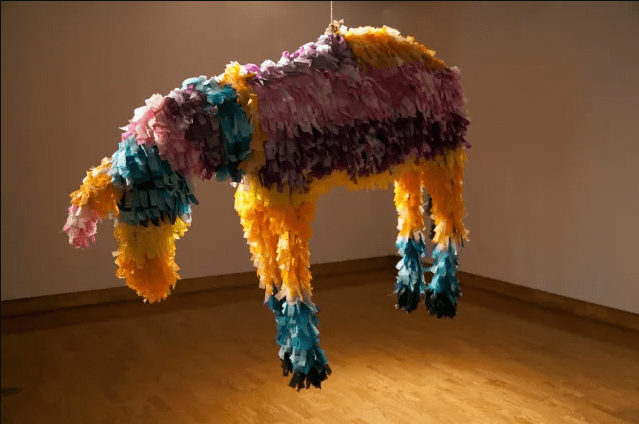
Born in 1986 and raised in Las Vegas, Nevada. Justin Favela is a Guatemalan-Mexican-American Artist who works in a large installation depicting cultural images and themes through ‘pinata’ art. Coming out of art school Favela adopted the practice of ‘pinata’ art as a means to end the constant commentary for him to speak about his identity as a person of color through his art for assignments. His first work “Donkey Pinata” depicts a realistic donkey hung by a string and covered in small cuts of tissue paper and adhesive to create the ‘pinata’ look. Using this visual language Favela creates large murals and sculptural pieces depicting Latin American landscapes and culturally significant objects.

“Donkey Pinata”

His career makes light of his identity as a queer person of color raised in the Southwest United States. Through this lens Favela also questions the ideas surrounding cultural appropriation in a humorous way that sparks conversation.

“Gypsy Rose Pinata” 2017
“Recuerdame” 2018

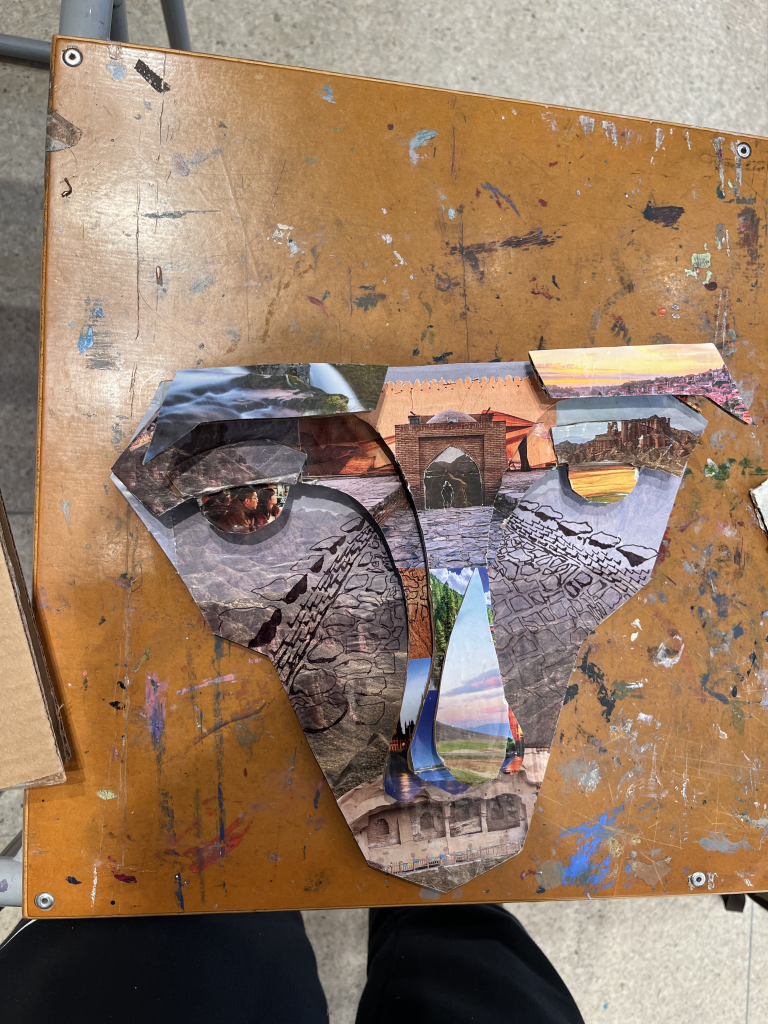
Collage: Defienlty not an African Mask

This collage assignment was given to me with a few passing notes of “or your collage could be cardboard and make something almost sculptural”, so I did that because it sounded like fun. Immediately I wanted something that resembles an illusion, where the sculptural aspect comes out to the viewer, but the collaged pieces, photos, and drawings would give a sense of space going into the piece. I made the sculptural piece resemble a face because I thought it would be the most recognizable shape for the human eye to see with all the other visual elements. The collage material I wanted to be nature photos because it did a lot of the work for me creating large vast spaces and atmospheric perspective. The goal was being able to give the viewer a choice of either seeing the face or the collage scene at either time.

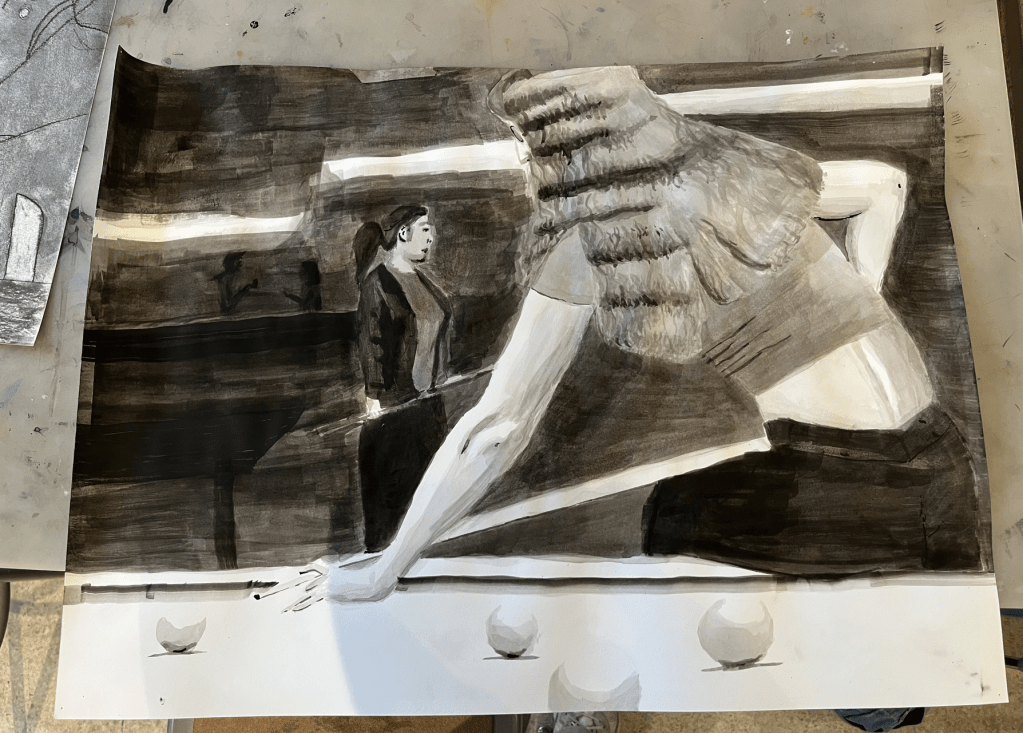
Atmospheric Perspective: Billards table

For this project, the idea was to practice creating a sense of space in an indoor scene without relying on perspective lines to push the images back. I have worked in digital media as a designer for years, so when I had the opportunity to try more traditional means of creating I wanted to try a wet medium. This piece was made using ink wash and my goal was to allow more gestural marks to come out of the piece because I’m used to working with very precise-looking images when working digitally.

One consistent issue was creating a dark enough scene for the background and capturing the texture of hair since the subject had very wavy curls.

Tom Haugomat

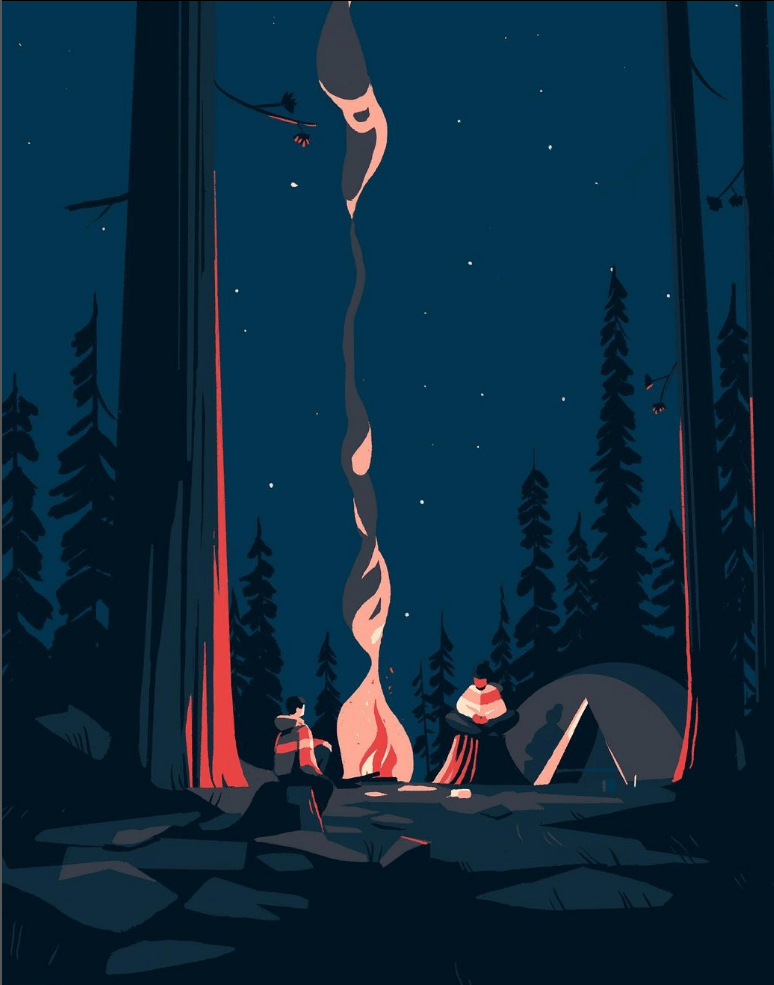
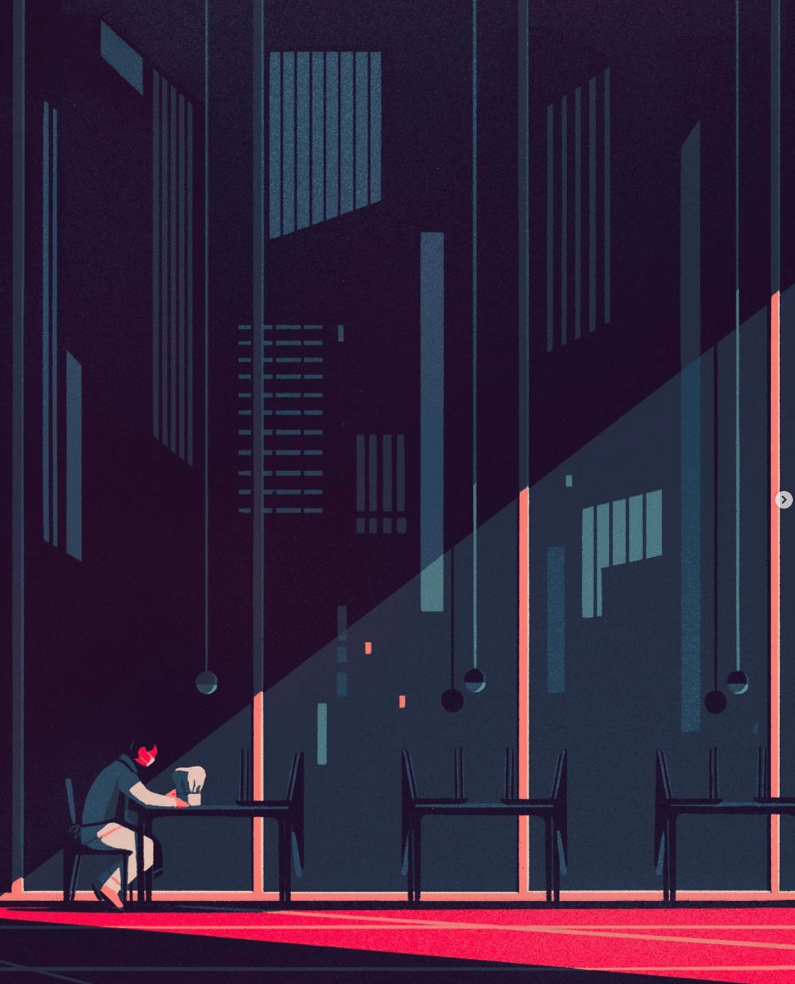
This week I will be talking about the french illustrator, Tom Haugomat. Born in Paris in 1985, Haugomat fell in love with drawing and telling a narrative in his pieces. Studying art history, archeology, and design, Haugomat’s first public project was a short film “Jean-Francois” (2009) with co-creator Bruno Mangyoku. (source)

His approach to visual storytelling of incorporating multiple figuring interacting to create a sense of dialog or a lone person surrounded by large nature/architecture. His style is very minimal in the sense of being very deliberate about the highlights and lack of detail to allow the viewer to feel a sense of participation in filling in the rest of the details. In terms of drawing into space, Haugomat uses scale and contrast and is able to control the scale of space in his work.

Haugomat currently has two animations produced and a number of art books released with a collection of his work. He has a large following of 258k followers and is still working in France as an illustrator / author.

Instagram Dec 14, 2021
Instagram April 24, 2020

Amanda Burnham

Amanda Burnham is from Toledo, Ohio. Born in 1979, she focuses on installation featuring scraps of paper with drawings of city architecture. In Burnham’s words, her interest in depicting cities comes from her admiration for the “adaptive sensibility of tinkerers, patchers, foragers, and those who make-do.” (Brunham) One thing that really stood out was her practice of archiving pieces of previous installations and reusing the visual assets in later drawings. I come from a digital practice so to see a similar methodology of reuse of visual assets was really interesting for an installation artist. Burnham will use walls as a pile of trash, or even use street lights as sidewalks, keeping tape and adhesives exposed in order to utilize these tools as a line in the work.

Aside from putting up really amazing work depicting space with a great sense of perspective in black ink. Burnham is currently a professor at Townson University in Rhode Island.

Intro to me as a person

Howdy, I’m Andre Covian (he/him), A senior graphic design student. Many of my interests align with my competitive nature (Chess, Esports, etc.)

I’m taking “drawing into space” to explore new mediums outside digital art. For a long time, I have been working in a digital space for a lot of my time being creative. From photo editing/illustration /printing, but I’ve never had the opportunity to explore more traditional drawing with ink and charcoal, I hope that I’ll be able to take away new practices of experimental approaches to visual making, and take them into digital practice.