Research Post #6

This week I chose to research the notorious Anish Kapoor. Anish was born in India and attended the prestigious boarding school: The Doon School. He later moved to the UK to attend Hornsey College of Art and the Chelsea School of Art & Design where he began his sculpture career. Kapoor became famous in the 80s for his signature geometric sculptures using simple materials. In 1995 he began working with reflective materials. He is most well known for his Cloud Gate sculpture in Downtown Chicago, also known as ‘The Bean’. His large-scale mirror-like sculptures canoe seen all over the world.

The main element that led me to dive deep into Anish Kapoor was his signature style. I was unaware of all of the sculptures he has created that resemble The Bean. As an artist who is somewhat trying to find my own style, I am envious and can deeply appreciate any artist who has a recognizable style/ trademark. I am also naturally drawn to large-scale art.
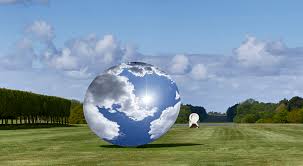
Sky Mirror, 2013

Turning the World Upside Down, 2010

https://en.wikipedia.org/wiki/Anish_Kapoor

Team Project

Before starting our team projects, each student presented their idea and as a class, we voted and narrowed it down to a few projects so that everyone could choose which group they wanted to be a part of. The project I presented was not chosen as a group project which worked out to my benefit as I could then use my project proposal for my final individual project. That being said I joined a group that I had not worked with anyone in the group prior to this project which I thought would be good for me. While doing a project I let everyone else take the lead and I just was a little taskmaster.

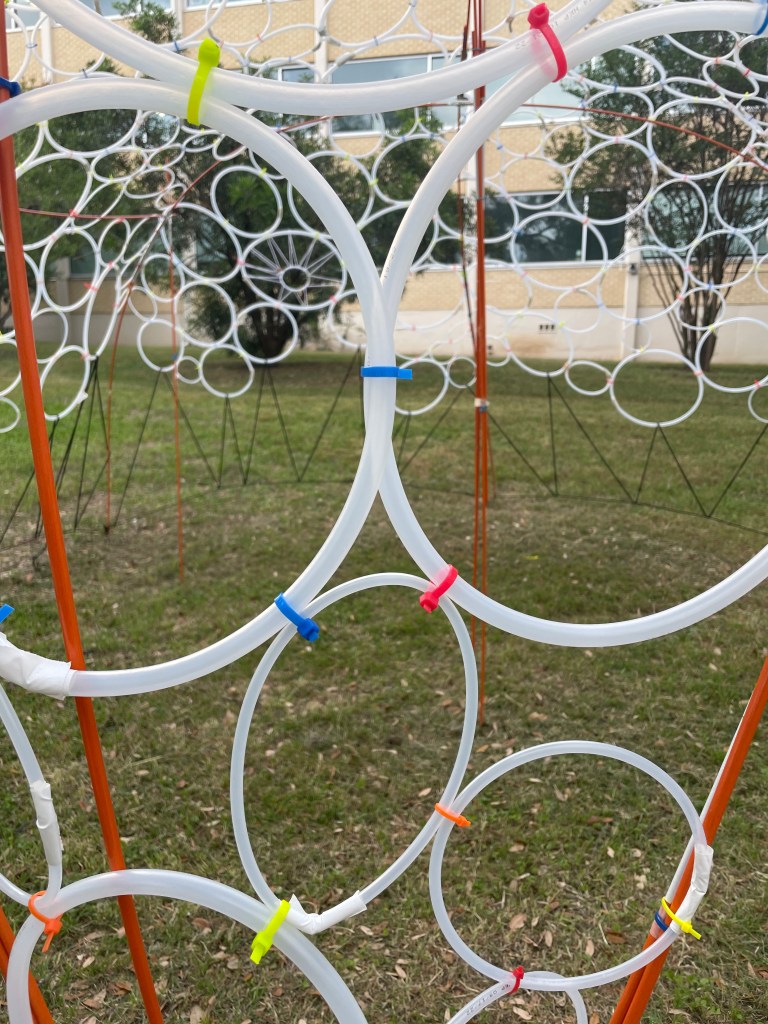
Originally, we started by creating a structure out of tall orange reflective steaks in the ground. We connected these by using bright colorful zip ties. From here we were trying to come up with something that would hold up with the outdoor elements so we created circles out of clear plastic tubing of various sizes. We used white duck tape to seal off the circles and then used bright neon-colored zip ties to connect the circles to then create a blanket-like structure to drape over the top of our foundation made by the steaks.

I think that this project turned out to be very interesting looking. The color zip ties I feel made the piece look much cooler. Without these colors, I feel that the project would be entirely different.

The process of creating the circles.
The final piece/
The colorful zip ties.

3D Project

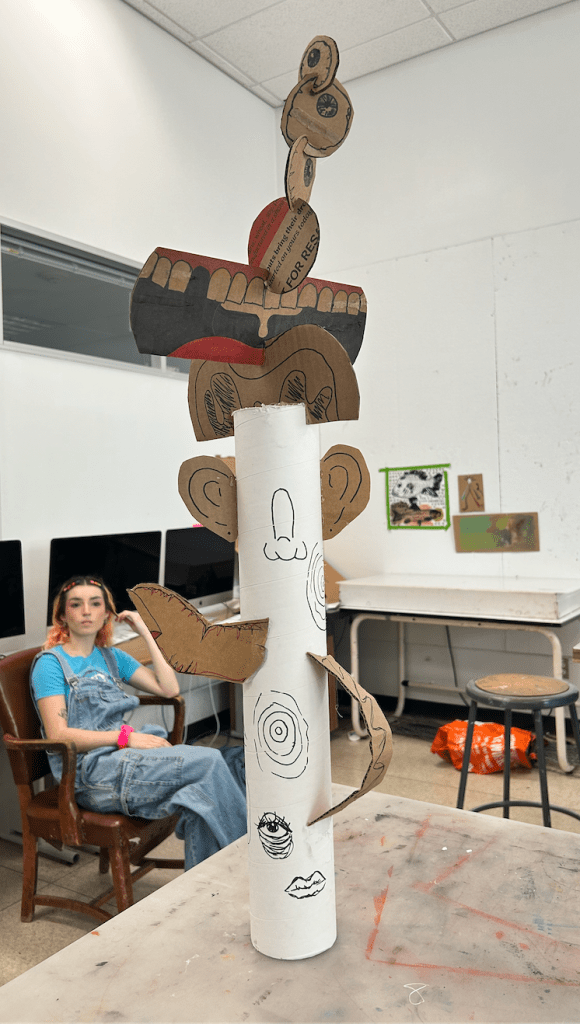
For my 3D Art Sculpture, I struggled with figuring out how to combine the cardboard cutouts I had made. I had an idea of what I wanted to create, but I couldn’t seem to find the right way to assemble the pieces. I kept trying different combinations, but they didn’t work. It was frustrating, but I knew I had to keep experimenting. Then, I found a round vase-like cardboard thing that I decided to use as my base. It inspired me to create a sort of totem pole-like sculpture with my cutouts. I had cut out different shapes of eyes, a mouth, ears, and a finger, and I decided to stack up the eyes on top of the mouth and put that on top of the vase thing. It looked interesting, but it wasn’t quite what I was looking for yet. So, I continued to experiment and try different combinations. I attached the rest of the cutouts on the vase like a totem pole and drew more images of lips and noses on the base. It was starting to come together. Finally, after several attempt, I had created something that I was proud of. It’s a totem pole-like sculpture with a mix of eyes, a mouth, ears, and a finger. It still isn’t quite what I had envisioned, but I think it has potential. If I had more time, I would have liked to paint on the cardboard and make the cut outs double sided so that it works from all angles.

3D Cardboard Project

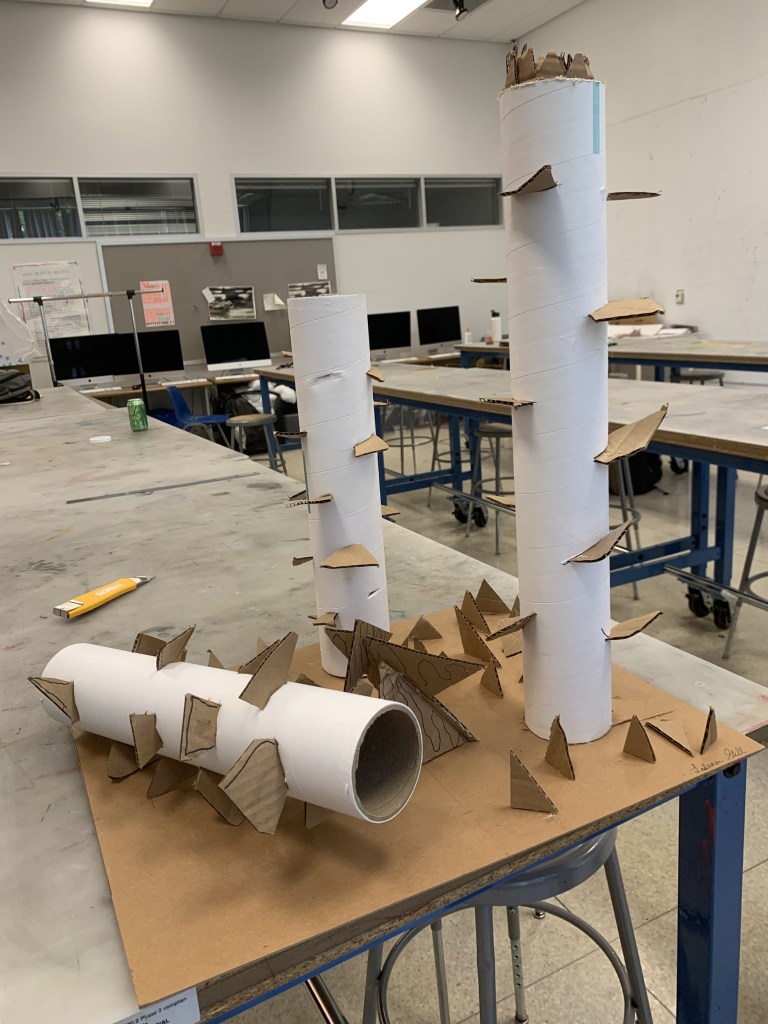
When starting this project, I found these white tubes to work with. I wanted to cut into them and add cardboard pieces almost making this staircase. The problem I found with that is how difficult it was to cut through them. I ended up using a saw and hatchet. When I finally got done add the holes and adding in the cardboard, it looked less like a staircase and more like a messed up deconstructed object from another planet. Thats where I got the idea of adding the triangular pieces to the board. Its still quite incomplete as I never got to add my drawing onto it. I think if I was to go back to touch it up with some ink, the project would look so much cooler.

Nike Savvas

Nike Savvas is a sculptor and installation artist from Australia though she is now based in London.  In her works she uses a variety of materials and varies greatly in scale. In the work seen below it is constructed using string and wood frames. In this series of work Savvas was inspired by the mathematical origins of art, to create the works she uses geometric formulas.

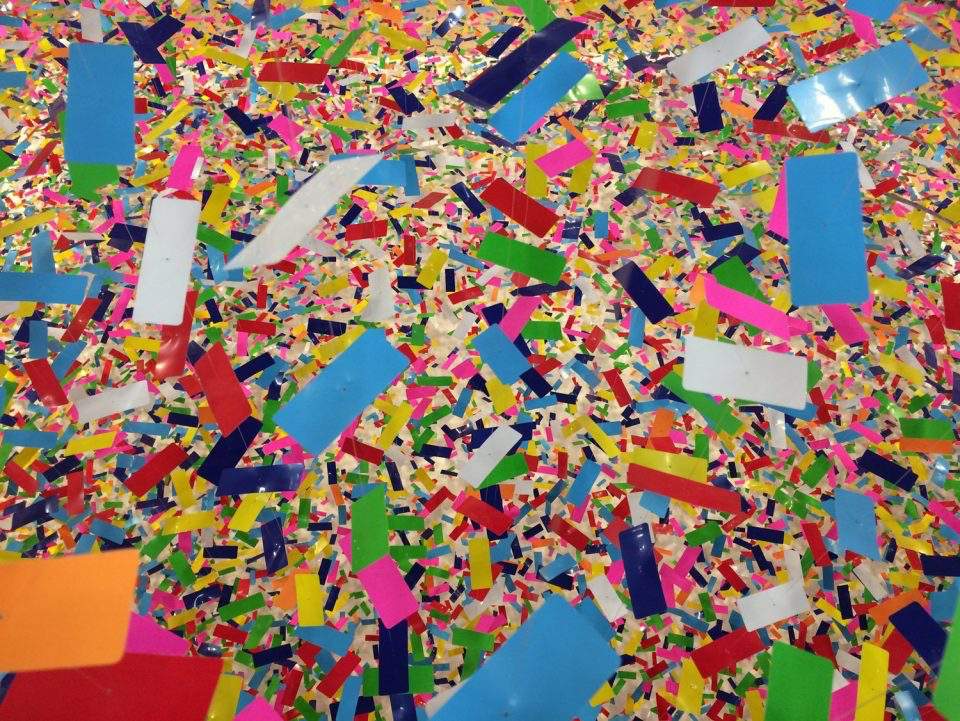
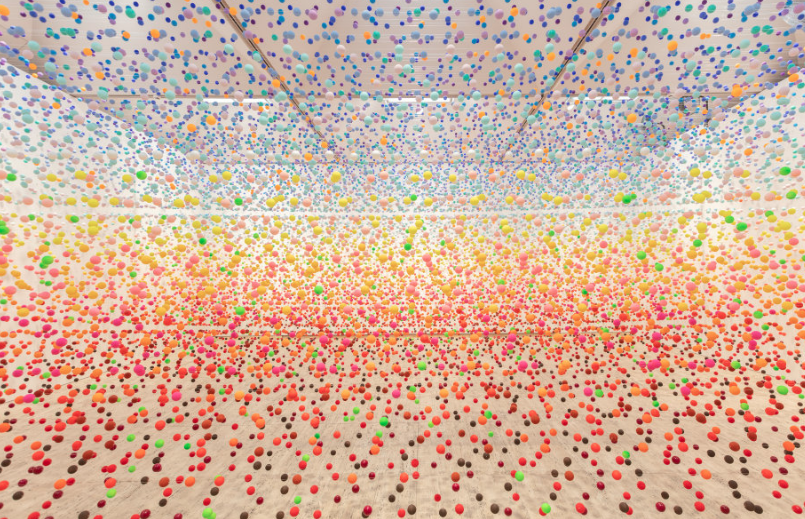
In her work she also enjoys playing with light and space. In another series of her work she uses pieces of colorful plastic and in another spheres strung together and installed into the space. Looking specifically at the installation using confetti like plastic, she has described it as a 3D painting. This is an interesting point to note because Savvas formal training is in painting. 

Nike Savvas – Finale: Bouquet, 2020, confetti, nylon wire, electric fans, installation view, Museum of New Zealand Te Papa Tongarewa, Wellington, New Zealand

In this installation below it is created using spheres that have been strung on nylon and each side of the string attaches to the wall. Her intention with this work was for the spheres to represent the structure of any element. 

Atomic, full of love, full of wonder

Works Cited

https://ocula.com/artists/nike-savvas/

https://nikesavvas.com/about/

https://www.tepapa.govt.nz/discover-collections/read-watch-play/art/finale-bouquet/about-nike-savvas

https://artpattern.altervista.org/nike-savvas/https://www.mca.com.au/artists-works/artists/nike-savvas/

Laura Catherine Soto

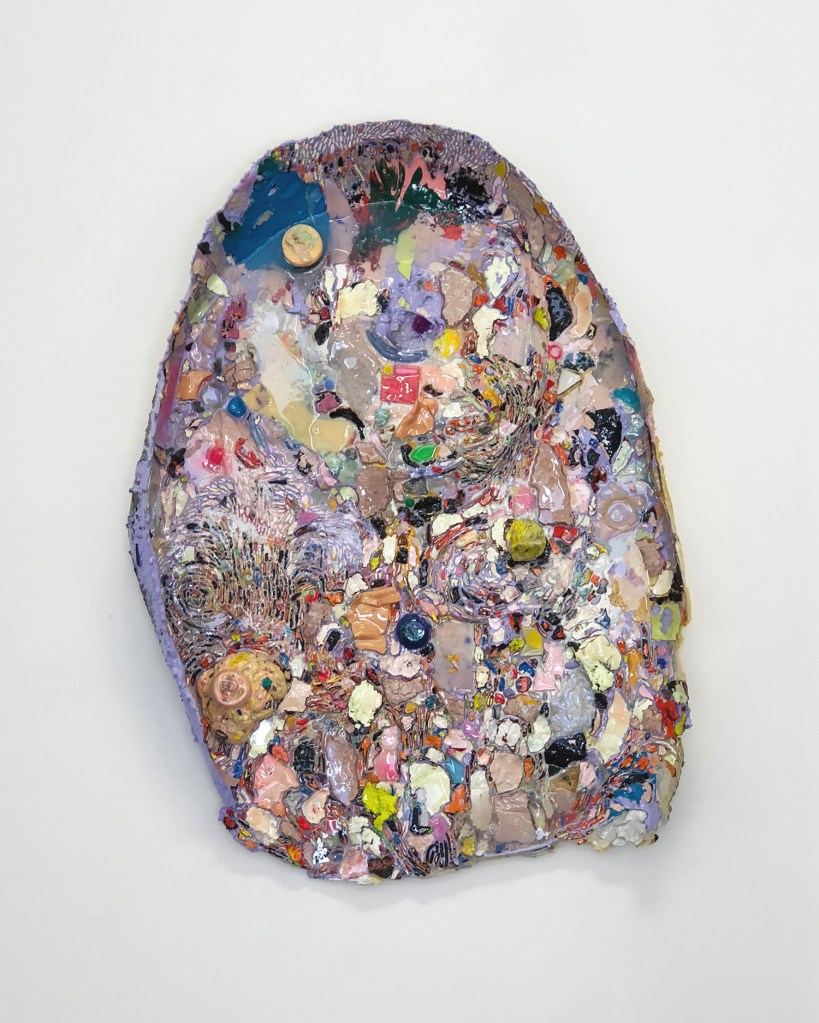
Laura Catherine Soto is a sculptural artist from California. The work she does is very unique- creating hundreds of man-made sea shells/rocks/organic forms which she integrates in books, journals, on furniture, and in installations. The materials she uses are mixed media, including oils, concrete, insulation, glues, acrylic, resin, etc. which typically coming from parts of her previous projects. I’ve followed her on instagram for a while now, and it’s really interesting to see her artistic journey and process. In one post she explains “I do not incorporate found natural material in my work. Instead, I let the long winded process mimic the organic world.” In another article, she expands on this stating “I enjoy this tension between what is naturally occurring and what has been amassed through mixing/amassing material.” I really like the shiny pastel, ecclectic and organic look of her pieces, and that she’s not afraid to really transform and create something foreign.

everything that rises must converge, 2016-18.
Untitled, 2017.
Flesh and Flood, 2018.

Nils-Udo

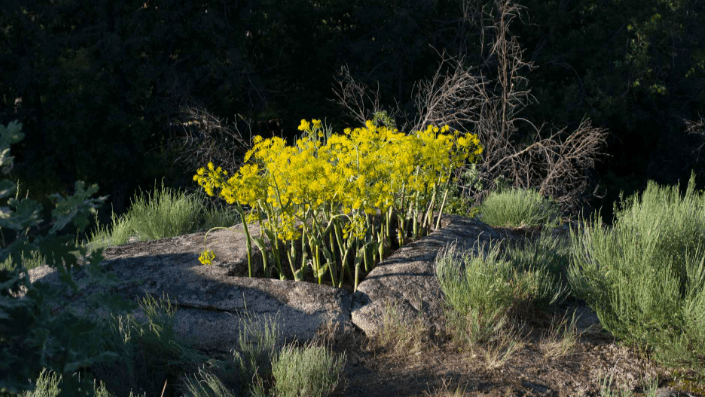
Nils-Udo is a sculptural artist from Germany that creates art revolving around nature. I chose this artist specifically because his work aligns with what I plan to do for my final individual project. In his work, Udo only uses objects found in nature. He says that “the basic idea is to achieve absolute purity. Nature performs a demonstration of itself. Every non-natural element is ruled out as impure. No other materials are used than those found in each natural space. The characteristics, the respective possibilities for processing, and the character of the natural space itself plays the major role in determining the shape of the work.” Unity and juxtaposition are commonly used throughout Udo’s work- He often creates bold nest-like structures with a central area surrounded by uniform objects expanding outwards, as seen in pieces like his Ginsterlicht series and his Grave-Stone series (see below). I like how the installations themselves are not only made of sprawling natural objects, but they are also always in different, fairly mundane and unrecognizable locations throughout nature. You can’t tell where you are when you look at his work, and I love how this creates a feeling of complete immersion. Besides sculptural work, Udo also creates contemporary paintings (of nature, of course) that have been exhibited around the world.

Grave-Stone 3, 2021.
Ginsterlicht 4, 2021.
Mountain Wind (Painting 1035), 2005.

Cardboard 3D Sculpture

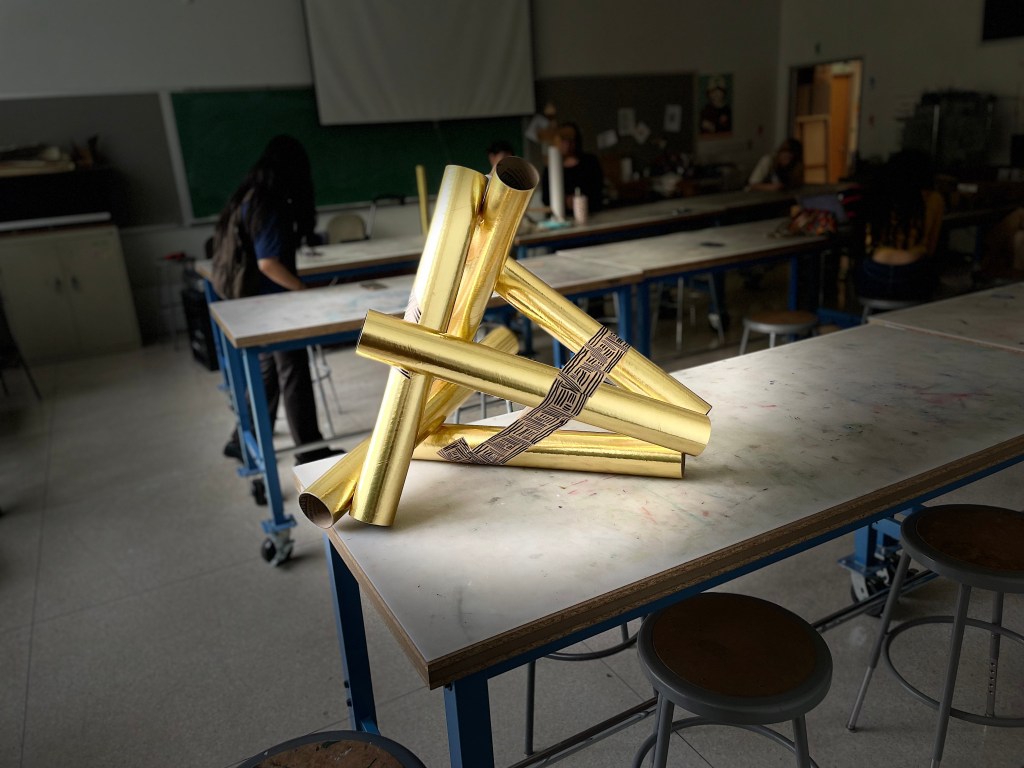
When this project was first introduced I was struggling to find inspiration for what I should create. Hollis brought in a basket of cardboard that we could choose from to create our piece. I came across quite a few cardboard tubes that had a gold foil finish to them which I found to be an interesting material to use for my project.

Once I gathered my materials I wanted to create a piece that was based on my favorite shape a triangle. With that being said, I started to create an abstract sculpture that I found visually appealing. I started with a tee-pee shape of three gold tubes. From there I knew there needed to be something else with the piece so, I added a triangle at the bottom of the original shape to create a chandelier-like sculpture. I got to the end and needed to incorporate drawing in some aspect. I used tape that is the same color as traditional cardboard and I took a sharpie and started drawing lines in different directions to create a pattern incorporating drawing and then draped the tape across the piece.

Tara Donavan

Tara Donavan is a sculptor and installation artist. She creates large-scale work using household objects, some examples being styrofoam cups, straws, buttons.

She has spoken about how her work somewhat mimics the ways of nature without becoming representative of anything specific. In fact she doesn’t give titles to most of her work so that she is able to make sure that it is able to exist without being associated with a specific idea that may not even be accurate. She wants everyone to have the opportunity to interpret the work differently. Below is an example of one of her works that has a title.

Tara Donovan, Colony, 2005, pencils, 4″ x 136″ x 113-1/2″ 

When creating she finds that what works best for her is to jump straight into experimenting with the materials and often doesn’t preplan or sketch. Something interesting to note is that while people often assume that she is trying to comment on the environment and mass production through her work though she has stated that that’s not her intention with her work.

Tara Donovan, Untitled, 2014, acrylic and adhesive, 10′ 1/2″ x 14′ 2″ x 12′ 10-3/4″ 

Works cited

Tara Donavan Interview: Sculpting everyday Materials

https://www.pacegallery.com/artists/tara-donovan/

https://ocula.com/artists/tara-donovan/

3D Cardboard Project

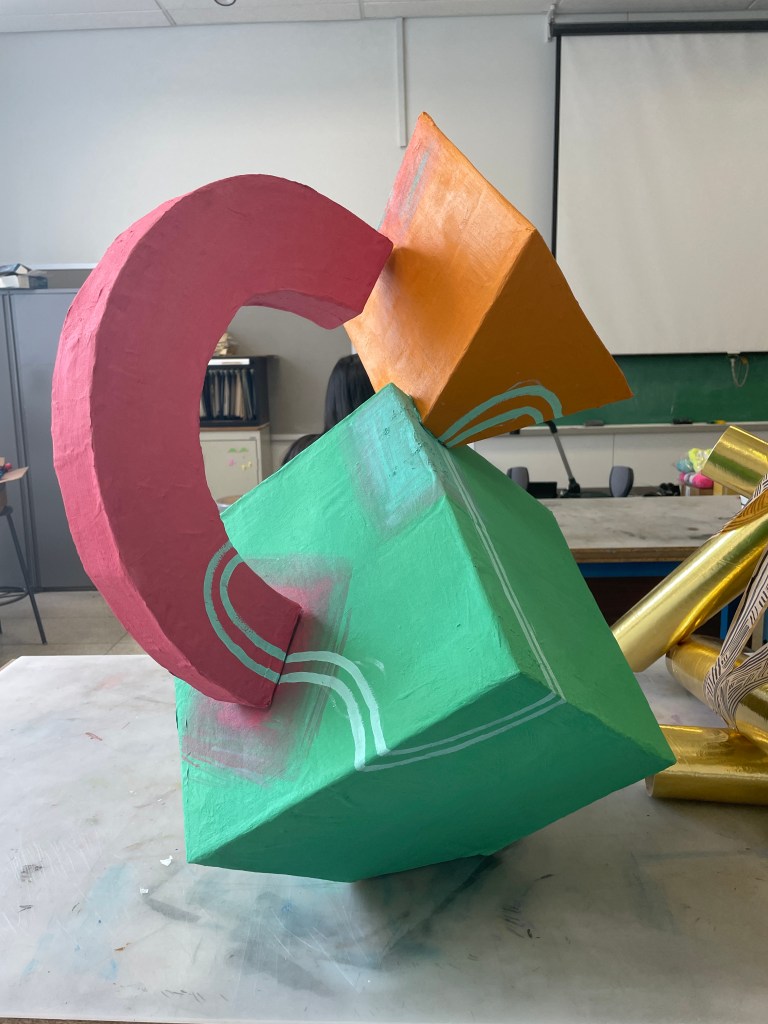
When starting this project the two things that I had in mind was color and balance. I wanted the sculpture to be sort of topsy-turvy. I first started by making the base cube of the sculpture and then cutting a corner of it so that it would be able to sit flat. I then began the process of making the triangular shape and cutting a slot in it that would allow it to sit on top of the cube. Finally I made an arch shape.

From there I began the process of covering the surface of each of the shapes. I put a layer of glue on each side of the shape and then placed a large sheet of paper on top of the glue ( a sort of quick version of paper mache). Once that was done and the glue dried I mixed acrylic paint and baking soda and painted each form.

The final step was assembling the pieces, during this process I had to make some adjustments so that the piece was still able to stand and one side wasn’t too heavy. After the shapes were assembled I painted a set of lines that would wrap around the entirety of the piece.