Olafur Eliasson

Olafur Eliasson is a multi-media artist who makes works that could possible inspire somebody group project pitch– which is why I decided to talk about him this week. He makes large scale installations, drawings, painting, sculptures and even does photography and film. Born in 1967, Eliasson are up in Denmark where he studied at the Royal Danish Academy of Fine Arts. Since 1997, he’s had solo exhibition in major museums all over the world.

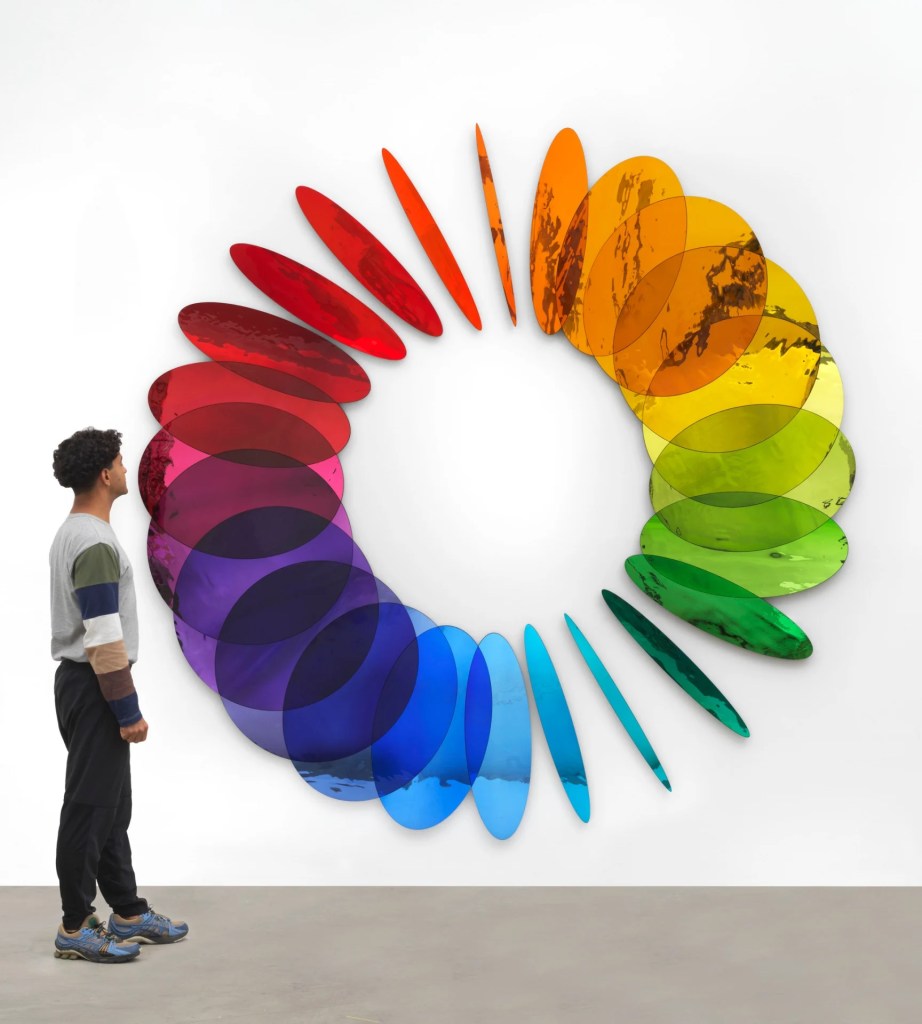
I find these pieces really inspiring when thinking about the group project proposal. He uses handblown colored glass to make his work, so we wouldn’t be able to use those materials but I like what he achieves when he plays with light, color and reflections.

Sources:

https://olafureliasson.net/artworks/

https://olafureliasson.net/biography

https://en.wikipedia.org/wiki/Olafur_Eliasson

Line Project

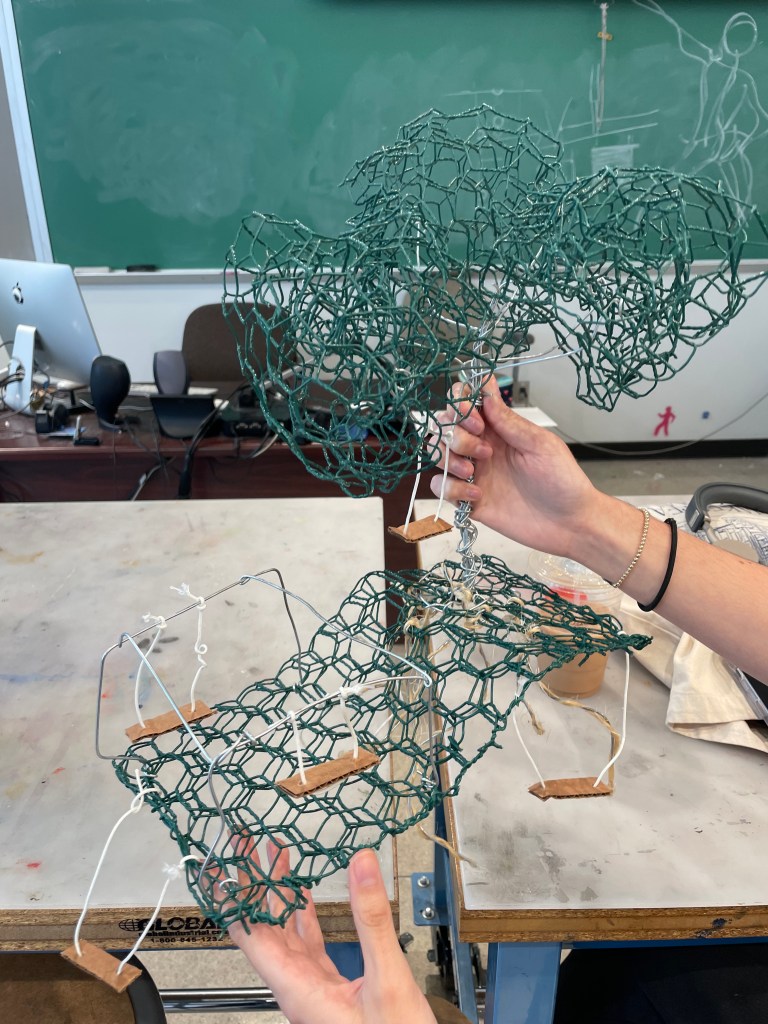
Our line art project started with brainstorming ideas and browsing Pinterest. We were drawn to the idea of incorporating a tree into our project, inspired by a green wire that resembled glass. After stumbling upon an image of a wire tree house, we decided to create something similar. We used the green wire as a base, laying it flat to represent the ground, and then used silver wire to form the trunk of the tree. To create the tree tops, we bunched up the green wire. However, we encountered a problem when the tree became too heavy for the flat wire base to support it. To solve this, we decided to hang the tree, which gave it a slightly crooked look that we liked. Ultimately, we decided to abandon the tree house idea and instead created a swing set.

As we continued to work on our project, it took on a darker theme. We added swings underneath the tree and incorporated roots emerging from the base, which gave the impression of an underworld. Our desire to add a creepy doll to one of the swings led us to craft one from sticks and twine. As we continued to work on the project, the dark theme became more prominent.

Collage

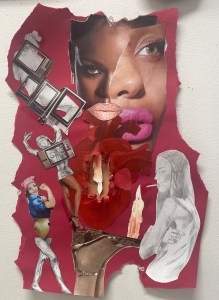
For my collage I wanted to focus on the female figure. I took lots of images related to the female figure found in magazines and some of my own sketches. I also took pieces of work I made that were painted and were of other objects like candles and a heart. I wasn’t sure what narrative I wanted to create but I started by using the xacto knife to cut all the images of the figures. I then placed them out on a red piece of paper and played around with different combinations. I ended up deciding I wanted the heart to be at the center and having the middle with the figures surrounding it. My goal was to have the figures interact with each other and connect with their surroundings.

Atmospheric Perspective Drawing

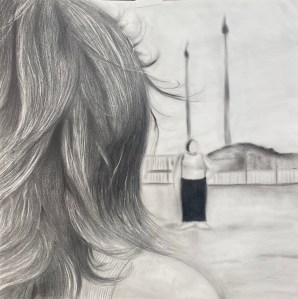
For this drawing I wanted to use an image that had high focus in the foreground and a really soft and blown out background. I knew I’d be able to achieve the contrast with graphite and charcoal.I chose a reference photo that was originally in color, but I changed it to black and white to mimic the media I’d be using. I focused first on the figure in the foreground and really paid attention to the details, depth, and values in the hair since that would be what everyone looks at first. A lot of it consisted of laying down darker values and using a brush to blend and an eraser to remove for highlights. Once I got to the background I used more charcoal to get a rich black color and used my brush to diffuse all the hard edges to give it that out of focus look. 

Line Project

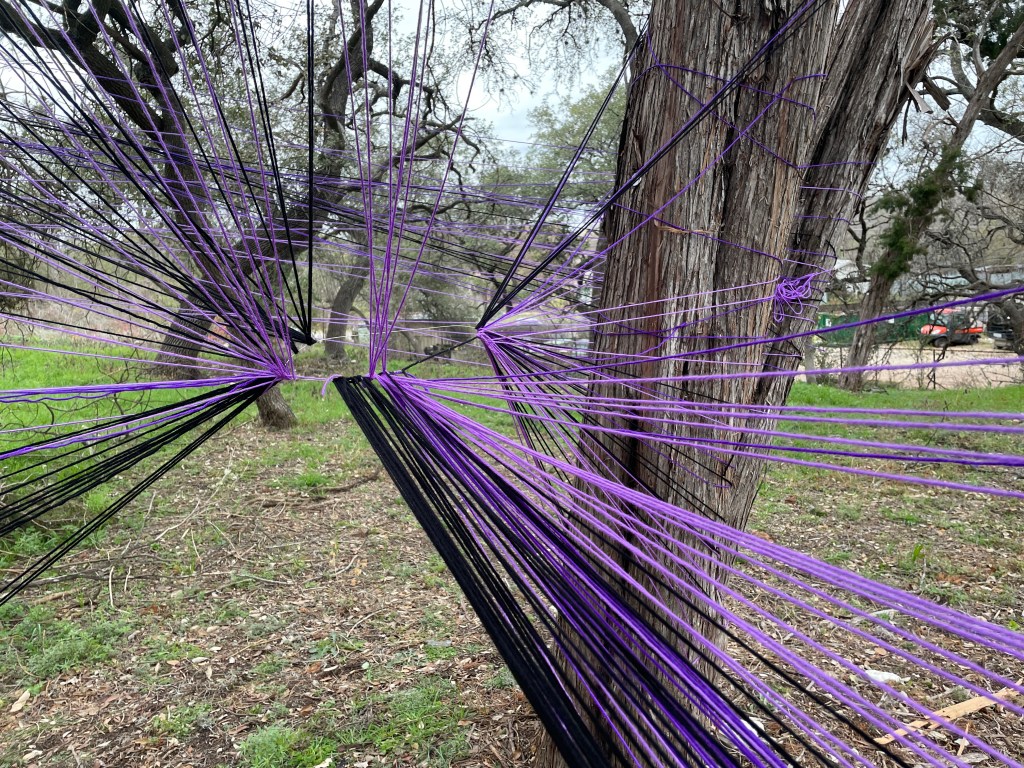
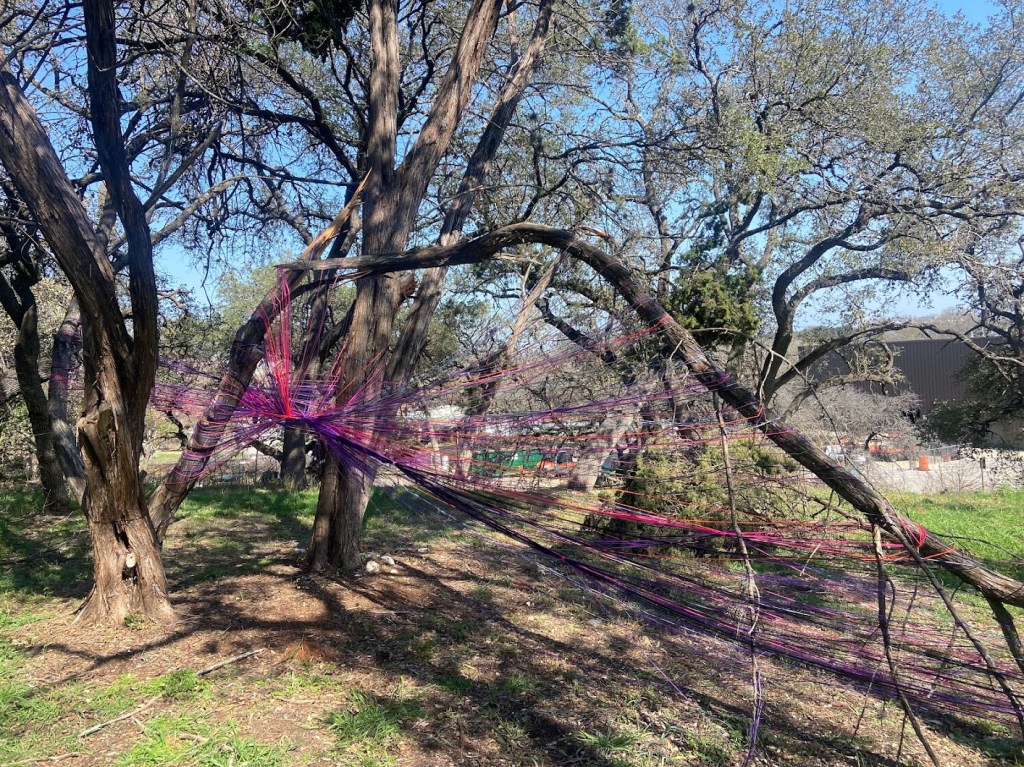
When beginning this project Clara and I talked about the works that we like best from a presentation show in class. We both really enjoyed the ones that were installed in nature. With that in mind we decided that we wanted to do something outside and use a tree in some way. Once we found our sight we started by brainstorming what colors of yarn we wanted to use and landed on using colors that would stand out from nature. We wanted to create a sort of portal between two trees. After gathering materials we began by first making a wire loop and tying it between the two trees and after starting to wrap the yarn. As we worked we started to expand from just wrapping on the two tree trunks. 

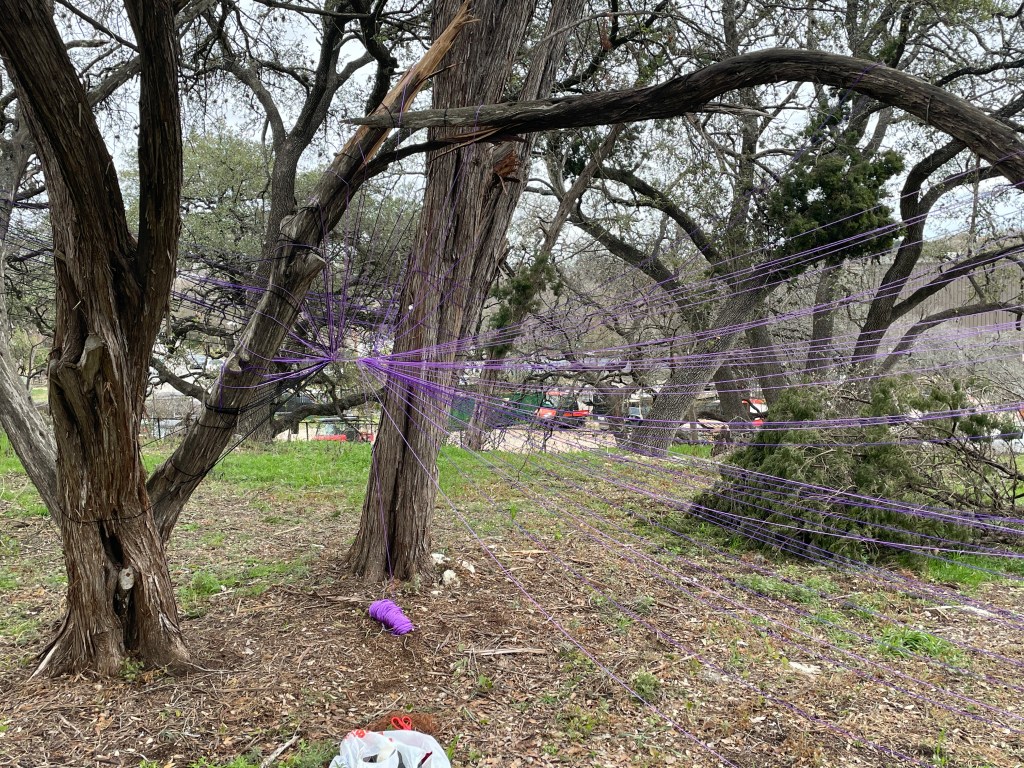
After working on it the first day it wasn’t standing out enough so we decided that we would get more yarn, specifically neon colors. Our primary strategy was to wrap as much yarn as we could because it made it more visible from afar. After returning from the weekend we found that the wire loop had broken and a good amount of the yarn had fallen. We decided to hang the yarn that had fallen on the broken branch above. We also decided to add more of the little knots we started to add the week prior. We also added some more yarn in areas that felt empty because of the fallen yarn. The final thing that we did was wrap black yarn around the center air loop so it was extra secure and acted as a central point for the piece.

Overall I really enjoyed the process of working on this project and ultimately think that it breaking made it more visually interesting with the contrast of the tight and more droopy yarn.

May Tveit

May Tveit is an artist that makes large sculpture and installation work. The work shown in the images below are specifically from a series Tveit created titled Universal Boxes. The medium of this work is cardboard. With this body of work Tveit wanted to explore the transformation of this everyday somewhat ignored material.

Her interest in cardboard began during a residency she completed at the Lawrence Paper company. During her time there the factory workers would make large sheets of cardboard for her which she would cut using their prototyping table.

While some may not believe that cardboard hols any special meaning as Tveit worked more with the medium she described that she began to think out it in a more metaphorical way. As cardboard is something that holds, protects, and transports things. Looking at this work you can see that there are numerous layers of flat cardboard that have been cut. Tveit has spoken about how her decision to work with flat pieces of cardboard is because she was intrigued when at the factory looking at the flat cardboard boxes because they had yet to fufill their purpose.

I enjoy how her work transforms the cardboard into a new sort of cleaner appearance where it also takes a second to realize what it is. It is also interesting to hear the concept and motivations behind the work.

Citations

https://www.kcur.org/arts-life/2018-01-05/working-in-magical-cardboard-a-kansas-artist-finds-herself-in-a-universal-box

https://www.maytveit.com/bio

Youtube: May Tveit – Universal Boxes

Line Project

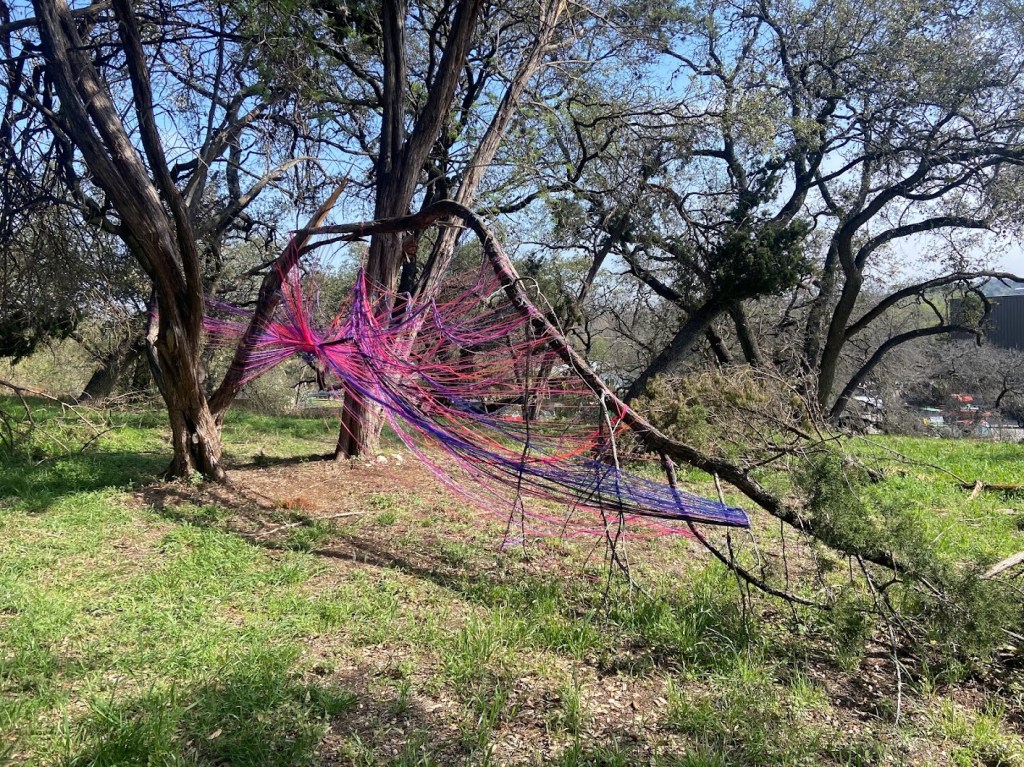
I knew right off the bat that I wanted to work with yarn and a tree so I found a like-minded partner. Together, we came up with the idea to create a “portal.” We decided to use purple and black yarn to contrast the natural green and brown colors of the site. We found a tree we liked (with a broken branch) and decided to do something to mend the broken branch back to the tree.

After one day of working on it we decided we needed to make changes. Instead of just using purple and black, we wanted to expand into other bright colors– specifically pink. We decided to incorporate orange, blue and a color changing yarn as well.

After adding those additional colors, we decided we wanted to play with the lines more so we took little pieces of yarn and tied the longer pieces of yarn together in certain places to shape the mass of the portal. It was at this point when we left for a weekend that the wire supporting our entire wrapping broke. We found it broken on Tuesday and went right back to work. First we repaired it to the extent that we could and then we continued to add more yarn and more little knots.

Overall, I’m super happy with the end result. I think it accomplishes everything we wanted it to accomplish. I think we did a great job of overcoming obstacles and making the most out of the two weeks we had to work on this.

Line Installation

When my teammate and I first started our project we found some inspiration on Pinterest thinking of maybe making a treehouse situation out of wire. From there, we created a tree and were struggling with how we should incorporate a treehouse into our tree. We eventually drifted away from the idea of doing a treehouse and created a swing set. 

The way in which we created the base was by using chicken wire and folding it to make it stronger. The color of the chicken wire is green so, that helped our line installation to represent grass we also rolled up some chicken wire into balls to create somewhat of a leaf-like appearance to the trees. For the trunk and the branches, we used some random silver wire that was pretty malleable. For the roots of the tree, we wrapped twine around some of the silver wire that was used for the branches. We then created some swings that would hand from the tree, the swing set, the branches, and the roots. 

Once we had finished creating the scene we played with names that we could name this piece and we landed on ‘Where Did All The Children Go?’ which is the name of one of the group dances that was performed on Dance Moms. After, watching the dance we wanted to create one figure that would be left swinging on one of the swings that are made of cardboard and white string with the figurine made of wooden sticks and twine.

Before hanging it up, adding the finishing touches and installing the final piece.
The final product of our line drawing into space with the figurine.

Alberto Giacometti

This week I decided to choose a more well known artist from the early 1900s (1901-1966), Alberto Giacometti. Alberto was born in Borgonovo, Switzerland and grew up around his father and grandfather who were both painters- Growing up around art inspired him to become an artist himself, and he would later become a painter and sculptor. In 1922, Alberto moved to Paris and got an education at the Académie de la Grande-Chaumiére.

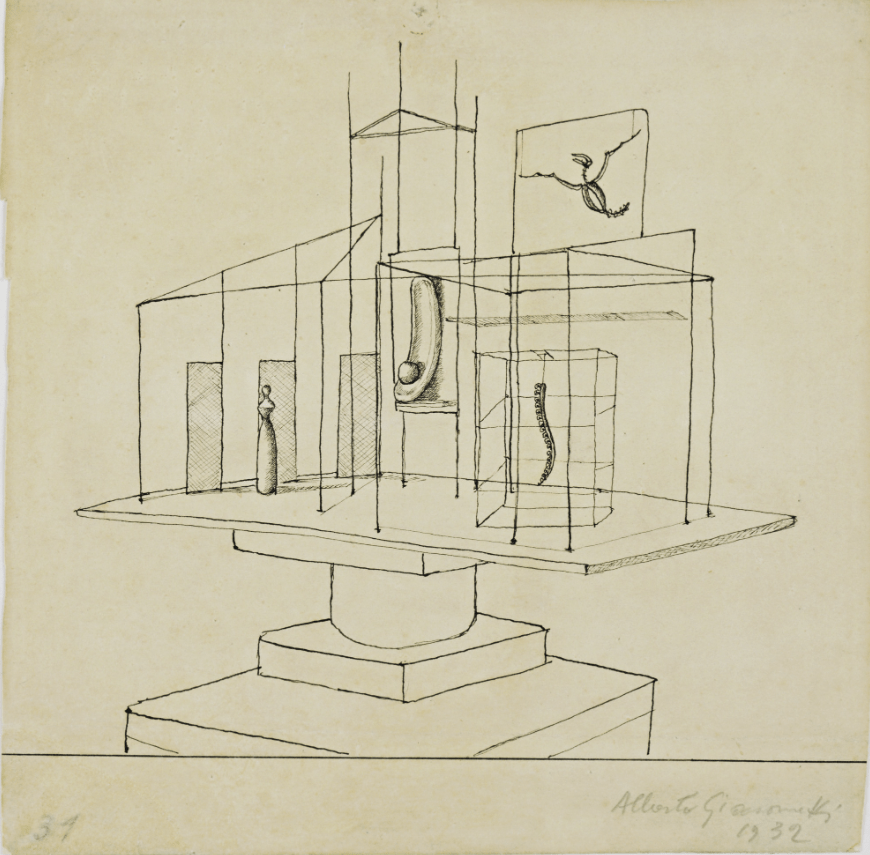
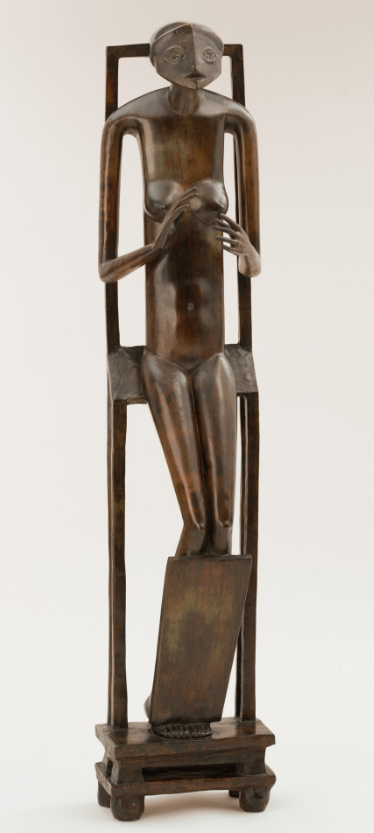
The surrealism and cubism movements of the 1900s greatly influenced Alberto’s work. He started off creating 2d work, integrating cubist elements into his sketches like Study for The Palace at 4 a.m. Over time, Alberto focused more on 3d work and started making bronze sculptures. As World War 2 unfolded, the chaos and despair of warfare stirred up was a common theme in Albertos work- The figures he created are strangely surreal, limber, and appear shriveled and existential. This may also come from his creative process, where he states “From 1935 through 1940, I spent every day with the model. Nothing went as planned. For me, a head became a wholly unfamiliar and dimensionless entity.” Emotion and the human condition played a big role in Alberto’s work, and a quote I found that sums it up pretty well is “He sought to make renderings of his models as he saw them and as he believed they should be seen.” For example- he sometimes made extremely small sculptures because the models he worked off were far away in the distance. However, he also made towering sculptures that spanned over 8 feet tall. Even decades after his death, Alberto Giacometti’s work continues to be eye-catching and thought provoking.

Study For the Palace at 4am, 1932
Hands Holding the Void (Invisible Object) 1934 (cast c. 1954-55)
City Square, 1948

Edwards Hopper

Edward Hopper was born in 1882 in New York. In 1900 he went to New York School of art and did illustration and proceeded his work as a illustrator after his schooling 1906. Later he went on trips to Europe which changed his way of doing art in the future. What really influenced his was the architecture and traditional art that influenced his work, especially in Paris, France. During the 1900s was when impressionism became more present. He found influence through artist such as the classic Monet and Van Gogh. Due to the references and influence, he started using a lighter color palette and quick strokes. He went on to do lots of paintings of landscapes and in 1942 his most famous piece, Nighthawks, was put in the Art institute of Chicago.

Nighthawks, one of my favorite paintings, was created during the war to reflect how Americans felt during the period of the war. You can see how the lighting on the diner is portrayed and how the influence of Europe is translated in his pieces.

Chop Suey by Edward Hopper is another impressionistic painting. The lighting is also shown in this painting such as the others that he has done. The light on the characters is carefully placed and done wonderfully. In this painting he also captures this moment of loneliness even though each person has company. I believe its due to the closure. It feels very alienated due to the sign being hidden and same for the other girl and table to the left

https://www.edwardhopper.net/chop-suey.jsp

https://www.edwardhopper.net/