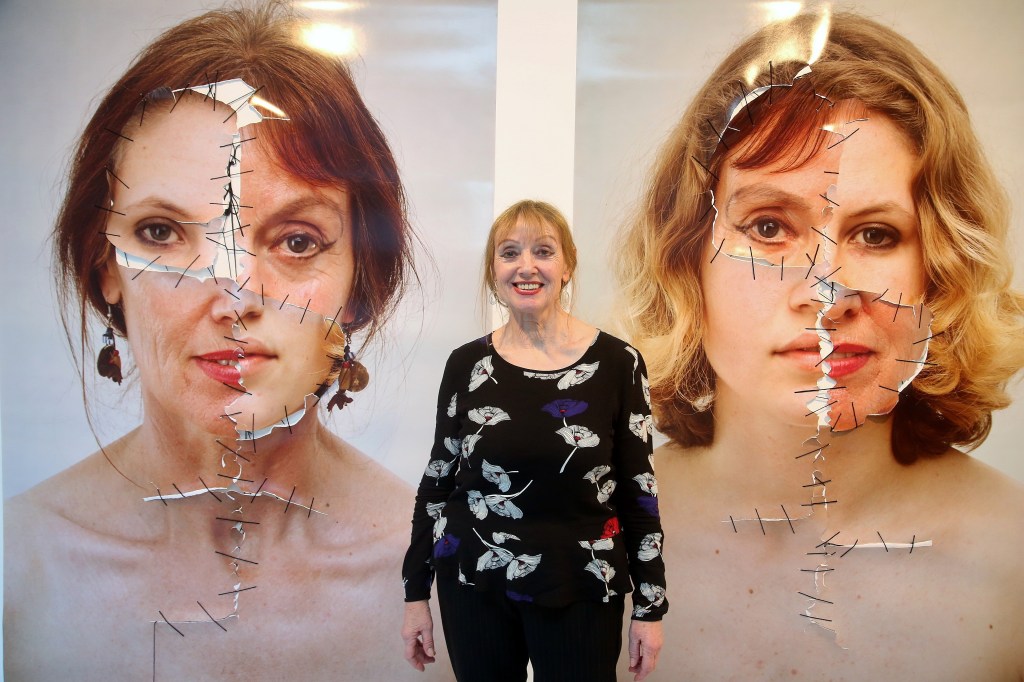
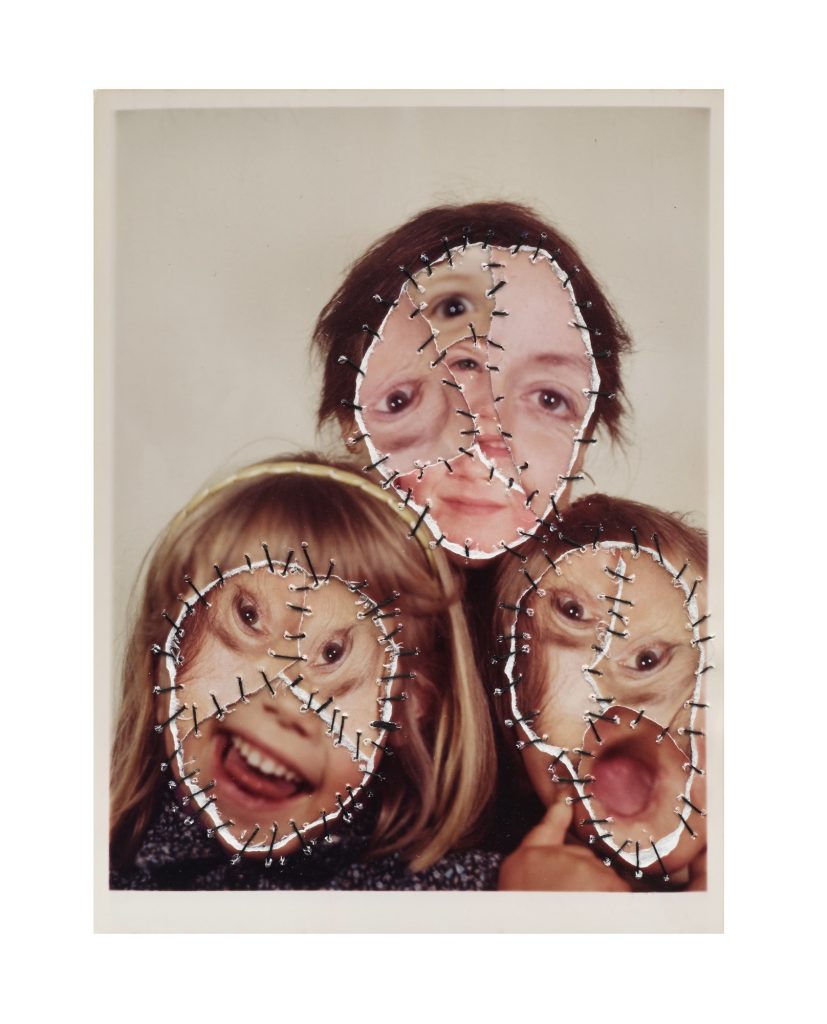
Annagret Soltau is a visual artist born in Luneberg, Germany, 1946. Majority of her work features photographic montages of herself and other people, cut up, and sewn with black thread. Although these works are collages, with threaded holes sewn throughout, they give off a pristine feeling.
Her photography and work focuses a lot on the female form and bodily processes, but it is also her way of searching for her identity. The work almost gives off a dark energy but I think it is just because peoples faces are being cut and sewn, which reminds me of the idea of mutilation. These are not as gory as that concept though, maybe she is symbolizing the mutilation of herself and what it can feel like when you are questioning your identity.
“I am using myself as a model because I can go the farthest with me” – Soltau
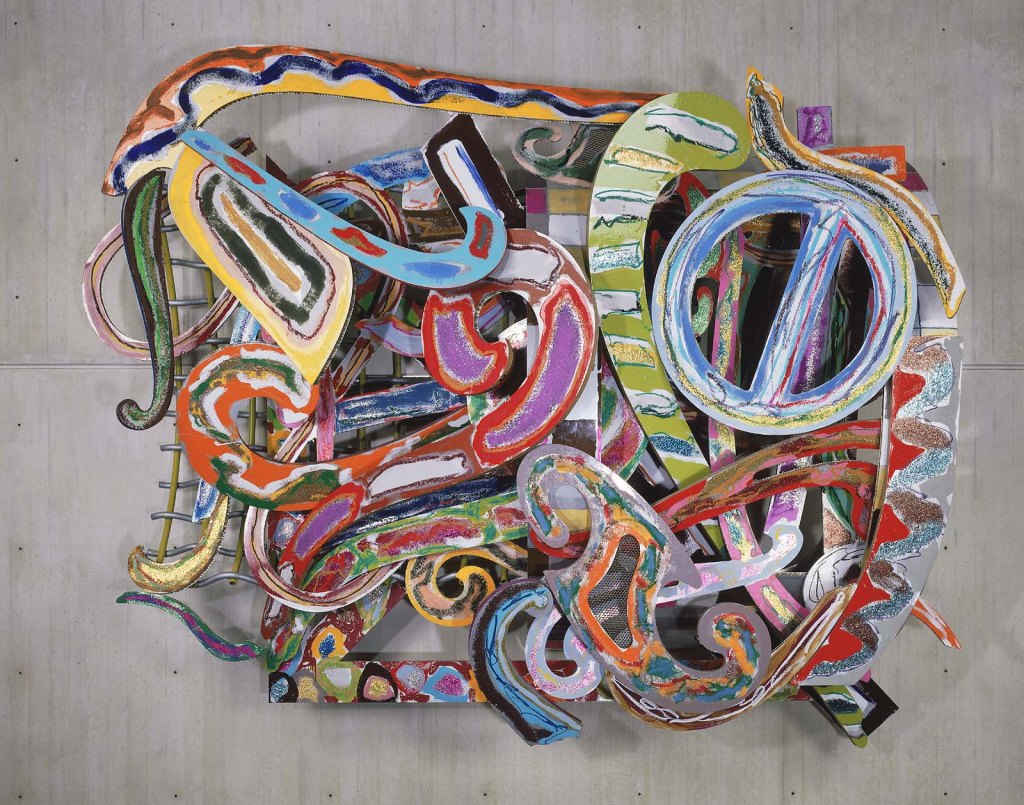
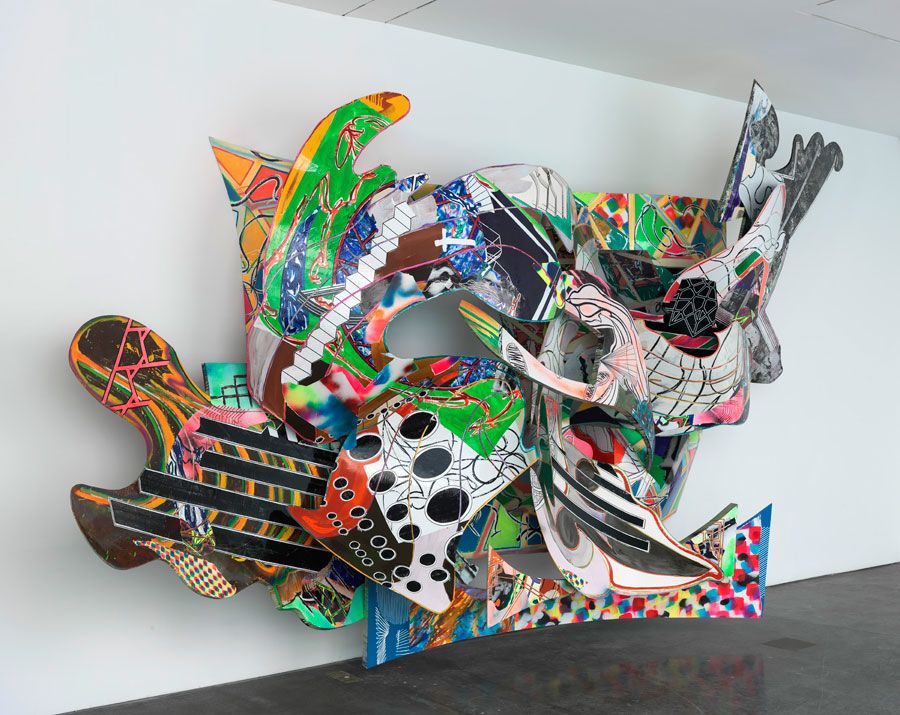
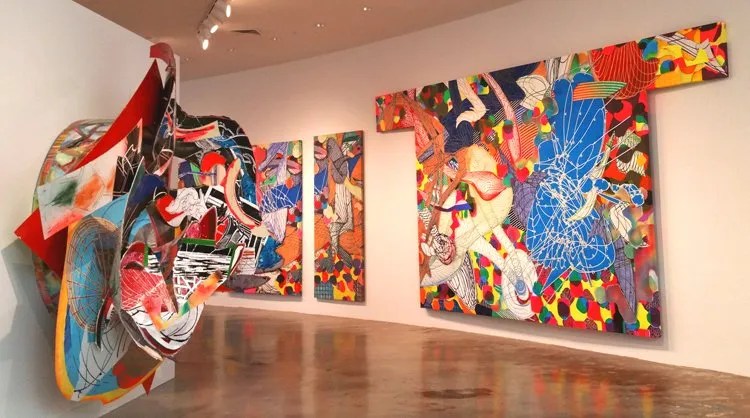
Frank Stella, born in 1936 on May 12, is considered one of the most famous post-American war painters but works with many other different mediums outside of paint, such as aluminum, cardboard and even 3D-printing. He began painting boats and cars, later using his creativity to make art when he moved to New York in his 20’s. His work is highly abstracts and saturated in different colors, textures, and patterns. Oddly enough, his work began with minimalist ideas and focused on basic lines and minimal colors. As time went on, he explored new ways of creating. He began as a leading figure in the Minimalist art movement and later became known for his irregularly shaped works and large-scale multimedia reliefs. When I look at Frank’s newer works, it makes me feel excited and joyous. It amazes me what feelings can come from abstract works like these.
Our line installation consists of fishing wire, broken pieces of glass, a wooden rectangle and chicken wire. First we attached the fish wire to the wood piece and spray painted it white in order for it to blend in with the ceiling.
I had these pieces of glass sitting in my closet for a good amount of time so I thought it would be good to utilize for the line project. I love how they are a bit transparent which gives a stained glass effect with the light and how they chime in the wind. The hardest part was tying the wire around the glass tight enough so that it would not slip or fall through. The piece reminds me of a more adult baby mobile that hangs above a crib. There are many ways that we could tweak this project to make it even better to look at, but it came out pretty decent.
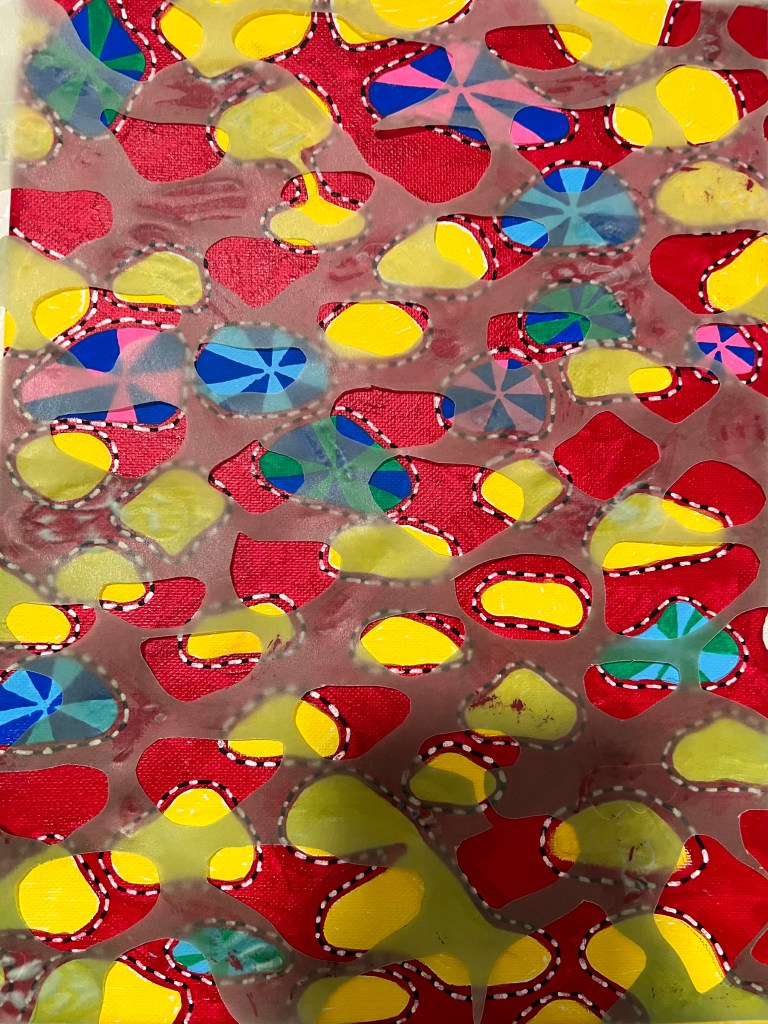
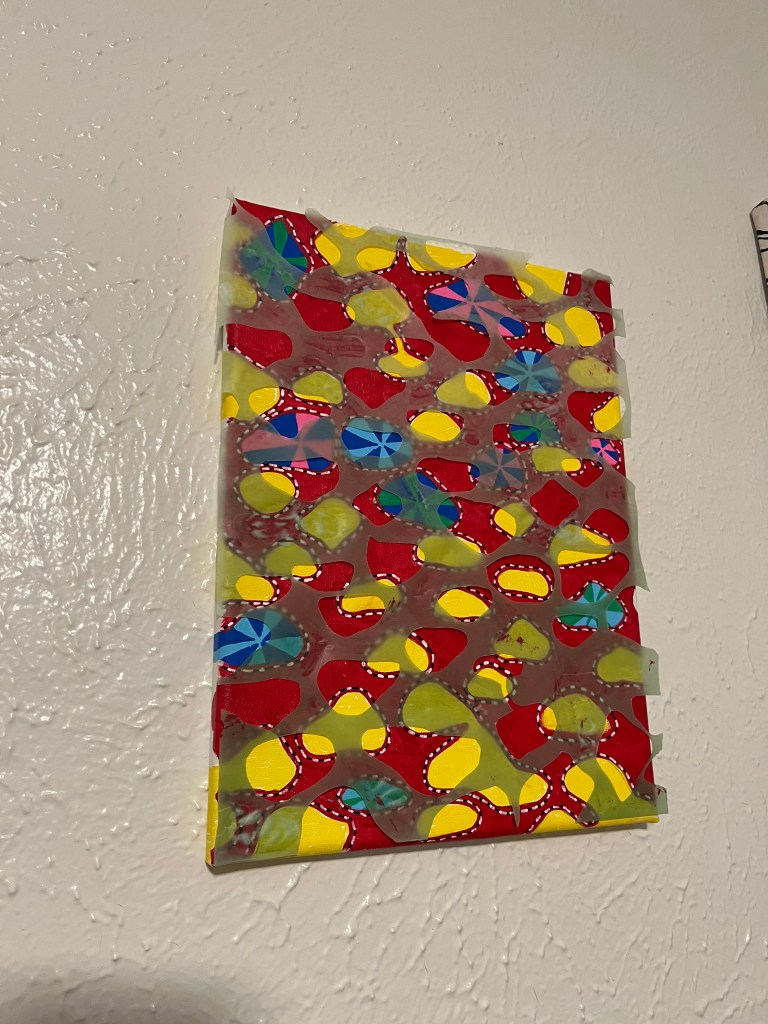
For my transparency project I utilized this thin blue paper I had. It originally had clouds all over it that I had to trim out, leaving holes on the page. A pattern of circular shapes popped into my head which is why I made the abstract pattern underneath. The colors are a bit hard to look at for me, I could have picked a better color combination in the end. Another thing I would have fixed was the splatter of red paint on some areas.
During the painting process, I found that it was therapeutic to make the striped lines and fill in the circles with lines. Pattern is something I love incorporating into my work, I love the organic nature of it. In the end, it was a fun project but I would definitely make something different next time, more aesthetically pleasing.
Lynda Draper is a ceramicist whose work pushes the limits of the medium. In her work often you will see narrow tubular forms that have been described as drawing like. Draper studied education and ceramics at UNSW, she is currently head of ceramics at the National Art School.
Draper is quite process oriented, finding that her best works evolve as she works allowing herself to exist in an almost subconscious reverie as described by Sonia Legge in an article titled “Home and also somewhere else very far away: Lynda Draper”. Taking this into account draper often will only create preliminary sculptures when she is without clay. Looking at the construction of the work itself Draper uses a variety of enamels, glazes and lustres on the surface of works. To build the works she uses handbuilding techniques such as coiling and pinching. Due to the delicate nature of the forms that she creates she often builds directly on a shelf that can be placed in the kiln to be filed.
A final interesting aspect of Draper’s work is that she has spoken about how some of her work is brought about by memories/personal experiences. She has spoken specifically about how some of her works were brought about from revisiting her childhood home and how working on the pieces allowed her to confront objects of her past that were once distressing to her. This is interesting to know because her works and the shape and colors used in them evoke different emotions.
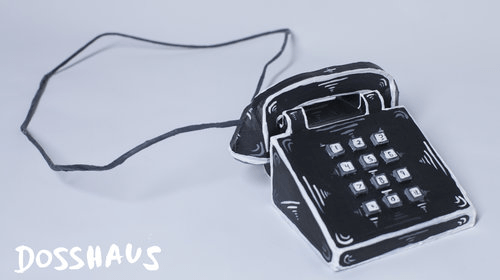
There’s not much I can find on Dosshaus when it comes to his age, where he’s from, and where he was born in. However, what I do know, is that he’s an art collective founded in 2011 and the nom de guerre of David Connelly. Created in response to a society saturated with social media-generated images in which reality itself seems all the more relative, Dosshaus uses recycled cardboard, paper, and acrylic to create its own highly idealized universe. He also has his own art exhibits at Oceanside Museum of Art and Torrance Art Museum. As awards go, he won in outdoor sculpturing at Lucca, Italy on August 2018. No more awards sadly. As for what kind of art he does besides sculptures, he does installations, performance art, fashion, film, video, and record and posts them on his Twitter, Instagram, YouTube, and Facebook.
I personally think his sculptures are so creative and artistic. It’s like as if I’m actually looking at a live action cartoon of certain objects that we usually see and use. I’ve never see anything like this before, so it’s kind of special.
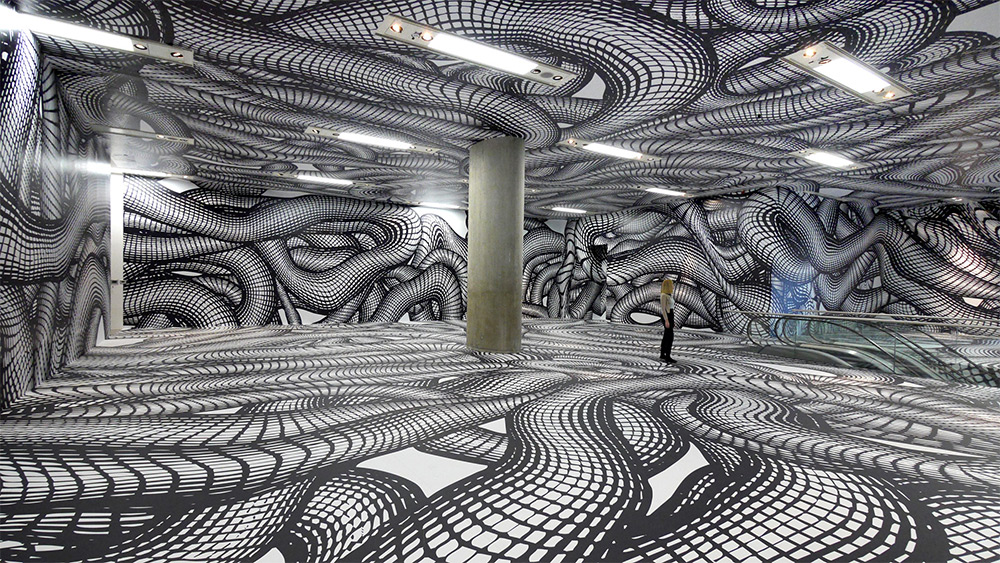
This week I chose to research the artist Peter Kogler. Peter was born in 1959 in Innsbruck, Austria. He was mostly inspired by the 1970s where that was a period of growth in the arts. He is internationally known, holding exhibitions all over the world such as: Galerie Sylvane Lorenz, Paris, Galleriea dell’Ora in Rome, and Museum Moderner Kunst Stiftung Ludwig in Videnna. Peter is widely known for his hypnotic room installations, taking architecture and creating it into surreal environments. He uses paints and projections to create his own wallpaper on spaces that are often forgotten, like stairwells, corridors, and entrance halls. He states in a 2014 interview, “I have always been very interested in the question as to how far my visual or artistic idioms can be transformed by technological developments and moves to different media”. His concepts create optical illusions that play with time and space. I enjoy his work because it’s interactive. I feel that any work or installation that allows the viewers to interact, or be a part of it, help engage them more. It’s as the audience is a piece of the work. The rooms would feel incomplete if no one was able to walk around them.
This week I decided to research Dan Flavin, an artist that works with lights. He studied at the University of Maryland Extension program in Korea to get his art degree. He also went to Hans Hofmann school of Fine Arts in New York in 1956. In 1959, he started working in drawing and painting that influenced the start of his abstract expressionism. In 1961, he created bunch of drawings for sculptures that had electric lights, which really where his success comes handy. He went on to take those drawings and make lights into monochromatic canvases, then later on worked with fluorescent tubes.
I feel as though his art works super well when drawing in space. I love how his installations provide these reflections onto the ground and made the piece bigger then what it actually seems to be. Especially when moving in different directions, you can make the reflection longer or shorter. Even though Dan Flavin offers this minimalist style, he makes his art super fun to look at. I think this is something I would want to try and create in the future.
El Greco was born, Domenikos Theotokopoulos on the island of Crete located in Greece on October 1, 1541. His father was a tax collector and there is not much information out there about his mother. Theotokopoulos’s brother was a merchant who did pretty well for himself however he spent the last few years of his life living with his brother.
He went to Cretan School where he studied various types of art. A main focus of study for him during this time was Post-Byzantine Art as well as classics and ancient greek art. Around 1567 he left to pursue an art career in Venice, Italy but soon after moving there, he moved to Rome, Italy. In 1577 he left Italy and moved to Spain where he spent the majority of his life and where he died. He moved to Toledo, Spain where he completed nine paintings for the church of Santa Domingo one of which was The Assumption of the Virgin. Soon after he had done some commission pieces for the king of Spain, King Phillip II.
From 1597 to 1607 El Greco experienced great success. During this time he painted in the styles of, painting, sculpture, and architecture while later being known for his contributions to Mannerism and the Spanish Renaissance movements. He died soon after this increase in artwork on April 7, 1614, in Toledo, Spain, and was buried at the church for which he did many paintings for.
The Assumption of the Virgin was painted with oil paints from 1577-1579 in Toledo, Spain. You can now find it at the Art Institute of Chicago in Chicago, Illinois.View of Toledo painted with oil paint on a canvas during 1596-1600 in Toledo, Spain. You can now find this painting at the Metropolitan Museum of Art in New York City, New York.
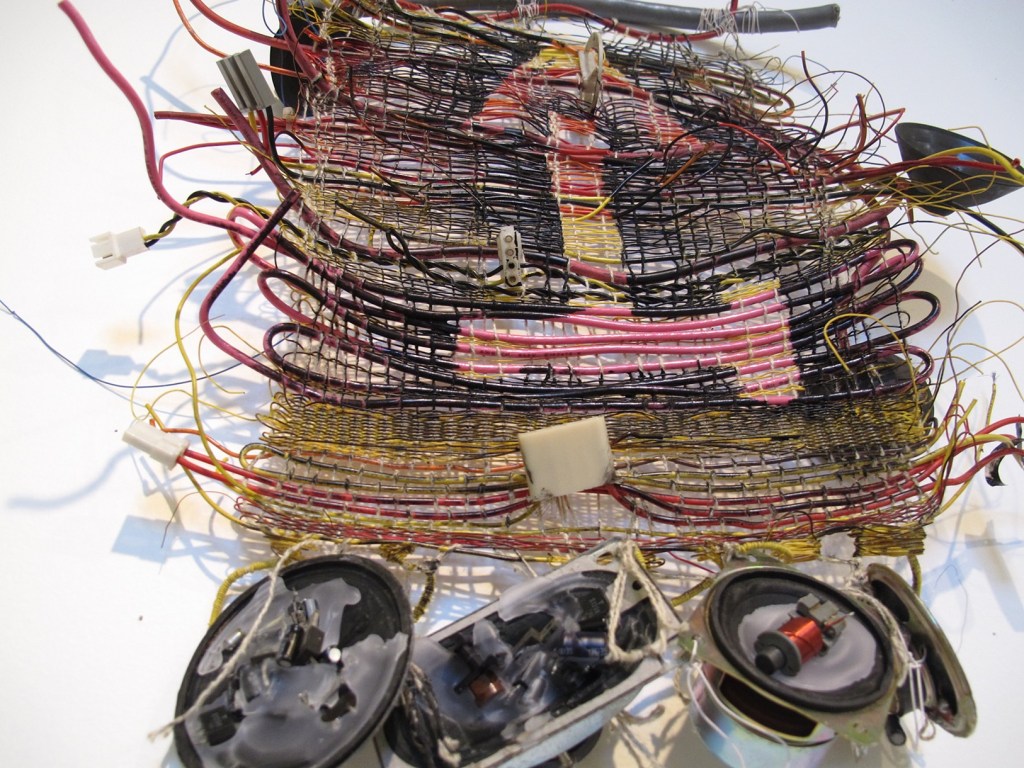
Robert Mertens is an artist and curator born in Wisconsin. His work covers a wide range of mediums, and he often uses material like fabrics, wire, and found items to create large, eye-catching sculptures. In his website bio, it is stated “His work revolves around the intersections between technology, religion, science and myth. These pieces combine new media with traditional fibers craft and culminate in performances, installations and powered sculptures.” I was intrigued by Robert’s work because of the rugged appearance of his pieces- aged fabrics, stained material, and overall coherence of pieces that you normally wouldn’t picture together. Aside from traditional artwork, Robert is also trained as a sound technician and creates soundtracks that reflect human life. Currently, Robert lives in Virginia and works at the James Madison University’s School of Art, Design and Art History as a creative director. He has held six solo exhibitions since 2010, and his work has been featured all around the country.













 drawing into space