Karine Jollet

“Ancestor”, 2005, old bed sheet and wadding, 36cm x 43cm x 25cm. Karine Jollet

Karine Jollet is an artist based in Paris who specializes in sculpture, metals, and design. Her main focus has always been on exploring the relationship between the outer surface and the contents of objects. She began working with textiles since it was a softer and more flexible medium, and eventually started using recycled fabrics such as old bed sheets and shirts to create sculptures that resemble the human body. Her work has been exhibited in private and collective exhibitions across France and in Switzerland, Belgium, Italy, and Japan.

Jollet’s sculptures show depictions of the human body, including organs, muscles and faces, but without any of the messiness or blood. All of her work is created in white fabric, which she uses as a symbol for skin, representing the “covering that conceals what lies beneath”. Jollet’s art challenges viewers to reconsider their perceptions of the human body by isolating it from its more unsettling aspects and presenting it in an almost ethereal light.
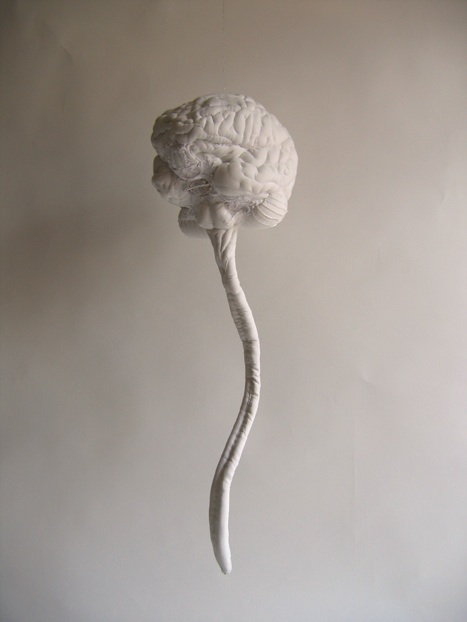
“Tribute to hypophysis – Brain”, 2011, old bed sheet, shirt, embroidery, pearl, polyester fiber and electric wire, 70cm x 19cm x 19cm.
https://medinart.eu/works/karine-jollet/

Clare Celeste

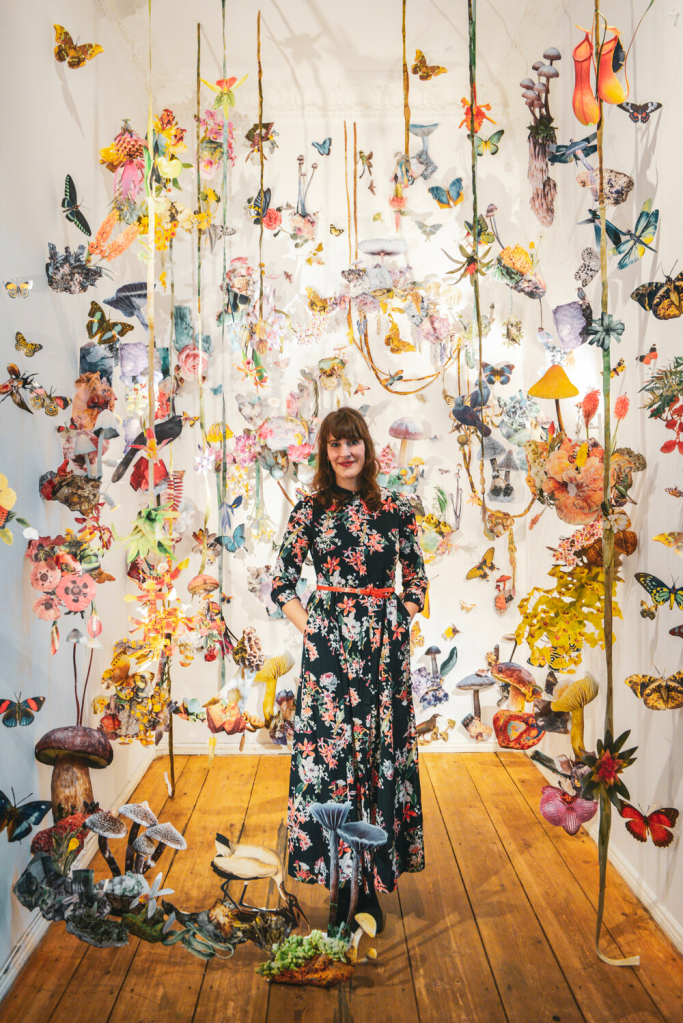
Clare Celeste Börsch is a collage and installation artist based in Berlin, Germany with her husband and son. As an environmentalist artist, she uses her work to create immersive installations of flowers and fauna that bring awareness and inspire action toward the ecological and biodiversity crises around the world.

Biodiversity

“68% of biodiversity has been lost in just 50 years. As I rip down, and then mend, 68% of my installation, I share a message of love, urgency and hope.”

Celeste’s love of collage comes from her own background of having to grow up all over the world. She compares her life to a collage of sorts and establishes her love of creating collages on a personal level. She would start by collecting, cutting, and sorting out all her collected images before delving into focused sprints of creativity to make her large works.

Celeste has even stated in an interview that her most prized object in the studio is her image collection. She has her collection organized into boxes with labels of what they contain such as “reptiles and amphibians,” “tropical flowers,” “roses,” “succulents,” and “snakes” just to name a few.

Holding Light (2021)

“Holding Light is a rotating chandelier made from images of flora and fauna. The work was accompanied by three personal essays that wove together personal narrative with broader issues of racial, social and environmental justice. The closing component was a guided meditation. The meditation was offered as a gift and a way to gather strength and light in dark times.”

Celeste’s mission when creating her work and installations is to:

• Partner with those committed to a just, regenerative and biodiverse future that is powered by 100% renewable energy.
• Create collaborative works that engage audiences of all ages on the importance of biodiversity.
• Use art as a form of environmental activism.

The Healing Garden

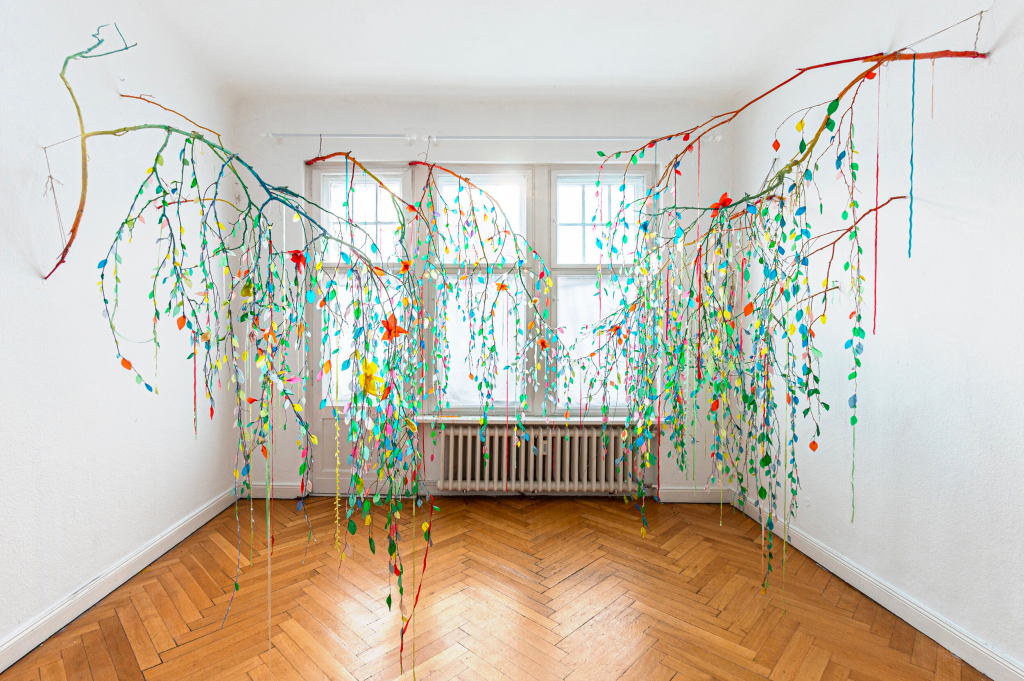
“The Healing Garden’s branches were foraged from local forest beds and the translucent leaves are made from a homemade bioplastic of red algae, plant gelatine, water, and organic food dyes.”

Celeste’s Links:

Dale Chihuly

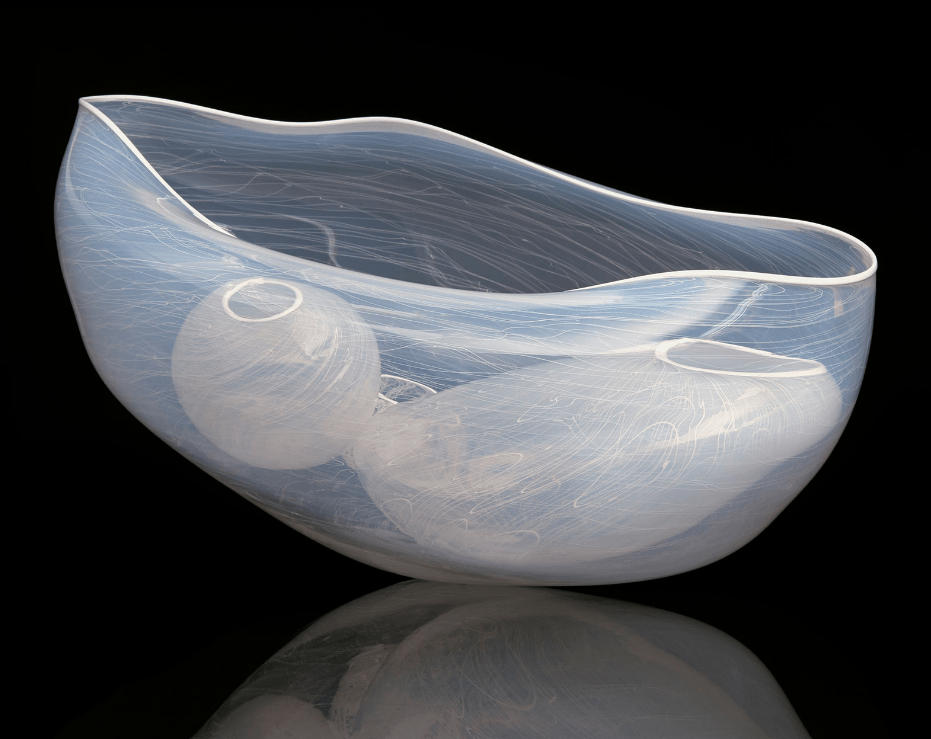
Dale Chihuly was born on September 20th, 1941 in Tacoma and is still alive today at the age of 81. He’s an American glass artist and entrepreneur. He is best known in the field of blown glass, “moving it into the realm of large-scale sculpture”. However, in 1976, while Chihuly was in England, he was involved in a head-on car accident that propelled him through the windshield. His face was severely cut by glass, and he was blinded in his left eye. After recovering, he continued to blow glass until he dislocated his right shoulder in 1979 while bodysurfing. No longer able to hold the glassblowing pipe, he hired others to do the work. Chihuly explained the change in a 2006 interview, saying “Once I stepped back, I liked the view”, and said that it allowed him to see the work from more perspectives, enabling him to anticipate problems earlier.

Personally, I really love his glass artwork. Working with glass is dangerous, but it sure does look pretty and colorful.

Gabriel Dawe

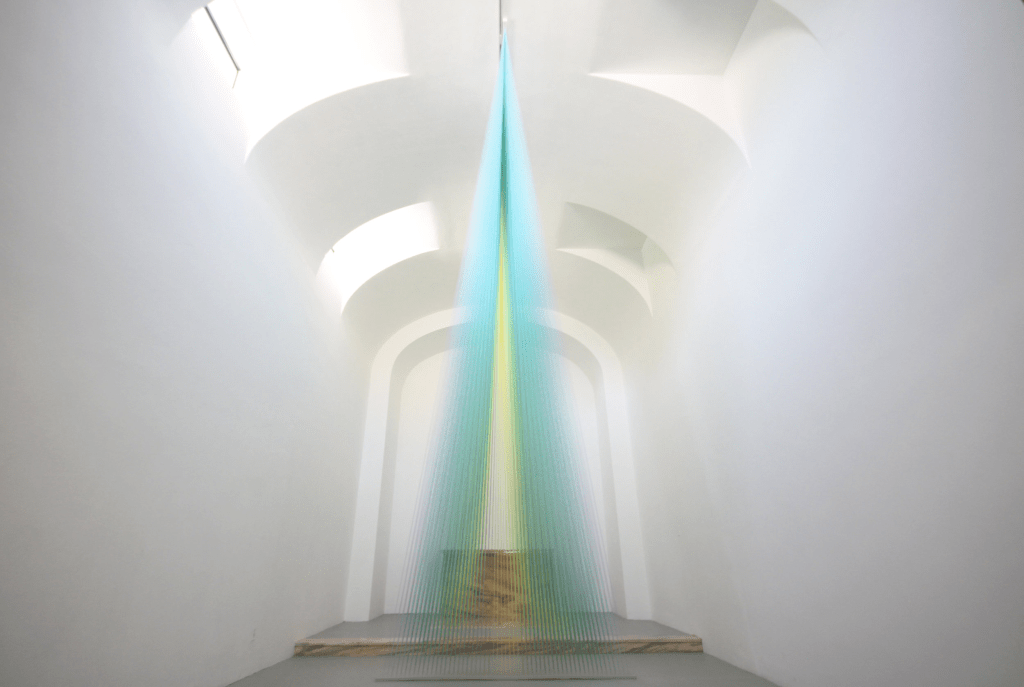
Using a variety of colored embroidery thread Gabriel Dawe creates installations that mimic the appearance of light. Dawe is from Mexico city and his work is heavily inspired by his childhood. As a young boy he watched his grandmother embroidery and showed an interest in it, unfortunately he was teased for this interest. Once grown Dawe went on to get a bachelor’s degree in Graphic design and after some years working in the field found he didn’t enjoy it much. He then decided to get his masters degree in Fine art from the University of Texas.

After getting his masters degree is when he began working with embroidery thread. In the early stages of working with embroidery floss he explored themes of his childhood and his frustrations he faced when his was younger. In his new workers as you can see in the images on this post he is working with rainbows. Often because of that people tend to assume that he is doing it to symbolize the LGBTQ community, Dawe has said that this is not his intention with the work. Instead he hopes to simply signify the feeling of light which is an idea that can feel unifying without making a tie to a specific community.

Citations

https://americanart.si.edu/exhibitions/wonder/online/gabriel-dawe

Jackson Pollock

Jackson Pollock born, Paul Jackson Pollock was born on January 28, 1912, in Cody Wyoming. While he was born in Wyoming he spent the majority of his childhood in Arizona and California. He was kicked out of two different high schools eventually he went to study at the Arts Student League in New York City, New York. 

The style of painting that Pollock is most known for is Abstract Expressionism. The drip period of painting was when Jackson Pollock became known during 1947-1950. The colors that Pollock would use tended to be on the darker side.

I first was exposed to drip-style paintings in elementary school. In fifth grade, we had Jackson Pollock day where we would go to the high school and do drip-style paintings on paper and ceiling tiles. The ceiling tiles were then put back in the ceiling of our art room to live forever which now looking back I think is pretty cool.

During his later years, Pollock would make sculptures by using wire gauze and plaster. Jackson Pollock died, on August 11, 1956, in a single-car accident while he was driving under the influence. He died in Springs, New York at the age of 44.

Convergence, 1952, Albright-Knox Art Gallery, Buffalo, New York
Number 1 (Lavender Mist), 1950, National Gallery of Art East Building, Washington D.C.

Patrick Rochon

For this week’s artist I’d like to look at Patrick Rochon. Rochon is a photographer and is often known as the master of light painting. For those who don’t know: light painting is a photography technique where you take a long exposure in pitch darkness and then “draw” with a light source. I decided to look. at this artist because nobody’s put up any photographers yet and this photographer’s work definitely relates to the class.

Rochon began light painting in Montreal, 1992, and five years later he made the decision to dedicate his life to mastering the practice. He’s very accomplished now and his work has been published several times. He describes his practice in his bio as the following: “As a light painter, I work in the dark. Intuition and imagination are my main senses. By practicing this art passionately, I’ve come to hear the inner self whisper hints and guides me towards new ideas and insights.” Even though his work requires him to largely use his intuition, I think that’s super inspiring and that we should all trying relying on our intuition while making a piece and see how it turns out (just for fun not for class:)

Sources:

https://www.patrickthelightpainter.com/about

https://rochon.io

Vincent van Gogh

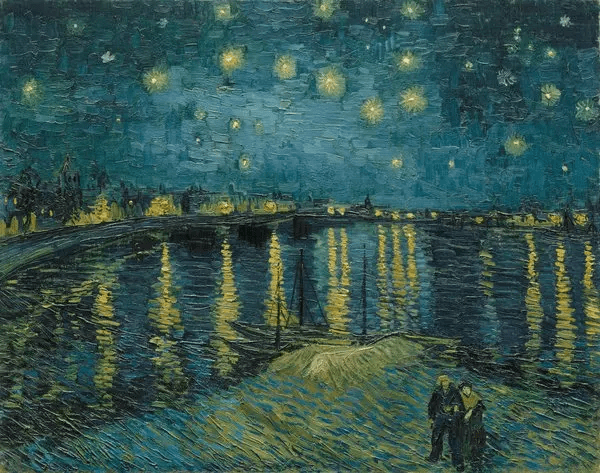
Pretty sure everyone is familiar with him, but Vincent van Gogh was born on March 30, 1853 in Zundert, Netherlands and died on July 29, 1890 in Auvers-sur-Oise, France from a gunshot. At the time, no one actually knew why he shot himself, but sometime later people figured it was because he had depression. As for his artwork, he’s mostly known for painting the starry night, cafe terrace at night, wheat field with cypresses, and his series of sunflowers. In a decade, he created about 2,100 artworks, including around 860 oil paintings, most of which date from the last two years of his life. And for someone who wasn’t that popular back then with his paintings, he was very talented and his art to this day is loved by so many people around the world. If you ever want to see some, there are a lot of museums around the world that have his paintings. As for buying, you can get cheaper and smaller versions on amazon or other websites.

Translucent Layers

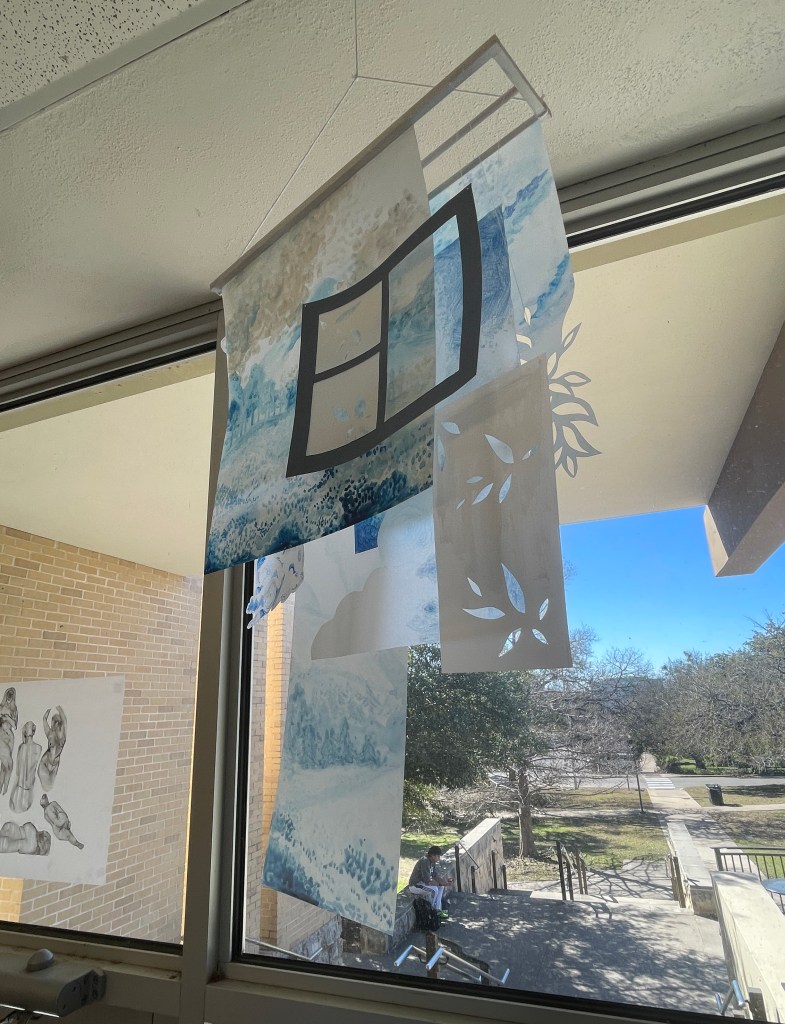
In class when we were shown inspiration images for the project I most liked the ones that were hung, so I knew that I wanted my project to be one that hung also. I started by making a structure with some square wooden dowels that I would then later attach each of the pieces onto. After making the structure I started by drawing on tracing paper, I drew a few clouds that I cut out once they were done. When drawing the clouds I used a blue marker, and later decided to make the whole piece monochromatic.

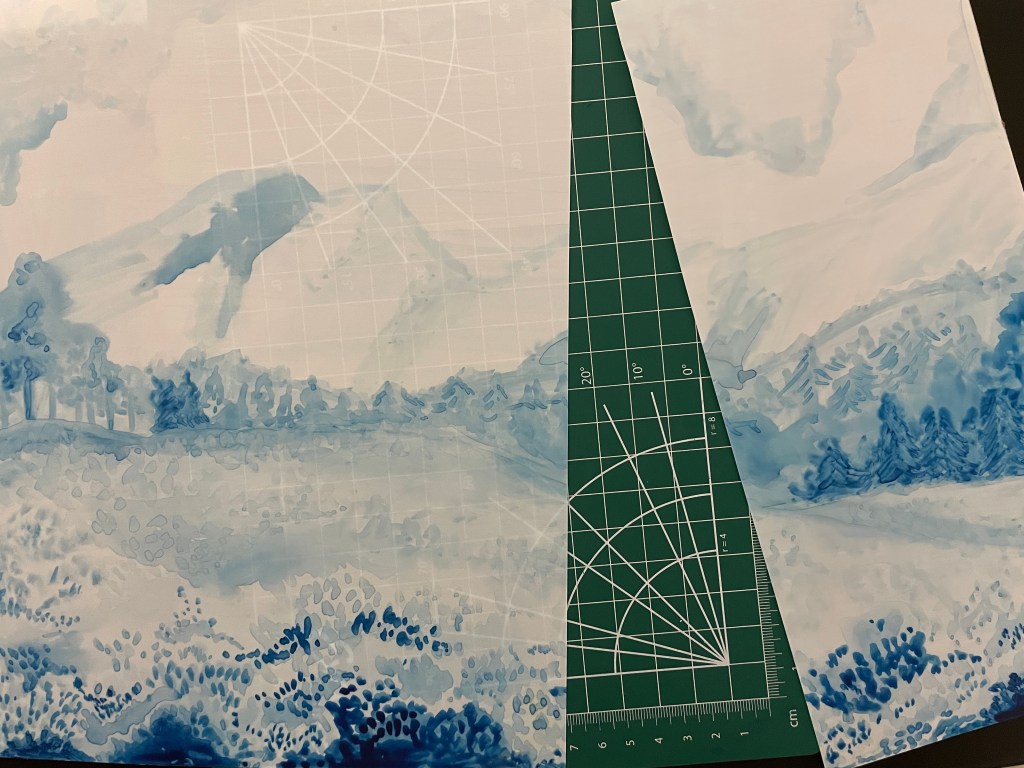
I then began to paint a landscape on the yupo paper using water color. I would later go back and add some white acrylic paint on the back and also cut the image. On another piece of yupo paper after painting I cut a leaf pattern into it. I also cut the leaf pattern into a little window that I made.

Once I finished each piece I started to poke holes in them and using fishing wire to attach them to the wooden structure. Overall I really enjoyed using the transparent paper and hope to experiment more with it in the future.

David Oliveira

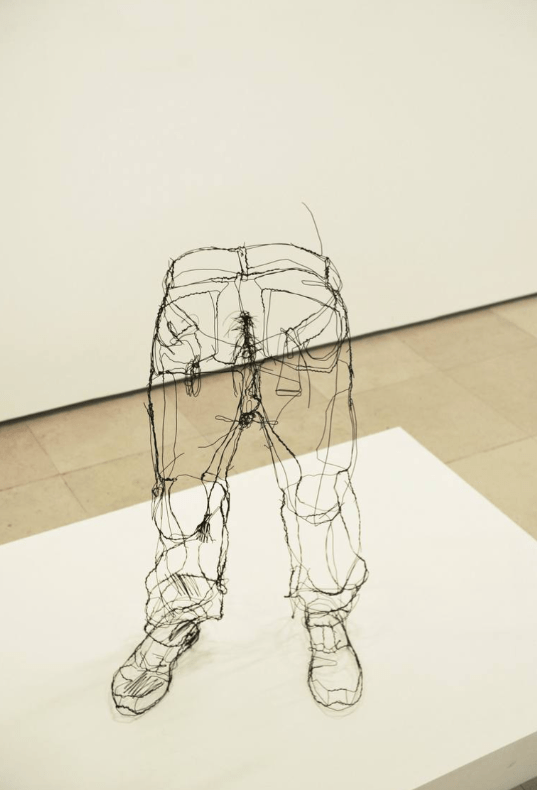
David Oliveira is a sculptural artist from Lisbon, Portugal who creates wire sculptures. He creates work that is both complex and anatomically accurate, but also gestural and lively through integration of loosely bent wire into the more technical parts (see Loose Skin below) Before starting his wire sculpture journey, David attended Lisbon University where he received a degree in ceramics/sculpture. He then went on to study anatomy in his postgraduate years; he says while studying figures, he discovered “In my work, I realise there was a lot of empty space underneath the visible (skin), so I started representing the bones. In 2014 I wanted to explore what I could find inside the bones (the energy, the intention, the movement).” Combining his two areas of study, David creates complex sculptures full of expression which are featured in exhibitions around the globe. I chose to do research on David because we are working in 3d space with linear material this week, and also because I really like the messy, but coherent feel of his work as a whole.

Loose Skin, Sculpture, 0.4 W x 0.4 H x 1 D in
Half Naked, Sculpture, 0.4 W x 0.4 H x 1 D in

Sources:

https://www.saatchiart.com/davidoliveira

http://davidmigueloliveira.blogspot.com/

Translucent Layers

When I was given the assignment to create a translucent piece of art using transparent paper, I knew I wanted experiment with a new technique/medium . I decided to create an abstract design using watercolors, as I thought this would work well with the translucency of the paper. I really enjoyed this process, the texture of the paper made the watercolor paint create really interesting swirls and patterns. After the paint had dried, I cut the paper in half and stacked the two halves on top of each other. I was amazed at the effect this created – the abstract paintings on the bottom layer were faintly visible through the top layer. I also loved how the figures looked when light shone through the paper. Next, I drew an image of a girl holding hands with a blurry figure, and pasted it in between the two abstract layers of the translucent paper. This added a new dimension to the piece, as the image was visible through the layers of abstract circles. To add another layer of depth, I glued pages from a book onto the back of the artwork so that the faint words could be seen through the images. This gave the piece a literary quality and made it even more intriguing to look at.