The Pink Range – Atmospheric Perspective Project

I struggled with an idea for this project for a bit, so I turned to scrolling through Pinterest to help generate ideas. From the scrolling, I came across a beautiful scenery of this Japanese bridge over a large body of water with cherry blossoms and tree branches in the foreground. Then, I got this picture of a beautiful sunset happening over mountain ranges. From these two images, I thought about combining my favorite elements of both pictures into one piece.
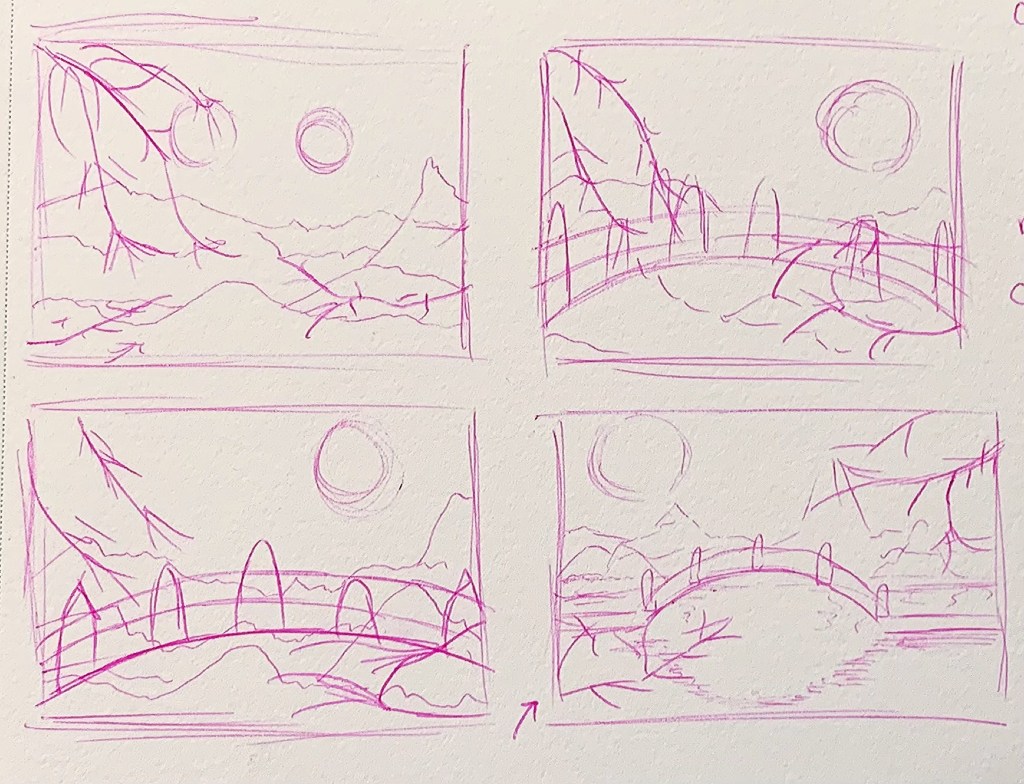
I then made some thumbnail sketches to get a better idea of what I wanted and to see where each element should go.

I settled with a combination of the top-left and the bottom-right for my final piece. From there, I sketched my drawing into a bigger mix-media page.
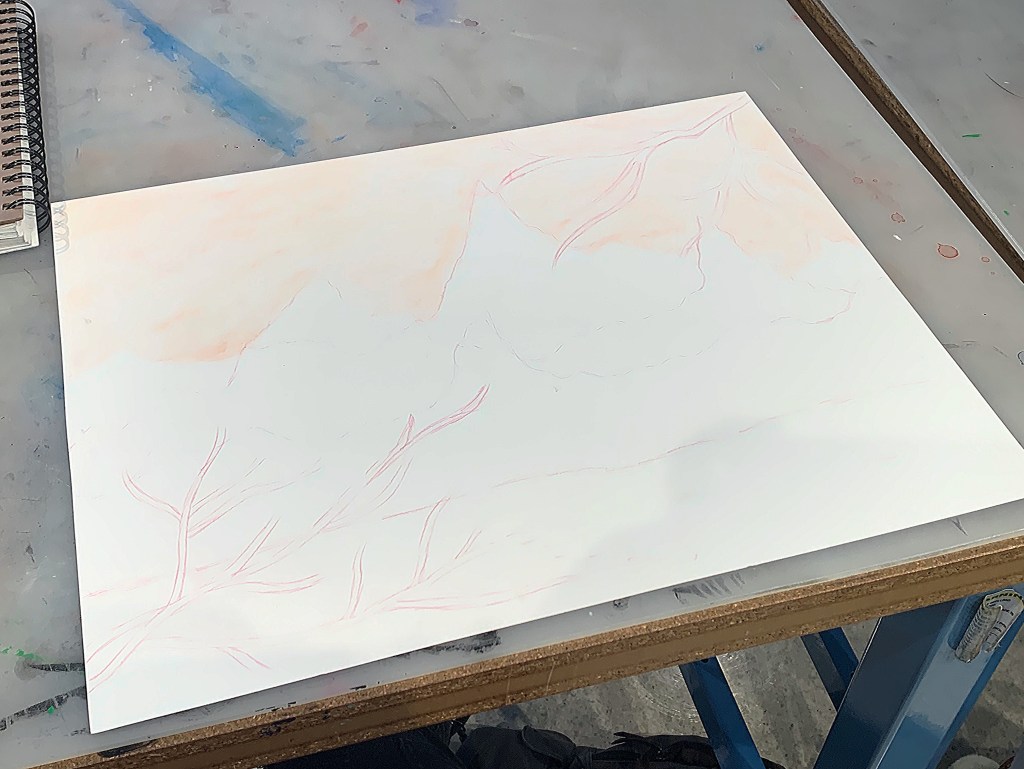
I also decided to use pastel sticks as a way to experiment with a new medium and thought it would be an easier way to achieve the color gradients that I wanted the piece to capture especially with the sunset sky and the reflections in the water.

I kept the piece relatively within a pinkish tone and decided to make the branches a dark blue since I felt having them be black would be too harsh for the piece.

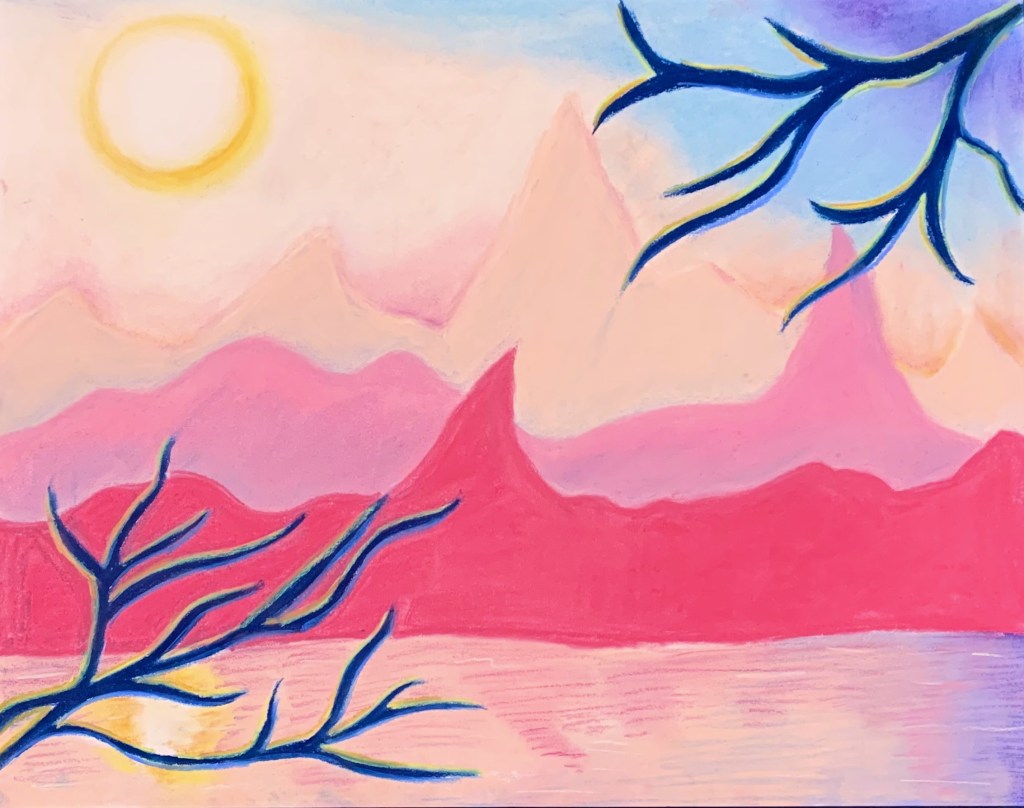
Lastly, I finished the entire piece by mixing some dust of the pink and red pastel sticks with white acrylic-gouache paint to get an opaque look for the cherry blossoms on the branches. For the cherry blossoms, I used varying shades of pink and white to get a look of the different shades cherry blossoms to have especially under the sunset lighting.
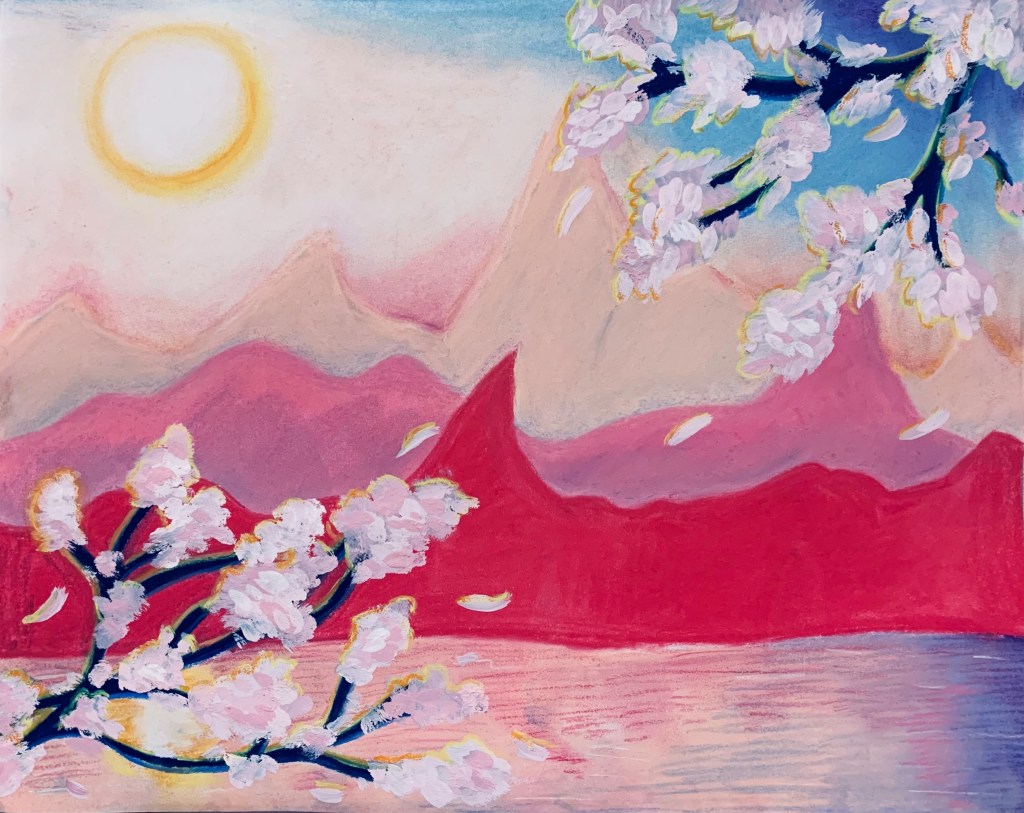
After getting feedback for my work, I was suggested to try making the cherry blossoms more in focus and defined by using a technical pen to trace some of the cherry blossoms so they have that more defined form like they would being in the foreground. Then, I was told that the closest mountain range in red/hot pink should be made a little softer since it felt to defined for being far away so I tried to blend out the red/hot pink pastel more to be softer.

In the end, I did not expect this piece to turn out as well as it did, and I ended up really liking the end result. I am proud of myself for experimenting with a medium out of my comfort zone and using what I could to keep the theme of using mediums I don’t normally use in my work. I enjoyed the process and finishing this piece to the very end.
David Adey

David Adey is a multimedia collage artist residing in San Diego, California. He began his career doing graphic design work for highly renowned companies such as Hasbro and Pepsi, and eventually ventured out more towards physical media. Most of his current work revolves around collage and unification of differing parts. He places emphasis on contrast and unification; In his artist’s statement, he explains “An experienced designer learns that the more distinct the elements are from each other, the more effectively they work together. Unity then is not achieved through uniformity but through juxtaposition.” Adey creates juxtaposition within his work by collecting a variety of colors, textures, and shapes, and incorporating them all into a single coherent piece. Another concept explored throughout Adey’s work is the relation between the human body and the digital world, as seen in his works Hide and Gravitational Radius (view below) which tie back to his roots in the world of marketing and consumerism.

Adey’s work has been exhibited in multiple galleries around the globe, including the Minneapolis Institute of Art and the Orange County Museum of Art.

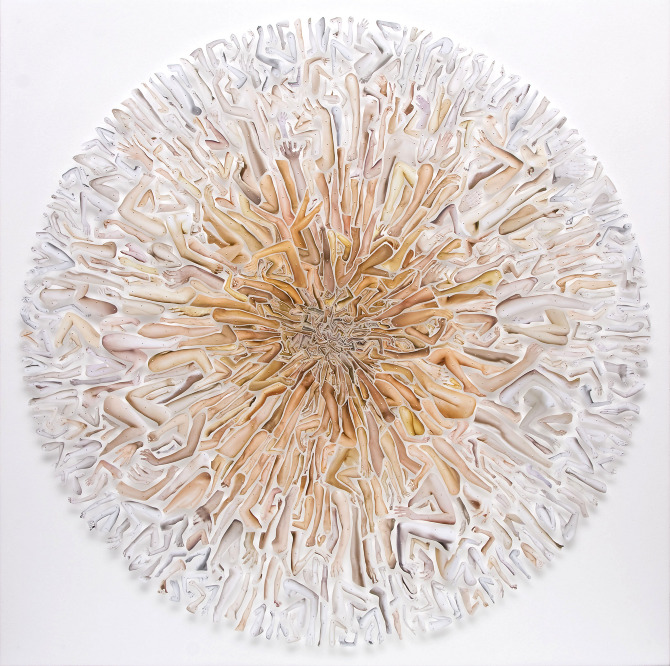
David Adey, Gravitational Radius, 47 x 47 x 3 1/2 , digital images, laser-cut digital print, pins, foam panel, 2012
Description: “Fashion and celebrity images are collected from various online sources via Google
image search. Digital prints are laser-cut and pinned to a foam panel.”

David Adey, Inspiration/Expiration, Ceramic, 2016
Description: “A permanent public commission for The County of San Diego, installed at the pedestrian entrance to the parking structure at Cedar and Kettner Blvd. in downtown San Diego. Approximately 3,300 hand made clay impressions of various tire treads are glazed in over 500 unique colors.”

David Adey, Hide, 120 h x 54 w x 3 1/2 inches, Laser-cut paper, fluorescent acrylic and pins on pvc foam panel. 2014.
Description: “Three dimensional scan of artist’s body containing over 75k triangulated faces is unfolded and flattened in one piece, then divided into a diptych.”

Sources:

https://www.davidadey.com

https://www.pointloma.edu/faculty/david-adey-mfa

https://www.artistaday.com/?p=13285

Jeremy Lipking

Jeremy was born in 1975 at Santa Monica, California and is 47 years old. There’s not much about him, but from his website, he uses oil paint for all of his work, and it looks very realistic. Many viewers are drawn to his art thinking that it looks just like a photograph. However, Lipking’s vision is the opposite of what a camera does. A photograph tends to flatten an image, reducing all relationships of color and shade to a stiff mechanical pattern. Lipking’s skill lies in his ability to probe in and around his subject. With a highly sensitive eye, he sees nuances of value and hue that the camera and most people can never see. More incredibly, he is able to translate his highly nuanced vision into a painted image. Seeing one of his paintings involves entering into the pictorial world he has created. Like all great realists, he has the ability to generate powerful fictions. Here are 2 of my favorite paintings of his

https://www.lipking.com/

Judy Pfaff

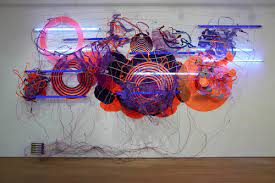
For my research I decided to do Judy Pfaff. She was born in London in 1946. She got her bachelors degree from University Saint Louis and her MFA from Yale University. Pfaff works in multiple mediums such as painting, sculpture, printmaking, etc. She uses materials such as, string, lights, or really any material that can be used to a larger scale. She works with spacial awareness that completely changes the environment showing a lot of spiritual and historical standpoints. Judy Pfaff uses her space in rooms to a unique degree as to how each piece she installs is different from the next.

She wasn’t only an installation artist, she was also a teacher. She taught at the California Institute of the Arts and now works at Bard college as the co-director.

Here is two examples of her art installations:

Transforming Traditions 2000-01

https://www.judypfaffstudio.com/#/sculptors-recollected-2018/

2000-2001 Judy Pfaff: Transforming Traditions

Hedwige Jacobs

Hedwige Jacobs is a Dutch artist who was born in Singapore, but currently lives and works in Houston, Texas. She has a background in Fine Arts, having earned a BFA from the Royal Academy of Arts in the Netherlands and an MFA from the Pennsylvania Academy of Fine Arts in Philadelphia. Her work has been exhibited in various galleries and art spaces such as Women & Their Work and DiverseWorks in Austin, Texas, The Amarillo Museum of Art in Amarillo, Texas, Friedman Benda Gallery and The Drawing Center in New York City, and Galeri Utama and ION Art Gallery in Singapore.

Jacobs work explores themes related to human interaction and society. She has developed a specific visual language over time, which is evident in her work. This language often includes imagery related to organic growth and woven structures. Her art also depicts lively human interactions and environments that suggest a specific event or place.

Here are some examples of her work:

“peeking inside! sharing space? the space within”, 2018, BOX 13 window box space site specific installation

http://www.hedwigejacobs.com/albums/pools/

http://www.hedwigejacobs.com/albums/pools/

Sarah Sze

For this week’s research post I decided to research the artist Sarah Sze. She was born in Boston in 1969 and attended Milton Academy, Yale University, and School of Visual Arts. She is currently a notable professor of visual arts at Columbia University. Sarah is an American artist who focuses on challenging the limitations of paintings, sculptures, and installations. She creates works from references that cannot be captured in the world by a camera. Ideas can often be limited to reference photos and her work and, to me, feels like something out of an abstract dream. Her work is influences by Futurists, Cubists, and her love for Russian Constructivists. Her installations in particular, draws from Modernist traditions of a found object and then builds large-scale installations using ideas from said object(s). Some notable mentions: Sze represented the United States at the Venice Biennale in 2013. She also won the MacArther Fellowship in 2003. Her Contemporary use of collage, space, and architecture will continue to help other artists “challenge” their own artistic limitations.

12 Landscapes (After Object), 2019 Hidden Relief, 2001

Research #1 Samuel Price

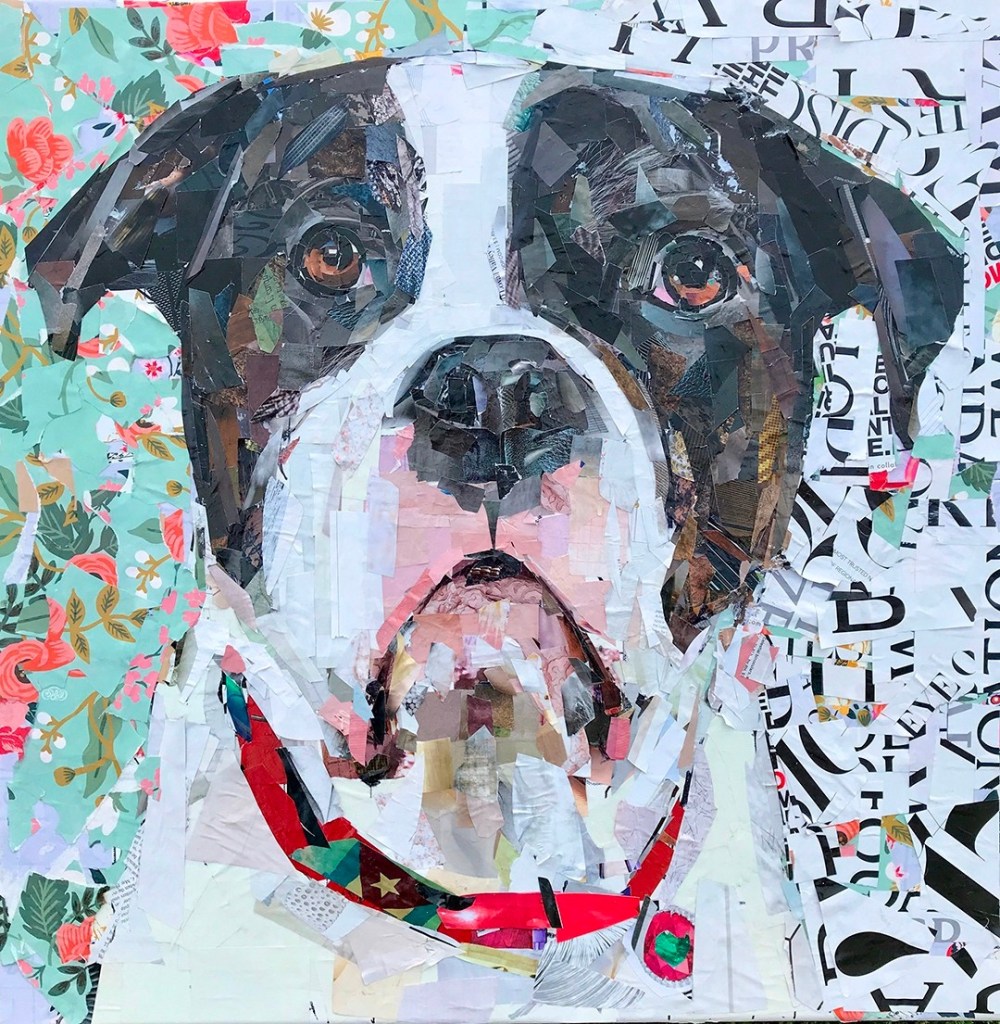
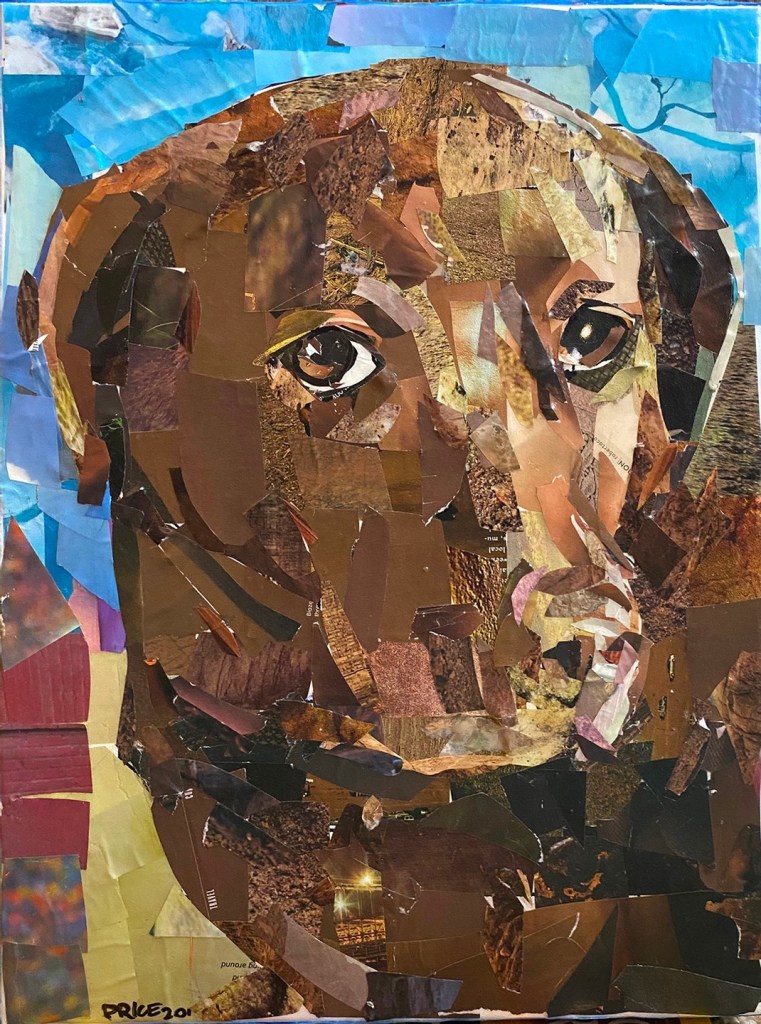
For my first research post, I chose Samuel Price. Samuel Price is a collage artist. He does his art in San Fransisco and surrounding cities. He was hired by the city of Palo Alto, California to do a 300-foot mural near the campus of Stanford. I found his art by doing a simple google search of collage art and found a few of his pieces. The medium that he uses to create his artwork is paper magazines which he pastes to a canvas. A majority of his artwork that I could find were the faces of pets. His website has many different types of dogs made from collages whether that be a chocolate lab or a huskie. Price offers a ten-week pet portrait art class that he has the link to in his bio on Instagram. Samuel also wrote a book Paper Collage Workshop. He shares different in which you can create a paper collage throughout his book.

Boxer

Border Collie

Chocolate Lab

Introduction

Hi, I’m Erin. I am originally from central Iowa until my mom moved down here to the Austin area during my first semester at St. Edward’s now, I don’t know where to say I am from. I am a sophomore and my major is Marketing I am minoring in Graphic Design. Drawing is not my strong suit but, when it comes to a physical art form I enjoy painting. Graphic Design is a form of art that I have always enjoyed. When taking classes in high school my teacher recommended me to a non-profit and I did graphic design work for them up until covid hit.

I have always had an interest in art classes. In high school, I made sure that I had at least one class in my schedule pertaining to art until covid-19 hit in 2020. At that point, I had taken all of the art classes my school offered from Graphic Design to Painting. I was in the middle of taking my Drawing class when the world shut down. That being said I have not had much exposure and have done much drawing in quite a few years. So, taking this course I know will be a challenge for me and I am looking forward to that challenge.

-Erin SEU ’25

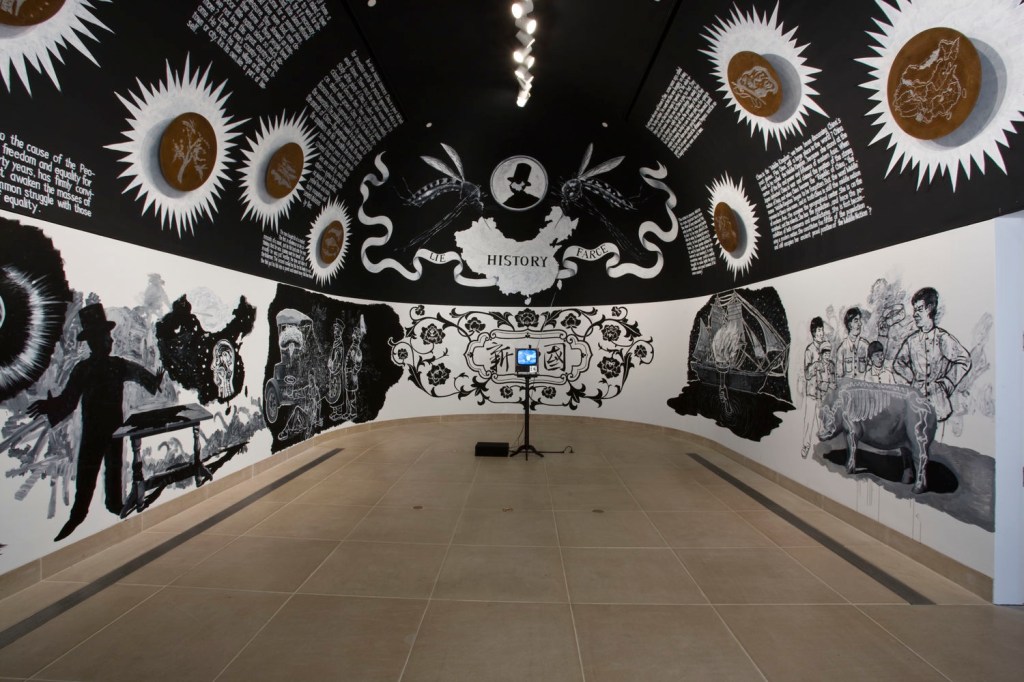
Sun Xun

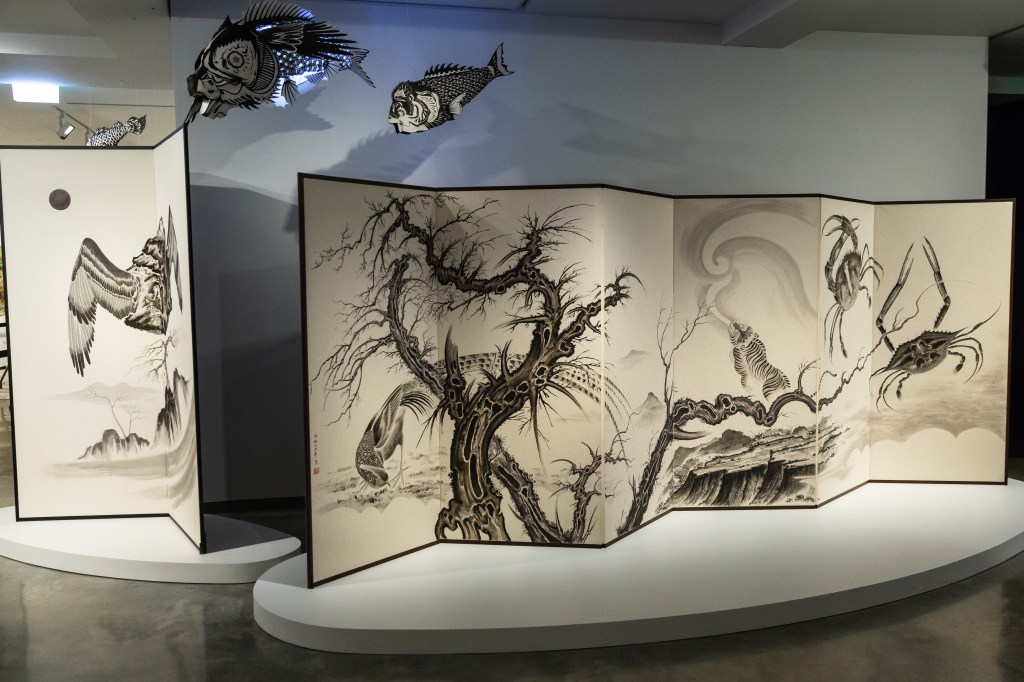
For this week’s research post, I have chosen the artist Sun Xun. Sun was born in Fuxin, a town once known for its thriving coal industry in China before over mining caused its bankruptcy and closure of many mines. Once he turned 16, he moved away to study at the China Academy of Art in Hangzhou. After seeing how progressive Hangzhou was compared to Fuxin which seemed to be stuck in the past, it left him feeling disoriented and questioning how two places existing at the same time can feel centuries apart. Because of this, Sun became aware of how time affects the rise and fall of powerful forces. Sun reflects this experience in his work by offering an alternative to reality and blurring the lines between fantasy, mythology, history, and reality. Sun Xun’s interest in traditional art forms is shown through his use of highly detailed monochromatic ink paintings and woodcut prints that are used in his animated films. These hand-drawn animations are energetically composed with single frames that range up to five thousand.

https://images.app.goo.gl/nMMUGkZRq82mb11X7

https://images.app.goo.gl/HrFMdQpu2Kd12fTC8

https://images.app.goo.gl/6ikN53mc5r3bXSJA7

Daisy’s introduction !!

hello !!!! I’m daisy I’m a junior, and I’m an art major. when I think of drawing I think of drawing, I think of visually manipulating spaces with the use of lines and mark making.

most of the art I make is focused on the human form. I look forward to experimenting with new methods of “drawing” this semester and meeting all of you guys!!!!!!