I first learned of Andy Goldsworthy in my Conceptual Practices class with Professor Rothrock. We were doing an assignment that dealt with nature and manipulating it in someway. I think his work, and specifically the ones I picked, really exemplify a spatial drawing. Andy almost always only uses materials that he finds on location so the work is impacted heavily by what the space provides. In the first one it appears he used a thing grass or vine of some kind to enunciate the circular contours of the stones and draw attention to the space they fill. There is a sense of movement that is reminiscent of orbital charts that I personally enjoy about it. The second image relies heavily on the colors available from the fallen leaves of nearby trees. The glowing contour that is created by the yellow leaves totally changes the way the tree stands in the space. The final image is a motif of sorts he replicates in various mediums but this one is exquisite in its own right because it is a loose construction of twigs that create a full circular form due to its reflection off the surface of water. We perceive a tunnel like space yet its all just an illusion that will change over the course of the day. Another aspect of his work that I find really intriguing is how impermanent they are. Their essence is captured in the one photo but as time goes the leaves or sticks will blow away or decay, surely changing the aesthetic and maybe even the concept of the original work. He is manipulating the space but not attempting to tame or contain it.
Progress 3(Final): Reflecting Dream
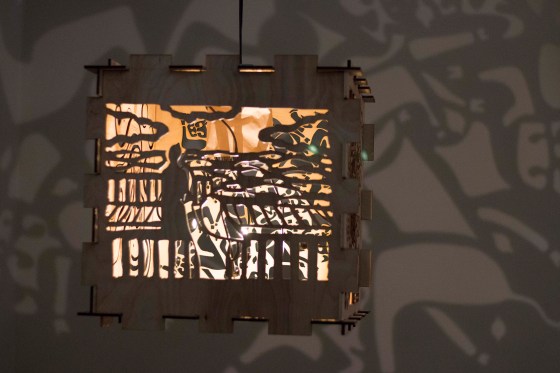
This week, as we were installing the work, we ran into a huge problem with the light bulb. We couldn’t get the perfect crisp shadows on the walls due to the incorrect wattage as well as the size of the bulb. The shadows appeared blurry and not focused. We thought part of it was because of the brightness in the room that is affecting the sharpness of the shadow.
So we went with the reading LED light with the USB adapter and project each light onto each panel so ended up using 6 lights in order to cover the entire cube. Yet the images on the walls were still not clear. However, we managed to install black curtains to block out the excess light from the gallery.
As far as how the concept goes, I think that we manage to communicate our ideas to the audience successfully. In order to install the cube, we glued ever side together except the bottom panel in case anything goes wrong which I think is a good call. We measure the distance from the wall out to the center of the space before we install the cube. The sheet on the ceiling was stretched tightly so when we project the image there won’t be any wrinkle or distraction.
On the reception day, we present the the cube by having slightly moved so the shadows could move around the entire space we create. The motion of the shadows reminded me of a child’s bedroom since the images are created to be dreamlike.
Dreaming into Space (Progress 2)
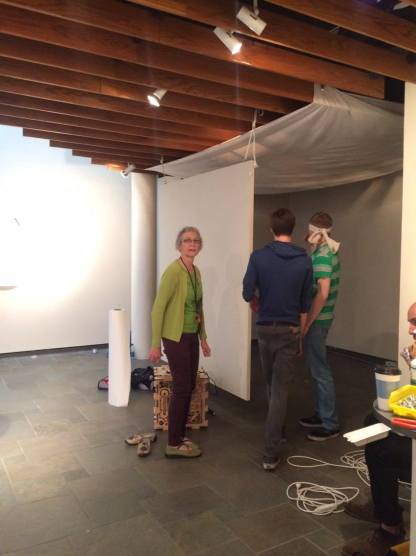
Once we had the space shrouded, the ceiling canvas stretched and the cube hung our main issue was which light bulb(s) would work best for our projections. Our first attempts were with a single bulb and we were finding that some were either not strong enough to project clearly or the bulb was too large and the projections were blurred and hard to make out. We knew a light source that was projected in a specific direction would create the clearest image. Hollis was able to find an ideal solution with a light fixture that could support multiple USB plugins. We plugged six manipulatable LED mini-spotlights into the fixture and then the challenge was how to project each side clearly without distorting the other panels too much. Jenny and Hollis proved to be quite adept at this stage in the process and since it was already night at this point the projections were quite clearly recognizable. The orientation they finally settled on worked well and allowed for the piece to really create the dream space we had hoped for. The difference in images also created a dynamic space since the amount of light being let out varied from where you stood and as the cube slowly turned. In the end I think it was successful and the last minute drapes were the final touch it needed to close of the space.
Dreaming into Space (Progress 1)

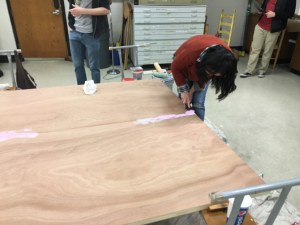
The early goals and obstacles for our project were to build the pieces we would need to help create the specific space for our installation. We knew we would need something to block out the light from the gallery so our projections would be clearly visible. After acquiring the hollow core doors we connected them together with screws, tape and puddy. After sanding and painting we were able to hang it where it concealed a good deal of light. However we realized we may need more to block the open spaces beside the wall for a better shadow.
One of our main objectives from the start however was getting each group members panel cut. We had the wood and I took it to the wood shop and ripped it down to fit into the laser cutter. After that it was a matter of signing up for a chance to use the cutter. Fortunately for our group we had members who were familiar with laser cutting so we were able to get everyones pieces cut correctly and in time for installation. Each panel was supposed to be based on dreams or an amalgamation of specific dreams, mine however was influenced by the night sky and how I associate that with nocturnal dreams. I coupled that with the doodles I frequently do during class while day dreaming. The aesthetic I hoped would emulate a night sky but not a specific recreation of it, like how must dreams are a hodge-podge creation of what may be on our mind that day or week. I had chosen to do the top panel so this image would hopefully help the viewer step into a dream-like world that they could react to on all sides of the room. Unfortunately in the installation process some of the center line work is lost due to the way we mounted the box to the light. I think the piece still conveys its point however.

Progress 2: Reflecting Dream
The week before spring break, some of us were preparing and gathering hardware and materials during class time, while the rest of our team members were trying to get the cutting part done so when we came back from the break we would have enough work as we expected it to be. The problem was that we did not have enough wall in order to project all the six sides of the cube. Luckily, Hollis came up with an idea of putting the two door panels together and then painted with white so we can hang it from the gallery’s ceiling to create an extra wall that we needed. On the ceiling of the gallery, we needed to stretch a white sheet so that we could project Drew’s design and not having it blend in with the original ceiling which could be distracting.

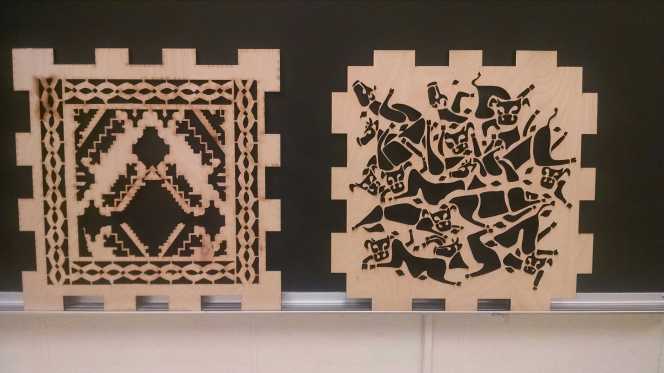
The picture on the right was when we temporarily put the cube together without light bulb and the one on the left was the finished version.
Cardboard Project
This experiment was reminiscent of assignments from 3D Design but due to the open nature of this assignment I was able to create something a bit less traditional and explorative. I started by creating multiple different pieces that were sturdy three dimensional forms that I could piece together with glue. The materials I chose to use were beer, wine and coffee shipment boxes. A common feature on a lot of these is their preference to design amusing or eye catching marketing to decorate the cardboard box. This provided already colored pieces I could juxtapose with traditional brown cardboard. Some where along the way, as I began attaching different forms, the piece took on a moveable and interactive tone. The orientation shown in the pictures is the most sturdy but it can be manipulated and held to create other viewpoints or meanings. I think that cardboard can be used to create stunning or evocative works of art, however I don’t prefer it myself. I did enjoy using some for my collage, they work well creating a layered aesthetic.
Progress 1: Reflecting Dream
At the first week of collaborative project, I chose to work with Britney’s main concept and idea of using light to project the negative cut-out. Our idea is projecting the unconscious dream onto the wall. The design I created was abstract because I feel more comfortable with non-narrative patterns and to me, I feel like it would be more convenient when working with the software and laser cut. Our concept is to build a laser-cut 18’x 18′ in. cube and project the light from the inside of the box. So every side of the box has its own individual design which represents the dream.
This is a picture of how the design looked like before cutting.

It took 30-45 minutes to cut this 18′ x 18′ wood panel. I loved how it turned out!

I also think that the actual cut-outs are very interesting in terms of the fragments and negative space on the laser cutting bed.

Inner-Twined
On top of the basic principles established in my first post on this project, as a group we were really able to build on our concept and develop its execution. We noticed that there was an increasing prominence of the theme of connection; there was the link between the six of us in our cooperation as well as literally through the connection of yarn from each of our pieces, to the union of dissimilar elements (two-dimensional space versus three-dimensional, personal and public space, representational subject matter and abstract, tangible versus intangible…) We decided on the name “Inner-Twined” for our piece as a play on the word “intertwined” to reflect these connections. (And also because yarn is kind of like twine, and they’re both fibers. So inner-TWINED. Get it?…)
Inner-Twined in early development.
Overall, I’m extremely pleased not only with the end result, but how we all managed to work together well. I feel privileged to have had the chance to work on exhibit before I graduated and with people who were as enthusiastic (or even more so) about the project as I was. I also really liked how the experimental quality of the projects over the course of the class still allowed us all to work in ways that were signature to our style and how we want our work to look as professional artists.
Spring Break Progression
It’s interesting how my contribution to our group’s concept was emphasis on the environment before figures were introduced, and yet mine is almost solely focused on the figure. I went with the first juxtaposition that popped into my head when we were proposing what we wanted to create on the drafting film once our group was settled and haven’t deviated much from it (the original thumbnail was improvised on the chalkboard, then translated into the pencil thumbnail from last post). I think the execution–a figure that is obviously me perched in bed with a ghostly gaze and hand clasped over my mouth with a laptop in front of me–stems from that I have the tendency to get myself worked up without ever leaving the house. Social media platforms and certain blogs can be a source of stress for me, and yet they’re a habit of mine that’s hard to quit.

As much as I enjoy the end result, I can’t help but contemplate what it would have been like for me to do something more similar to my other group members’ more relaxed, dreamy portraits that featured things that made them happy. Then again, it probably would have been the exact same picture, only with a different expression, as I’d likely be playing a computer game (with my kitty cat sprawled out beside me and all).
Wire Installation Progress
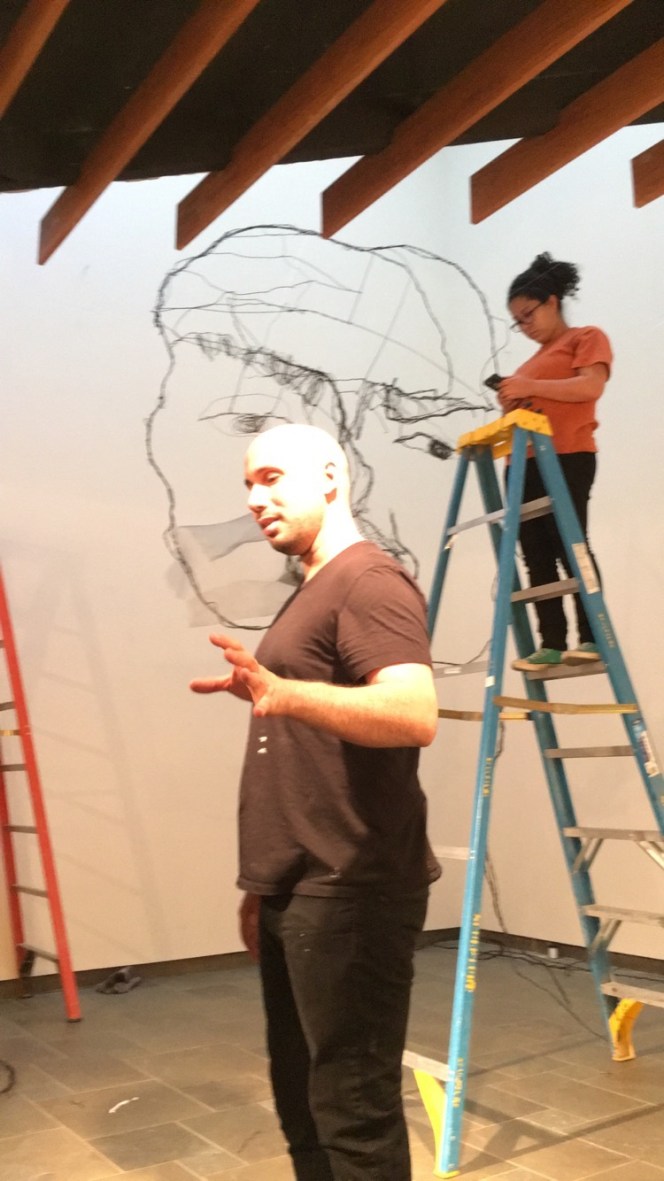
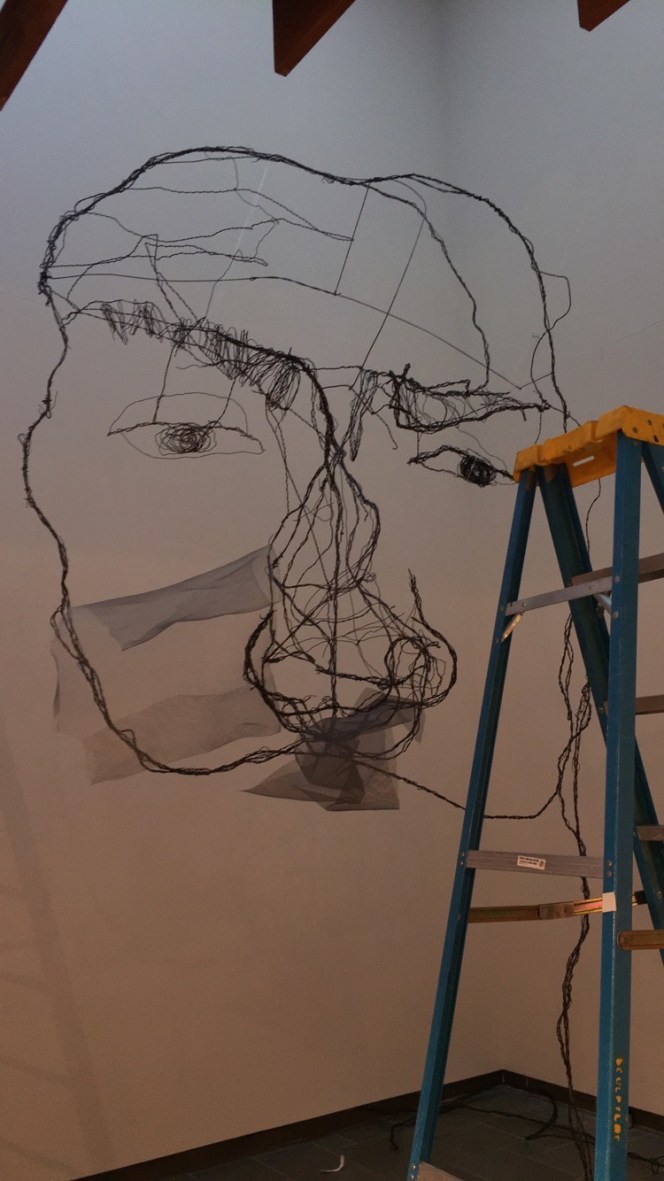
The sculpture continues to be built. As of now we are making more wore and prints of drawings to be placed on the wall. We are currently figuring out how to support the weight