Matthew DiVito’s Moving Art

Matthew DiVito is a motion graphics artist from Somerville, Massachusetts. While having a very diverse range of skills (from game design, to music video collaborations), DiVito is most well known for his motion-based GIFs. For those who don’t know, a GIF is a series of images played in rapid succession and looped to create short animations. In fact, the vast majority of DiVito’s work consists of GIFs. However, what makes his GIFs unique – and most relevant to this blog – are how he utilizes movements and abstract forms to interact with and transform space. Using the programs After Effects and Cinema 4D, DiVito crafts three-dimensional objects that, while in motion, completely alter the viewers perception of space.

While wanting to specifically focus on DiVito’s GIFs for this blog post, I think the possibilities of GIFs projected into a space can bring a whole new aspect of this idea of drawing and interacting with space.

Here are some examples of DiVito’s GIFs:


DiVito, ribbon, video art, 2012


DiVito, rough_seas, video art, 2012


DiVito, globulus, video art, 2013

cubic_tunnel

DiVito, cubic_tunnel, video art, 2015

vertigo

DiVito, vertigo, video art, 2014

Official website: http://cargocollective.com/matthewdivito

Tumblr Blog: http://mrdiv.tumblr.com/
Hew Locke’s “The Nameless”

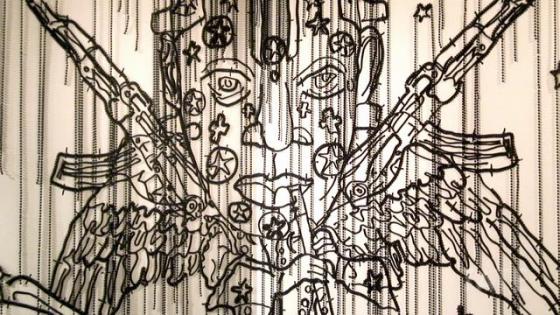
Hew Locke is a London-based, multimedia artist known for his wall-covering installations made from objects such as beads, cord, and tape. He received a B.A. in Fine Art in Falmouth and an M.A. in Sculpture at the Royal College of Art in London, and has won both a Paul Hamlyn and an East International Award.

The Nameless detail

The Nameless
2010, dimensions variable
Cord, plastic beads, glue gun, gaffer tape

According to Locke, the conception of The Nameless was executed in a way that was “out of necessity”. He couldn’t afford to ship over a large installation to an installation in Atlanta, so, instead, he approached the problem as having to fill up the walls. He made drawings that were then enlarged and applied to the walls, and then outlined them with cord and Halloween necklaces (that reflected his current budget. Though he states that the drawings themselves aren’t approached at a particular political angle, he did wish to reflect both of his English and Guyanese identities, and how the imagery of the two don’t necessarily “fit” together, yet persist to coexist as a mish-mash of cultures.

//players.brightcove.net/1854890877/4811b2e3-75b4-4489-b1a5-21a18a61075e_default/index.html


http://www.hewlocke.net/CV2ndsite.html

http://www.tate.org.uk/context-comment/video/tateshots-meet-artist-hew-locke 7 January 2010

Blu- Street Artist

Blu is an Italian street artist, who currently lives in Bologna, Italy. He is best known for his large scale murals usually in urban and industrial areas. These massive artworks are often in response to political and socialistic controversies. One of his most famous works is culminated in the silent film, “Muto”. It took months to film, and was completed throughout the streets of Buenos Aires, Argentina. This film has garnered much attention, resulting in millions of views online, and several awards.

The beauty of his work is the ability to transform a common space into something that tells a story. It forces people to stop and look at something, that otherwise would have been less than ordinary and boring. The sheer scale of his murals is enough to make viewers stop and stare. When he chooses to begin a mural, he completely changes the space around it.

Blu 1Blu 2Blu 3Blu 4

http://www.streetartbio.com/#!blu/c91a

Alessandro Diddi

Alessandro Diddi is an artist who works mainly in the simple graphite and paper media. While he certainly has the skill and practice to use more complicated media, he prefers to use the sketchy quality of graphite to prevent his works from looking completely photorealistic. This way, his works look more like the work is in the process of coming to life. He relies more on his use of shading and angles to trick the viewers into believing in a new dimension that isn’t there, which is Diddi’s purpose in his art. He is less interested in sending a message and more into creating a new dimension with his art. Often he even uses his own hands in the photographs of his works to further enhance the illusion. The works are not meant to be viewed from more angles that the one in the photographs he takes for his blogs which helps his goal of viewers being pleasantly surprised but not understanding of how he has created his dimensions.


http://www.dailymail.co.uk/news/article-2358778/Artist-Alessandro-Diddi-makes-drawings-leap-page.html


Diego Cusano

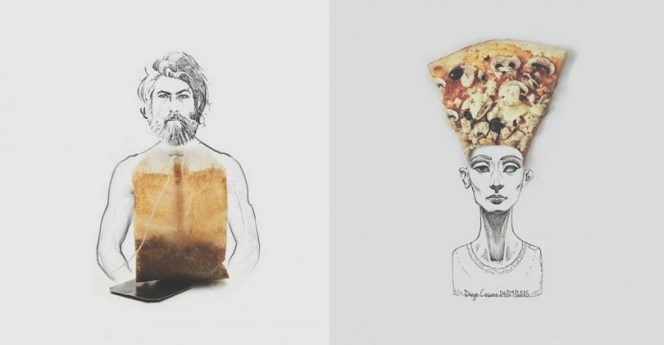
Food_and_Everyday_Objects_Turned_Into_Creative_Illustrations_by_Diego_Cusano_2015_08

Diego has a very intense background and history with art. He attended an art restoration high school and eventually moved towards graphic work. This recently new player in the art world caught his break with a memorial piece for Amy Winehouse, which lead him to an interview on MTV France and the circulation  of his clip on all music channels.

The body of work that grabbed my attention was his graphic drawings coupled with pictures of food! They are less serious, and it took him a while to come to terms with art for fun’s sake versus his formal training in restoration. This work is fun and keeps Diego inspired.

His integration of food into his drawings shows an interesting perspective on drawing into space. He uses things us illustrators use everyday, food and doodling, and combines them in a very clever and comedic way. The work is very fresh and original.

http://www.diegocusano.com/gallery.htmldiego_cusano20_resizeDiego-Cusano-preview-810x421tumblr_o0035ln6jU1s5qhggo5_1280CKL5hQlWUAAK40e

Trina Merry – Body Paintings

Trina Merry resides in NYC’s East Village, creating art in a studio at Chelsea, but her pieces are very unique in “performance” art. She uses models as a canvas for her pieces, and documents them at a specific location, creating a relationship between the subject and the location. What she creates in the connection is what she describes as a “human experience”. How Merry uses the subject in her pieces is that she makes them almost invisible. She paints them into the background, have them pose, and documents them into a photograph, having them blend into their surroundings. Although, she has also done pieces where she uses models and creates an illusion of buildings or animals out of them.

Lost in Wonder Series:

“Lost in Wonder” Series- (click to view all 9 images)

Pyramids of Giza

Great Wall of China

Great Wall of China

Stonehenge, UK

Stonehenge

Machu Picchu, Peru

Machu Picchu

Organic Art -Bridget Beth Collins

Bridget Collins is an artist in Seattle, and graduated from Seattle Pacific University in a BA in Theater. She finds inspiration in nature, gathering foliage around her neighborhood and using them to create these organic compositions that almost seem like illustrations. Because of her “art” supplies that she uses, her art comes to life as she recreates certain pieces like Katsushika Hokusai’s The Great Wave at Kanagawa, to arranging adorable animal compositions. Many of her works are very simplistic and have a certain aesthetic appeal to them. Though it doesn’t seem as many or any of her works are permanent in its original setting, but kept as photographs and prints. Some of Collin’s works have been done for magazines and webpages, while her other works are posted on social media for people to admire and purchase.

The Great Wave, 6″x6″ or 8″x8″ Print, mixed media

Flamingo Flock

Flamingo Flock, 6″x6″ or 8″x8″ Print, mixed media

No Name, 6″x6″ or 8″x8″ Print, mixed media

No Name, 6″x6″ or 8″x8″ Print, mixed media


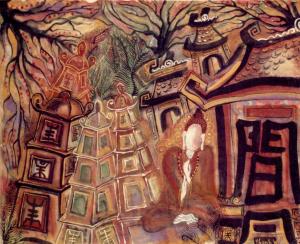
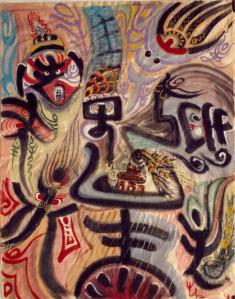
Chi Thanh Mai


These drawings drew my attention because of the unique ways in which large seemingly flat linear elements invoke different sensations of space. In the first drawing, which depicts a Buddhist temple, the stacking and layering of the different towers help to develop a sense of depth and perception in space. With the tree limbs acting as visual guides to move us around the negative space we eventually converge on the dense patch of leaves in the background. This focal point in the drawing/painting helps generate a sense of shrinking back to a singular moment in space. The temple facade on the right side of the painting sets a very stark foreground in contrast to the tunneling effect of the buildings and tree limbs. The figure which appears to be some what abstracted from the reality of the painting by hovering between foreground and background. The whole drawing almost seems to reach out while still beckoning you deep to the tree line.


The other two drawings dealt less with creating an illusion of depth or perception, rather their effect on me was mostly a projection of space from a 2D plane. The wide strokes are angled in ways that almost make them seem like they are coming off the paper and filling the space between you and the wall/screen. The one on the right with the white line work creates such a noticeable vacuum on the bottom half between C shape objects. The triangle that is formed by the negative space opens up the painting to the viewer and creates a path into the painting.

Goodbrush and lighting in space

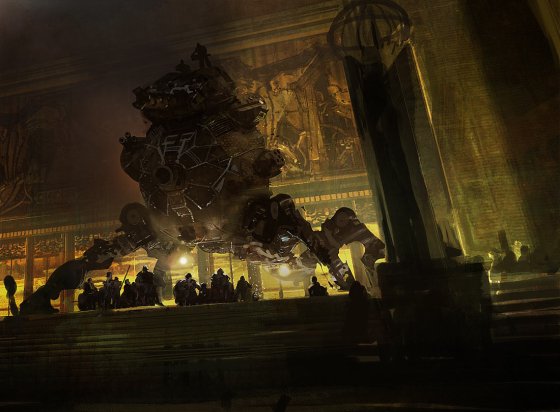
Goodbrush ( a.k.a Craig Mullins) is a renowned concept artist,well known for his digital work and amazing ability to suggest the inessential and while maintaining a high level of visual fidelity to the work.

What always brings my attention on his work has always been his attention to light and shadows, and how that always creates intense depth in space and often nods at the scale of the space and the relationship between objects. It also helps that he chooses to simplify the forms the further they go in space, which is also a great way to create and manage depth.

hovership_dome.jpg

hovership_acrylic.jpg

hallway.jpg

blue_coat.jpg

hovershiphall.jpg

india3_19.jpg


Sources:

http://www.goodbrush.com/x4oynmjkxr5fhgmi0xsh6a9ml2dhxl

Craig Mullins (Goodbrush), new website


Mia Pearlman

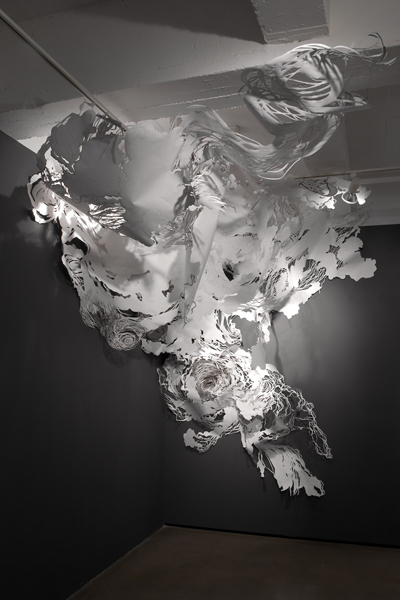
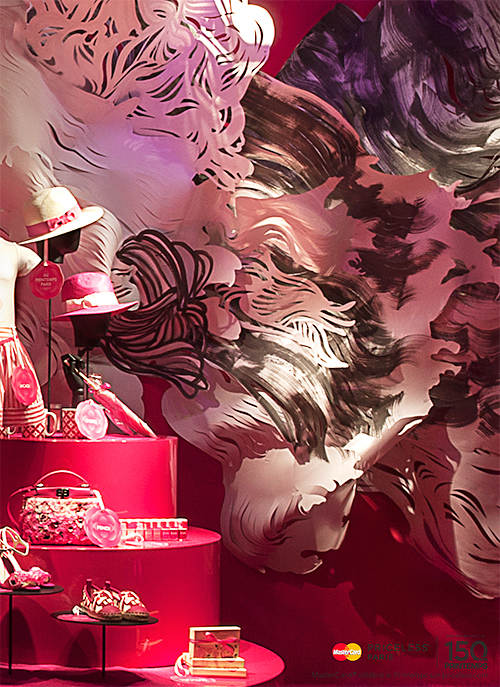
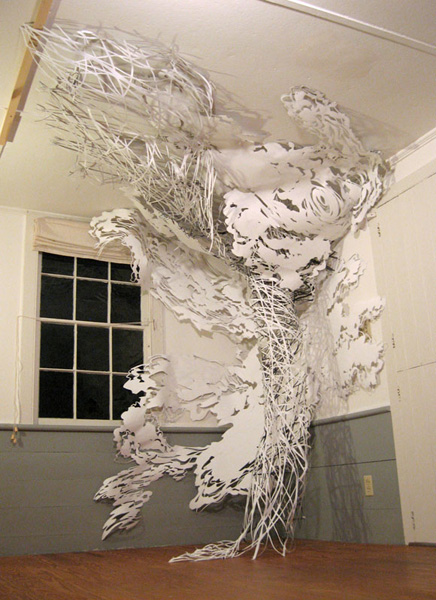
Pearlman got her BFA from Cornell University in 1996. Most of her works are non-representation and freeform. The drawing was done with India ink on roll paper. She cut out the negative shapes between lines which guiding to the next cut. Her work process is very spontaneous. Because she doesn’t want to end up recreate the work like the way the might end end in her studio, the installation is mostly done in the gallery space intuitively. If the work needs to be transported, she would roll them with the drop cloth and fit them in a tube to check with her baggage. She hasn’t had any sketches of how the installations should turn out. However, she would measure the dimension of the space and work from there instead. The works are in a quite large scale in order to represent the idea of bigger forces or powers, including her inspiration from nature, in the universe.


These are some examples of Pearlman’s works

Pearlman_EDDY_full2.jpg

Mia Pearlman, EDDY, 2008 11′ x 12.5′ x 14′ Sears Peyton Gallery, NY


Printemps_det_rt.jpg

Mia Pearlman, Printepms window, 2015


tornado_right2_600.jpg

Mia Pearlman, TORNADO, Paper, india ink, tacks
52″ W x 84″ H x 54″ D, 2007

Official website

http://miapearlman.com/index.htm