For this project I didn’t have an initial idea in mind. using cardboard I created an abstract sculpture using mainly geometric shapes. This project was a go with the flow type project for me. I was simply building on top of what I had previous step as I was building the object. I also added plane structure sticking out of the object to make it more interesting and more sharp.The result of which as an odd abstract totem with a river a cardboard tape running through the entries and orifices of the sculpture. The drawing I did with charcoal was much like the sculpture itself, impulsive and abstract yet done with intention. If I could redo this project I would. I would have planned more in advance of given the option. 


Cardboard Project


For my project, I constructed a fish that was supposed to be a koi fish. Originally I planned it out to be more detailed, but ended up getting frustrated and made a simple base and hot glued pieces together. I did enjoy doing the linear aspect of it, I think the lines that I drew makes it more interesting on the scales, but it also kind of doesn’t look like a fish, kind of looks like a hedgehog now.
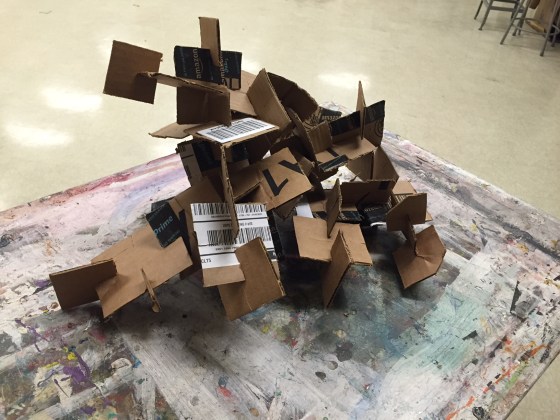
Repetition
The cardboard sculpture assignment given was reminiscent of 3D-Design for me, both for its rudimentary materials and for the fact that I am bad at sculpting. With these in mind, I dove right into the project with time and objective in mind. In respect to basic foundations studios, I decided to go with the theme of repetition, a principle of art.

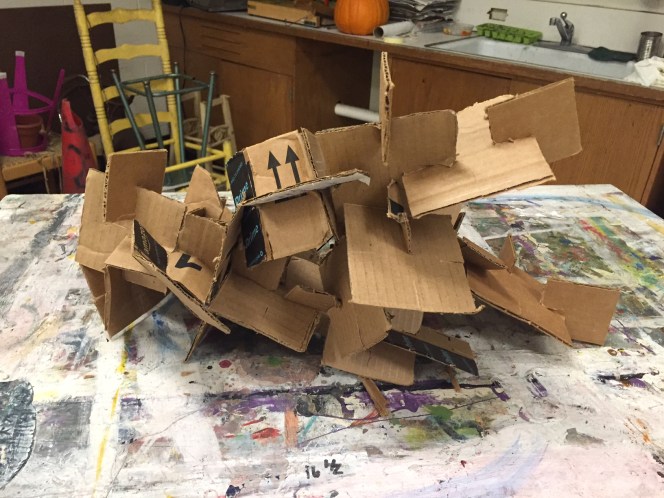
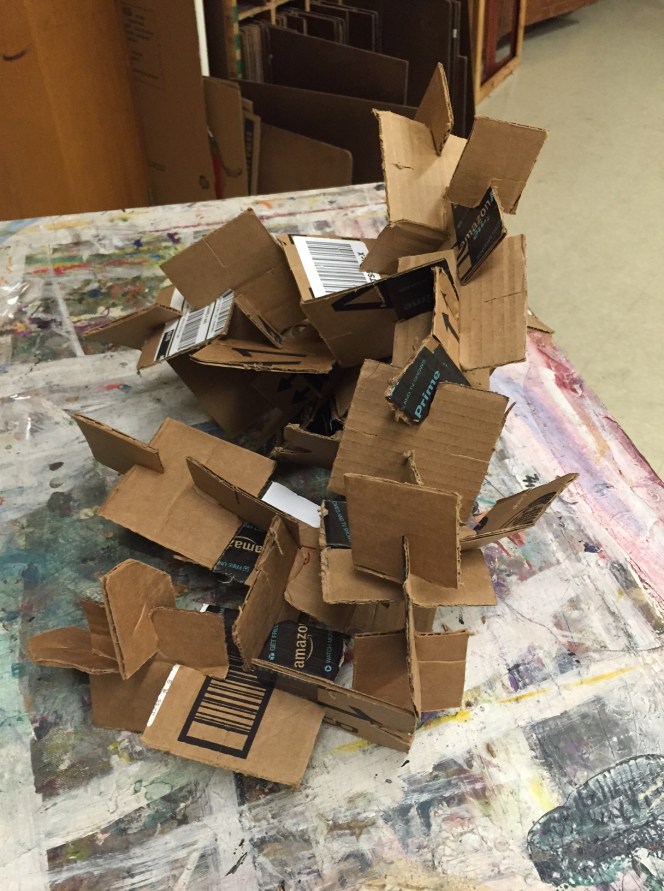
This was completed by cutting up pieces of cardboard into uniformly-sized squares (that then began to include different-sized squares as well) and cutting slits into the sides of them. The squares were then configured together by using the slits to interlock them. As the pieces were imperfect and made for unequal distribution of weight, the sculpture had a fluidity to it that was flexible when moved and made for a varied, almost crystalline-like structure. Through this method, the sculpture could essentially go on and on by adding more pieces.
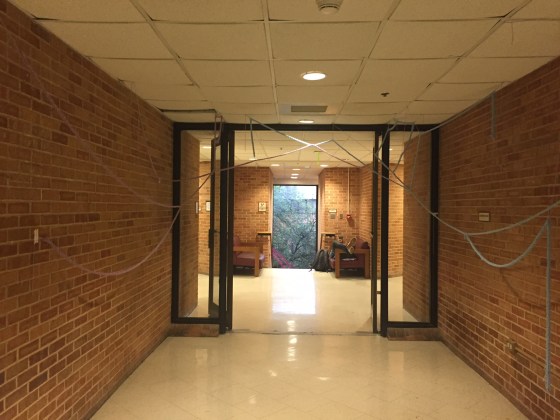
Stick Figures
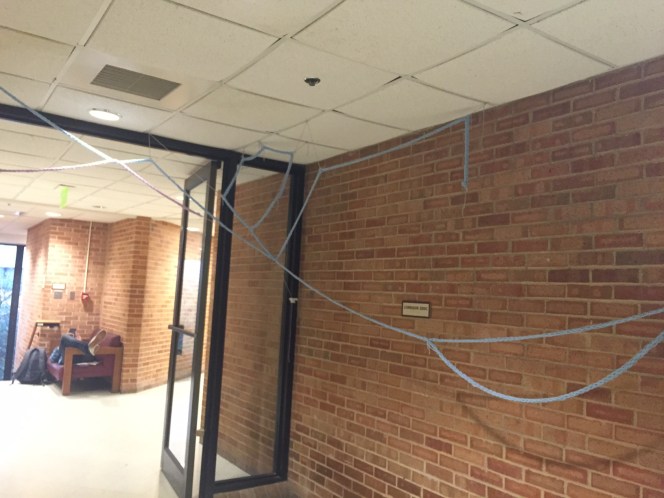
Ari and I constructed these stick figures in the second-floor hallway in Rowe as a group effort for our installation project. We played with the idea of figures occupying space, both of whom became interestingly warped and distorted as the project came to fruition. The subject matter was Ari’s idea, whereas their means of construction was mine.
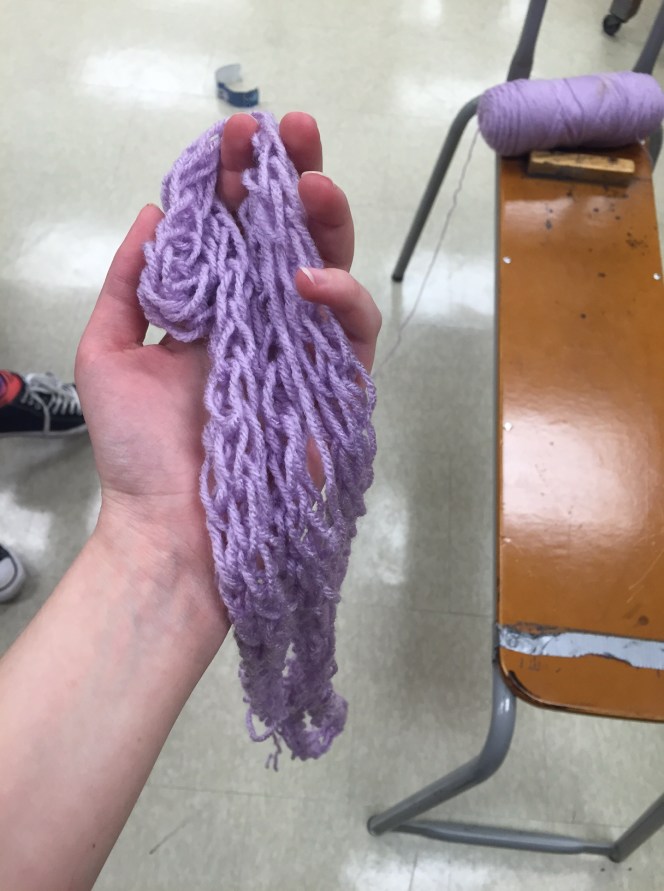
We used a process referred to as “finger-knitting” (or “finger-weaving”), which was essentially using our hands as a loom. This was easy to learn and efficient, allowing for us to quickly make colorful structures that were just thick enough to be viewed from afar.

There seems to be a theme of having mysterious/imposing figurative sculptures throughout the Rowe building for various classes (such as the hand coming out of the ceiling and my own crocheted dolls, each from last semester for Fibers 1). The figures were intended to be standing, but we’d made them so big that we elected to have them float in the air. I think it makes for a nice effect in that their “imposing” nature may stem from taking up so much space in a narrow hall.

Stale Fruit
I call my cardboard piece stale fruit. Despite its alluring appearance, this fruit has no flavor! And is argueably flat. I was inspired to make this piece by an old memory.
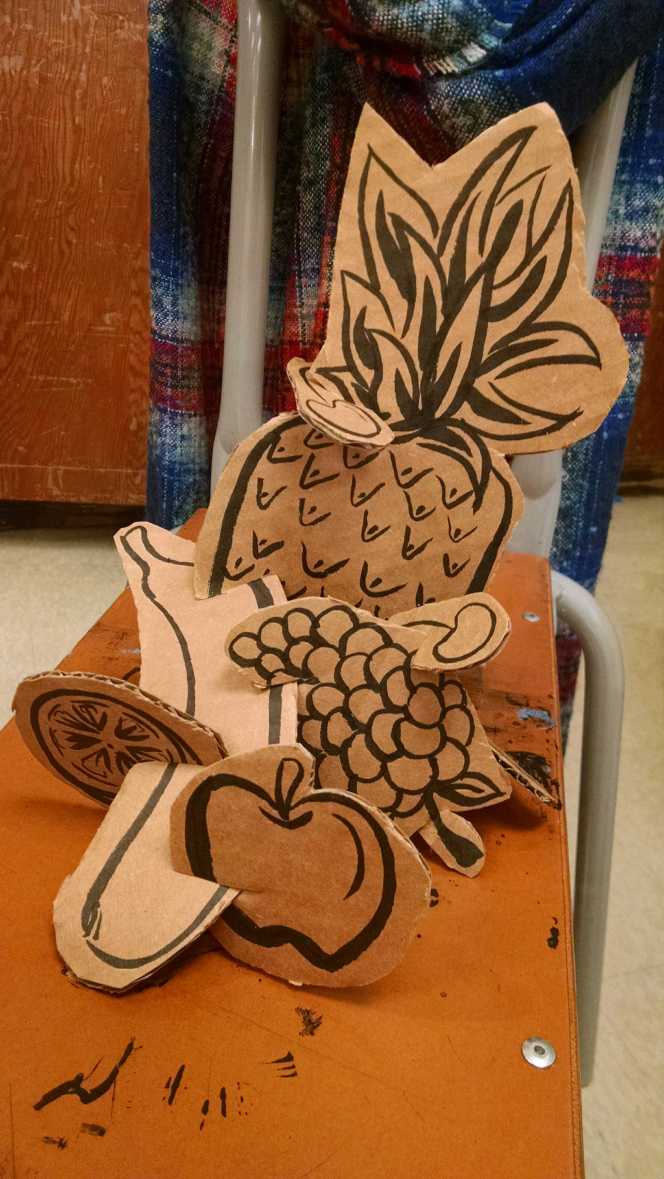
One time my family went to Boston, and my family has very thick southern accents, which up there are thought to show ignorance. My mom noticed that at the fruit market there were smashed fruit shaped tiles around the street, she said to my aunt “they dropped some fruit”, of course as a joke, and a Boston local explained to her that it wasn’t real fruit but a tile. My mom was fuming.
Katy Ann Gilmore

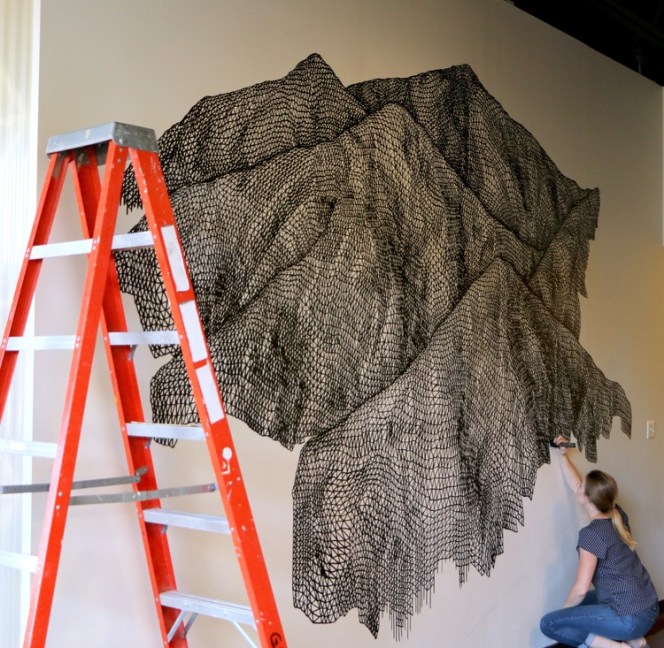
This versatile artists uses small triangles to show depth and perspective, bringing 2-D scenes to life. She is currently living and working in Los Angeles. Trained in a bunch of fields, she received a BA in Mathematics, Art, and Spanish from Greenville College in Greenville, IL and an MFA in Visual Art from Azusa Pacific University in Azusa, California.
She works in sculpture, installation, and drawing/painting, and I found her most impressive work to be her massive wall drawings. “I’m currently influenced heavily by topography and the relationship between 2D, perpendicular planes and their distortions into 3D space. ” She says.

String/Linear Installation


This project was interesting in its creation because where we chose to install it would heavily influence the work itself. The location Mollie and I chose ended up being quite dynamic due to the wind the is blown through that section of the sculpture yard. This allowed us to create line work that would not only mimic movement but also move itself whenever the wind blew. We used tape to cover up certain areas so that the translucency of the bars didn’t subtract from the wind elements. With the tape and the ribbon we were able to create linear elements that operated on different axis while being contained within the same piece. The tape was more sporadic in its placement but was still static and did not move, while the ribbon was extremely dynamic in how it moved with the wind but the ribbons were all placed more specifically to create a unified movement across the gate. The experience was interesting since the piece grew and developed into something more the longer we worked on it. Specifically when the weather varied so the reaction to the piece was different at certain times and called for different attachments in various ways. Even when the wind was not blowing the piece still evoked what we hoped it would so it was still successful windy or not.
Yarn Project
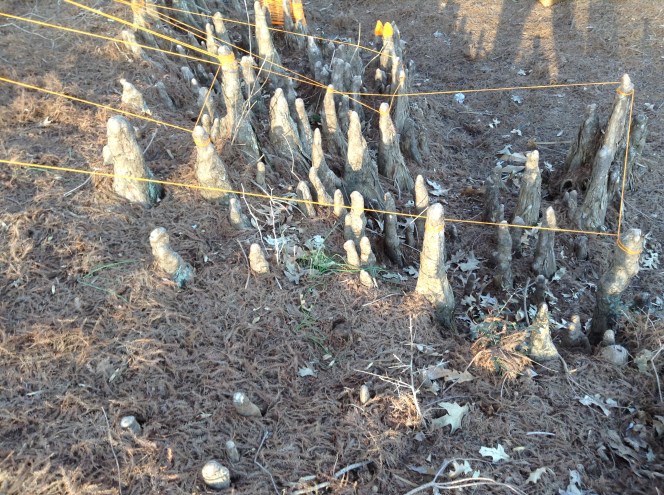
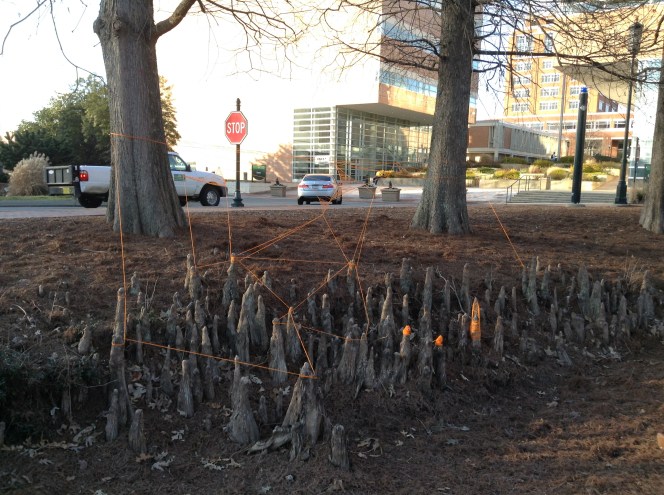
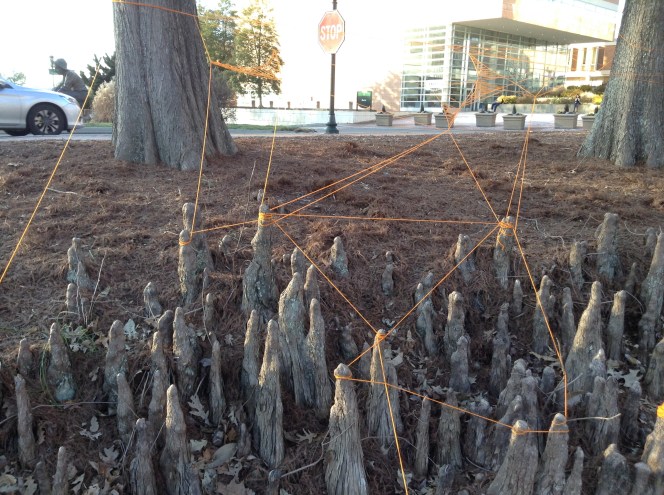
For our project we chose a site that had an interesting roots structure. We played with eh idea of building up sections of yarn while leaving others bare. The end result was a push and pull of attention around the area. The eye was more attracted to the built up areas and more disturbed by the plainer areas.
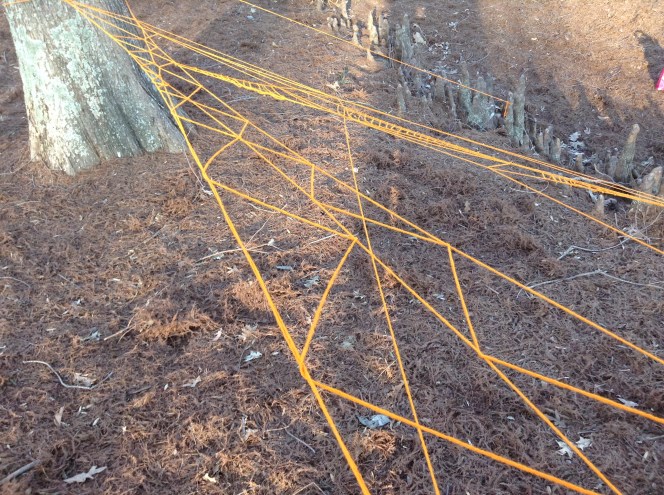
This is a good example of one of the built up areas surrounded by the barer areas. see how the eye darts for one busy section to the next.
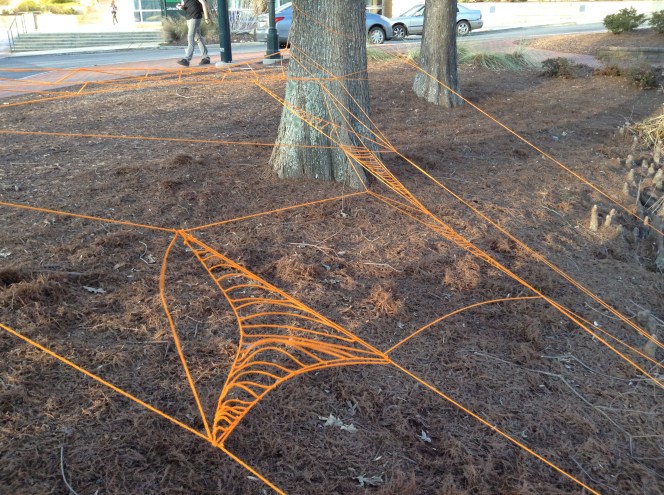
And here how the eye is not attracted to the plainness of the single strands.
Lesia Trubat
Lesia Trubat graduate from Pompeu Fabra University (UPF) with a degree of design in Barcelona takes the concept of dance, movement, and translates it into digital expressionist pieces. She focuses her art on the relationship between product and design while keeping her eye focused on the underlying beauty and emotion of her pieces. She finds the depth of her projects to be directly related to their success.

This project is called “Captivated by the dance”where she took ballet slippers and attached monitoring devices to the bottom to track when the slippers hit the floor, much like a stylus does on a tablet. similarly again, you can program the weight and style of the strokes.


Not a Quitter


Brittany and I collaborated on the installation assignment. We decided to to use yarn as the material. Our location was behind Rowe on some strangely shaped roots. We strung bright orange yarn across the roots in a geometric pattern. It was very reminescent of the cats cradle game. There was little to no concept behind the work; it was designed with aesthetics. Passer byes seemed very interested and admired the angular lines contrasting the natural environment. The piece survived 50mph winds from a storm a few days later. However it did deteriorate and was ultimately taken down. The installation was a success with the public.
 drawing into space