JANET ECHELMAN

a

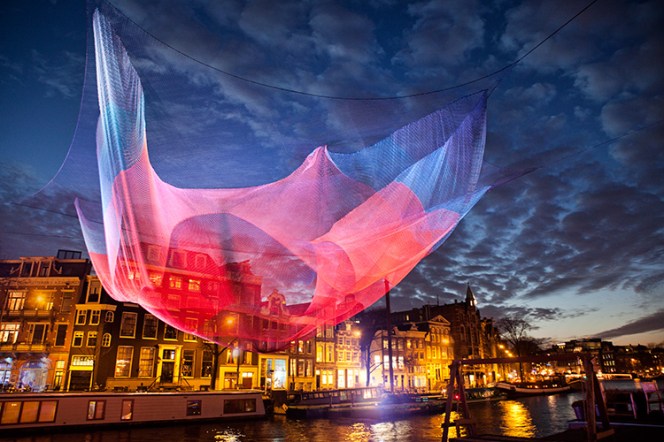
Janet Echelman, 1.26 AMSTERDAM, NETHERLANDS, Sculpture Project at the Amsterdam Light Festival, December 7, 2012- January 20, 2013
Janet Echelman started her career as an artist after graduating from Harvard. She moved to Hong Kong in 1987 and completed a study in Chinese calligraphy and landscape painting then moved to Bali, Indonesia. Echelman had cooperated traditional textile methods with contemporary painting.  She’s spent several years working, living, and traveling in Asian countries. From there Echelman’s works were discovered and purchased by Robert Rauschenberg. She has created large scale sculptures as a living environment that we could be a part of. Artist uses unusual materials in the artworks to emphasize on environmental forces like wind, water, and sunlight. Echelman also created public art and collaborated with artisan such as fishermen in a series of netted sculpture. Her sculptures are a combination of cutting edge technology, public art, and urban transformation as a goal to create diversity in different cities and environment. There are some concerns about birds and wildlife regarding her large scale sculptures. However, she said that the team including herself have cautiously discussed the process and idea before asking for construction permission that her artworks will not harm the animals.

artwork examples
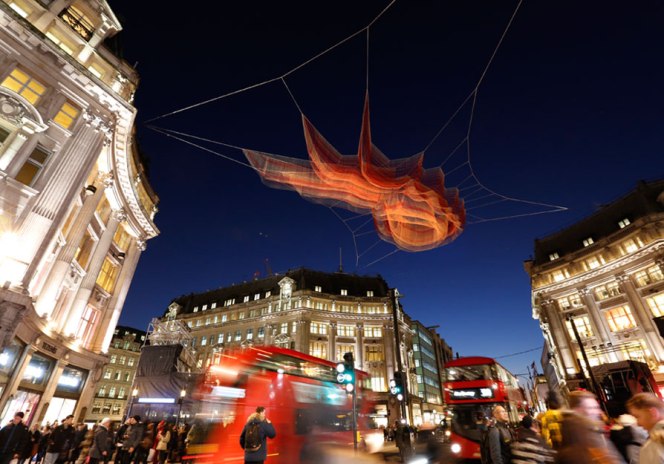
LDN_Echelman_PhotoEmaPeter_1091

Janet Echelman, 1.8 LONDON, UK, Fiber, Buildings and Sky combined with Colored Lighting, Wifi, and Interactive Computer Programming. Fibers are braided with nylon and UHMWPE (Ultra high molecular weight polyethylene)Dimensions of net: 100 ft. length x 45 ft. width x 20 ft. depth
Installation Dimensions: 180 ft. length x 180 ft. width x ft. 70 height, 2016 

VAN_Echelman_PhotoClaytonBinkley_Nate-on-the-net_edit

Janet Echelman, SKIES PAINTED WITH UNNUMBERED SPARKS, VANCOUVER, CANADA, Twisted nylon, braided polyester, Honeywell Spectra fiber, and interactive, colored lighting, Dimensions of Net: 300 ft. length x 110 ft. width x 40 ft. depth, Installation Dimensions: 745 ft. length x 475 ft. width x 175 ft. height,  2014


Echelman, Janet. “Biography.” http://www.echelman.com. N.p., n.d. Web. 23 Jan. 2016.

Marc Hagan-Guirey and the Art of Kirigami

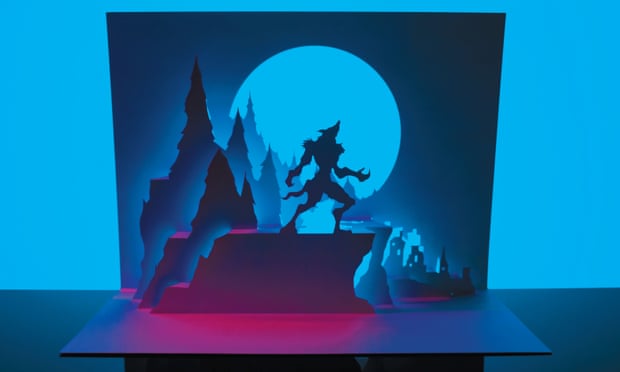
Marc Hagan-Guirey (also known as “Paper Dandy”) is a contemporary digital and paper-cut artist, most famously known for his skill in the craft kirigami. Kirigami is the process of cutting intricate shapes into a single sheet of paper that, when folded, create detailed, 3D dioramas and spaces. Guirey’s first exhibition Horrorgami, was a collection of these small paper cuts all revolving around popular horror iconography. His more recent (and well-known) exhibition Cut-Scene, Inspired by Star Wars, opened last spring on May 4, 2015, featuring intricate scenes replicating famous moments from the Star Wars film franchise.

While kirigami may not appear to have many similarities with traditional 2D drawing, the two are actually quite compatible in process and how kirigami relates to drawing into space. Guirey’s work has him “drawing” into the surface of paper with an Exacto-knife. The results, when lit properly, are dioramas that create a real and perceived space from the cut drawings. If possible, it would be interesting to see kirigami on a large scale in which the audience could observe or explore the finished work in and around the piece.

Here are some examples of Marc Hagan-Guirey’s work:

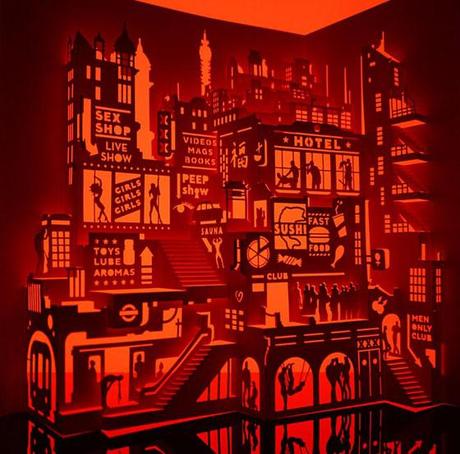
Hagan-Guirey, Soho Uncut, Paper, 2014.

Hagan-Guirey, A Kirigami Palace for Decorex International’s 2013 Campaign, Paper, 2013

Hagan-Guirey, Howler, Paper, 2015

Hagan-Guirey, from Cut-Scene exhibition, Paper, 2015.

Official website: http://paperdandy.co.uk/

Julian Beever – Chalk Art

Julian Beever is an English artist who is most famous for his chalk art on pavement. He worked many odd jobs such as tree-planting and carpet fitting and even a street performer but also as an Art and English teacher for a while before his art became well-known and popular. His earlier works were mostly celebrity portraits he would draw in the streets so that passer-by would recognize and take interest in him. Soon enough, his love of chalk drove him to create scenes in blank portions of pavement and to make them stand out. The drawings are two-dimensional but when viewed from a single particular angle appear to be just as fully formed as everything else around them. While Beever’s works is not suited for gallery or museum spaces, he is often called upon by different corporations and has worked in twenty-eight different countries. Beever does not consider his work a type of graffiti as it is done openly and in a non-permanent media though he has been escorted to police stations on a couple occasions. He does enjoy the impermanence of the chalk, though, the benefits of its speed and flexibility outweighing how easily it can be destroyed. He considers the photographs of the chalk drawings to be the piece itself because they will last much longer and allow it to be seen by millions more people.


Home

SARAH K. BENNING

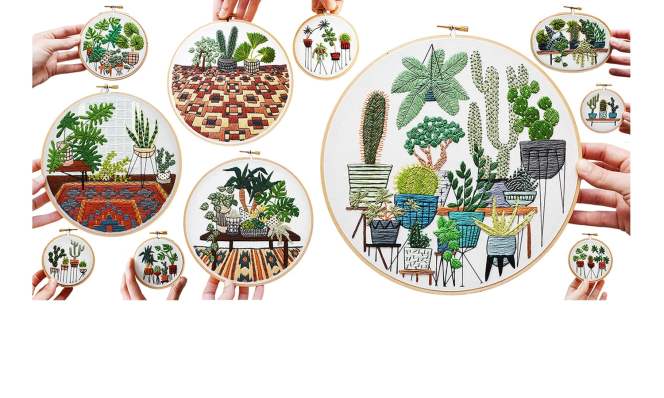
Untitled-3An astonnishing embroidery artist who got her BFA at the School of the Art Institute of Chicago in fibers and material studies in 2013. Originally a hobby to pass her time while nannying, her form of relaxation turned into her work. She is very prolific and creates very illustrative fiber work. She currently works from her home in Menorca, Spain.

Evidently from her work, we can see that Sarah concentrates on depicting house plants. Each piece is inspired by her personal house plant collection. She is self taught in the art of embroidery and treats each piece as an illustration. Her site suggests “Her emphasis on drawing, composition, and color choice keeps her work fresh and vibrant.” As viewers we can see how her choice in medium gives her work a certain draw. the line quality can be not only observed but touched. The element of physical interaction sets her illustration apart from the mainstream.

benning_portrait

Julie Mehretu

large

Myriads, Only By Dark, 2014, GEMINI G.E.L. AT JONI MOISANT WEYL, New York, 4-panel, multi-colored aquatint and spit bite, https://www.artsy.net/artwork/julie-mehretu-myriads-only-by-dark

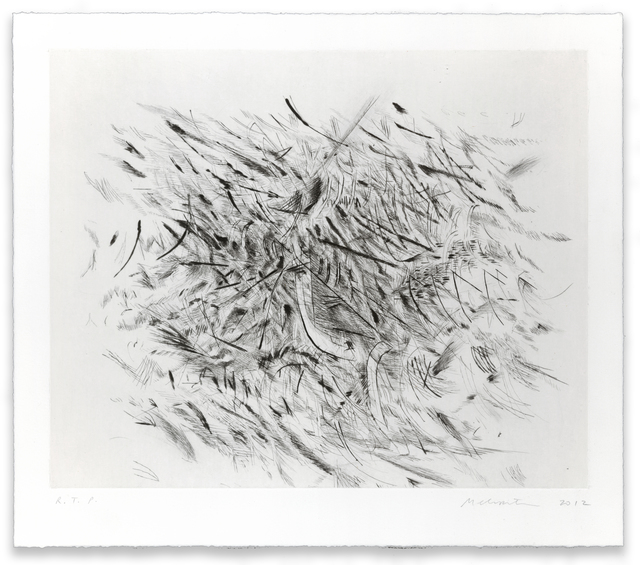
The Ethiopian-American artist, Julie Mehretu, creates a 2D experience of time and space through the narrative maps she creates with her expressive mark making. One of her more recent body of work is the Myriads, Only By Dark series, which was displayed at the gallery Gemini G.E.L. at Joni Moisant Weyl, February 12th-March 28th 2015 in New York City. This work reflects an autobiographical sense for Mehretu through the layered gestural marks, as well as the juxtaposition of the four panels of the work. Although there are no figures or defined symbols that generally accompany a narrative, Mehretu rather suggests the narrative within the work through the process of layers that suggests a time and space that exists in the picture plane. In the artwork below, Myraids, Only By Dark 4, a sense of depth is created through the straight colored lines and the black mark making that is layered over it. Also the use of negative space to create an opening that reveals the background behind the foreground of marks gives a sense of space in the overall composition of this piece of art work.

https://www.artsy.net/artist/julie-mehretu

Myriads, Only By Dark 4 (origin), 2014, GEMINI G.E.L. AT JONI MOISANT WEYL, New York, Multi-colored aquatint and spite bite on Hahnemühle Museum Etching 450, 84 3/10 × 49 1/2 × 2 3/10 in https://www.artsy.net/artwork/julie-mehretu-myriads-only-by-dark-4-origin

Below are some others works created by Julie Mehretu, which carry the same narratives of time and space in relation to Myriad, Only By Dark.

large-2
Haka
, 2012, 1-color etching, with chine-colle, GEMINI G.E.L. AT JONI MOISANT WEYL, New York, 12 X 14 in., https://www.artsy.net/artwork/julie-mehretu-haka

large-3
Cairo
, 2013, “The Inaugural Installation” at The Board, Los Angeles, Ink and acrylic on canvas, 120 × 288 in, https://www.artsy.net/artwork/julie-mehretu-cairo

large-4
The Mathematics of Droves
, 2014,Ink and acrylic on canvas, 72 × 84 in, © the artist Photo: Jason Mandell,  White Cube, https://www.artsy.net/artwork/julie-mehretu-the-mathematics-of-droves


Minty Sainsbury Silhouettes and Architecture

Minty Sainsbury studied architecture at the University of Cambridge in the UK. Graduating top of her class in 2013, Sainsbury moved to London to continue in architecture practices. Her main concern was to bring attention to the detail and craftsmanship to architectures through simplistic compositions contrasting with extremely detailed drawings of buildings. Most of Sainsbury’s drawing consist of single buildings, drawing in pencil. Some of her works are architectures that seem to “float” or sit in a blank space, while others include silhouettes of other buildings in front of or surrounding a single detailed building. By including silhouettes in her pieces, Sainsbury creates this kind of scene as if the viewer is focusing on little peeks of a building hiding behind other buildings. As of right now, it doesn’t seem that Sainsbury has had any exhibitions or been featured in galleries, but rather keeps herself known on social media and doing commissions or selling works done in her portfolio. She has however, been featured in an article on My Modern Met, where links to her blog, facebook, and instagram can also be found.

Minty Sainsbury, Milan Cathedral (9x9cm) Graphite on paper

Minty Sainsbury, St Pauls Cathedral, (56×76 cm) Graphite on paper


Minty Sainsbury, View of San Salute in Venice (100×65 cm) Graphite on paper

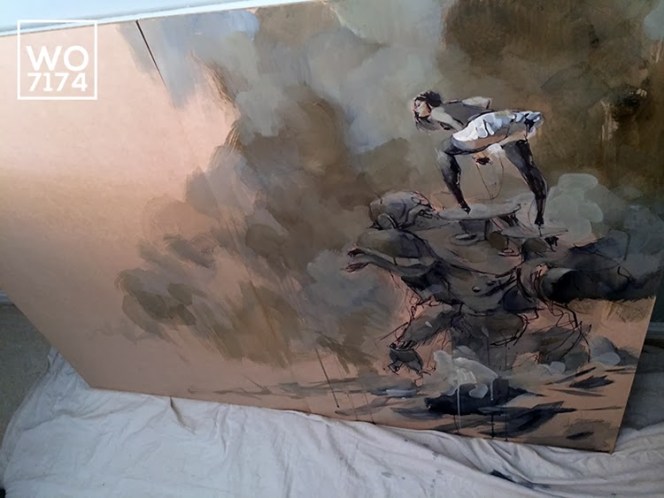
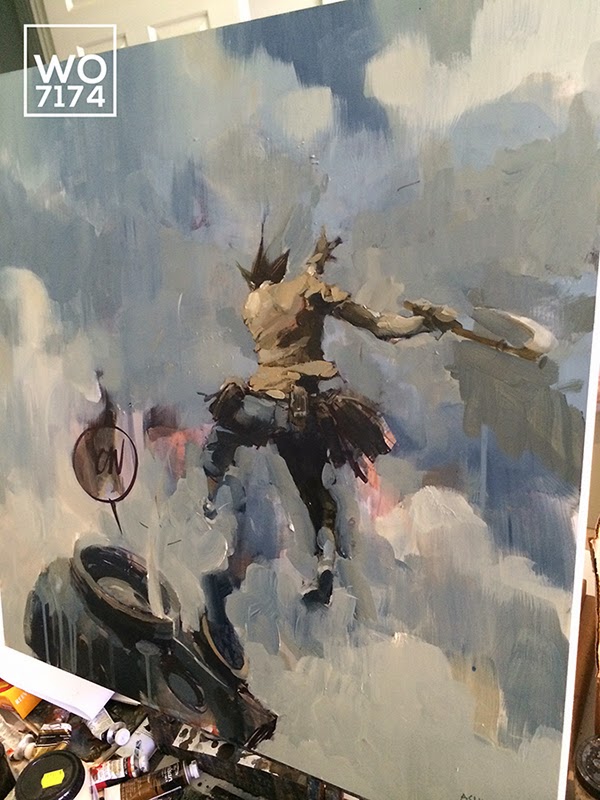
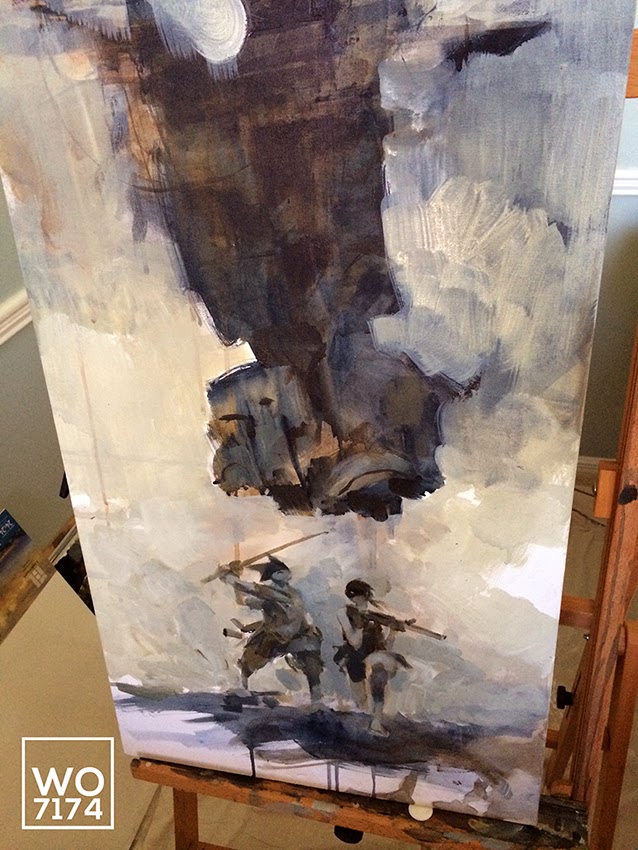
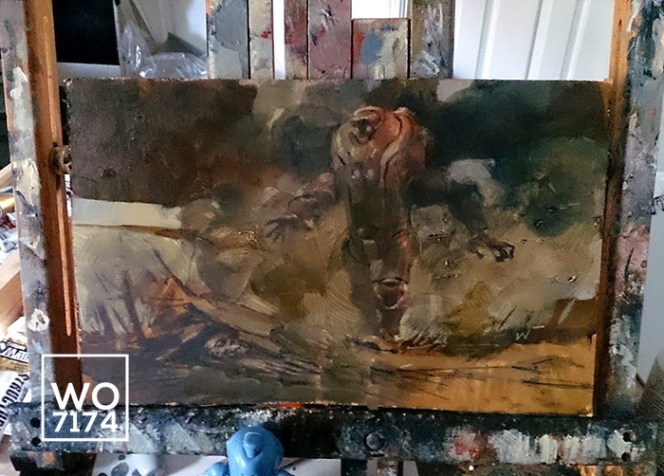
Ashley Wood and the breath of drawing

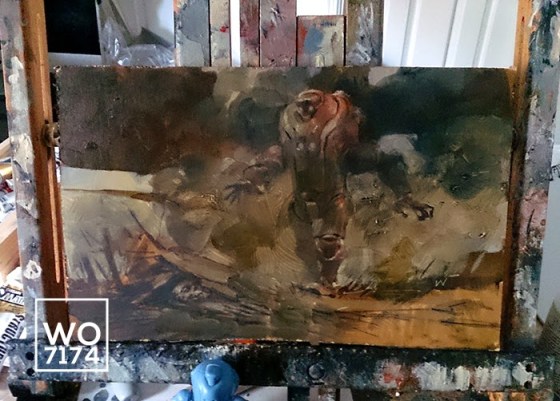
Drawing has many forms being it a tight  realistic drawing , or a simple doodle, all drawings are different and reflect a lot of what we are as both artists and as people. The balance of roughness and neatness is what differentiates each artist and their style,questions such as ” How much should I take from a reference?”,”How expressive should I be?” and ” how much neatness should I put on a drawing to make  it acceptable, and where should I apply it?” are what spawn the differences between personal styles, and differentiate how each artist both approach and expect from their work.This leads me to what really inspires me in Ashley Woods drawings being their roughness and stylistic choices. His choices with the exploration of space interest me,almost as much as his  choices in style ,given that he worked with comics most of his career , find his usage and rendering of space in his paintings to be the most interesting and relevant aspect of his style,at least for the purposes of this blog entry. What is interesting about his usage of space is how abstract yet thematically specific it is.His usage of color to convey space is fantastic, and the many shades used and the interaction of each color makes the feel of each space both unique and unquestionably Ashley s own in style and feel.


All examples taken from his blog at

http://ashleybambaland.blogspot.com/?updated-min=2012-01-01T00:00:00-08:00&updated-max=2013-01-01T00:00:00-08:00&max-results=50

Do Ho Suh’s “Rubbing/Loving” and Thread Drawings

Do Ho Suh explores our theme of space through capturing an aspect of the term familiar to all–that is, living space–through intricate rubbings of his old New York apartment and North Korean locales. For his “Rubbing/Loving” project, he and several assistants performed the rubbings of walls, floors, and other surface areas on paper while blindfolded and with various media from graphite to conte. The papers were then arranged on wooden panels and constructed as an exact replicas of the rooms that museum-goers were free to walk through. The project’s namesake is a play on the fact that there are very little to no distinctions between the “r” and “l” or “b” and “v” consonants in the Korean language, so “rubbing” and “loving” come out sounding similar.

Do Ho Suh
Rubbing/Loving Project: Apartment A, 348 West 22nd Street, New York, NY 10011, USA, 2014
rubbing paper on wooden panels
dimensions variable

While the above example is of the artist’s apartment, Do Ho Suh also exhibited his contributions to the 9th Gwangju Biennale, “ROUNDTABLE” from 2012. Gwangju is located in South Korea, and the Gwangju Biennale is held in honor of a 1980 demonstration against an oppressive military regime. Although it was reported that 200 people were killed, an estimated 2,000 people is the reality, and it is this censorship that has motivated contemporary artists to hold the festival since 1995. The themes of the 2012 program were things relevant to the East Asian experience, such as isolation, migration, and “the relationship between group trauma, memory, and history”.

Do Ho Suh
Rubbing/Loving Project: Dormitory Room at Gwangju Catholic Lifelong Institute, 2012
colored pencil (cyan, magenta, yellow, black) on paper, wooden structure, video monitor and player and speaker
154.33 x 131.5 x 105.12 inches
392 x 334 x 267 cm
Commissioned by Gwangju Biennale 2012

This is one of the two projects he had displayed at his “Drawings” exhibition at both of Lehmann Maupin’s New York spaces. The other is a series of thread drawings (“experimental”, as Do Ho Suh refers) in various colors depicting organic and architectural forms. These were a result of the artist’s invitation to Singapore, a testament to his multinational exploits. Having been born in South Korea, been educated at both RISD and Yale, and beginning an artistic career in New York, Do Ho Suh has a focus in exploring his identity in the various spaces he occupies.

Do Ho Suh
My Country, 2014
thread, cotton, methylcellulose
11.5 x 14.5 inches
29.2 x 36.8 cm

Do Ho Suh
My Homes, 2014
thread, cotton, methylcellulose
18 x 24 inches
29.2 x 36.2 cm
frame: 22 x 28 inches
55.8 x 77.1 cm

Chu, Christie. VIDEO: Do Ho Suh Explains His Ethereal Rubbings. Wednesday, September 17, 2014.

http://universes-in-universe.org/eng/bien/gwangju_biennale/2012

http://universes-in-universe.org/eng/bien/gwangju_biennale/2012

Paul Cadmus

Paul Cadmus was an American born artist known for his highly erotic and photo realistic depictions of men. Cadmus was first recognized because of his painting “The Fleet’s In!”- a controversial depiction of the American Navy. The painting was filled with highly sexualized depictions of sailors and women and homosexual undertones. The scandal generated a great amount of publicity for Cadmus. He continued to create paintings without the fear of offending the public. His 1935 painting, “Coney Island” was included in a show at the Whitney Museum of American Art, and generated the same amount of buzz. The Coney Island residents threatened to sue if it was not removed.

His later work includes intensely detailed sketches of lounging men. The use of crosshatching allows the figures to leap off of the page, and his incredible knowledge and accuracy of the human anatomy leaves the viewer to almost believe the drawing is alive. Here are some examples:


http://www.notablebiographies.com/supp/Supplement-Ca-Fi/Cadmus-Paul.html

http://www.artnet.com/artists/paul-cadmus/

http://www.dcmooregallery.com/artists/paul-cadmus#9

KARINA SMIGLA-BOBINSKI – ADA

Karina Smigla-Bobinski is an artist working primarily in Germany although she has been in shows and festivals in dozens of countries on five different continents. She works in many different media ranging from digital to sculpture and enjoys creating large kinetic and interactive installations. Her piece ADA was orginally finished in 2010 without a particular client in mind, but many different curators soon came to her wanting to show the piece in their galleries. ADA is treated more as a being than a machine, as her movements are too erratic to be controlled despite the efforts of the visitors who are allowed and encouraged to touch and push her around the room. She is a large, helium-filled sphere with charcoal sticks placed on her evenly so that as she moves the white walls, ceiling, and even floor of the room slowly become covered with her dots and lines. Her appearance is much like that of a white blood cell, further adding to the illusion of life. Smigla-Bobinski enjoys these participatory pieces as many artworks are limited to only looking but she feels that interaction allows for a further connection to the piece. By visitors using their body, they are even able to become a part of the piece themselves. This relates to Drawing Into Space because it is a piece that is able to draw around the room within the space that is provided, drawing in every place it can reach and surrounding the visitors.

http://www.smigla-bobinski.com/english/works/ADA/index.html
http://www.smigla-bobinski.com/english/about/index.html